
How to Choose the Right 100ml Perfume for Your Personal Style
How to Choose the Right 100ml Perfume for Your Personal Style
A 100ml perfume is a practical choice for regular wear. It offers substantial capacity, visible shelf presence, and enough surface area for expressive packaging design.
But choosing the right fragrance is not only a matter of liking citrus, rose, vanilla, or oud. A perfume communicates through several connected elements: its scent profile, the way it fits your lifestyle, the shape and color of the bottle, the feel of the cap, and the presentation of the box. Together, these details create a complete identity.
This guide explains how to choose a 100ml fragrance that reflects your style and how brands can turn the same logic into a coherent fragrance packaging brief.
Why Choose a 100ml Perfume?
A 100ml bottle makes sense for a fragrance you expect to wear consistently. It lasts longer than a smaller format, and it may offer a lower cost per milliliter within the same fragrance line.
The format also gives designers room for a readable logo, color transitions, textured decoration, or a distinctive silhouette. Its size can create strong shelf presence while remaining practical for daily use.
For gifting, 100ml feels substantial. For a brand, it can anchor a fragrance collection. People who rotate many scents or travel frequently may still prefer 50ml, so match capacity to actual use.
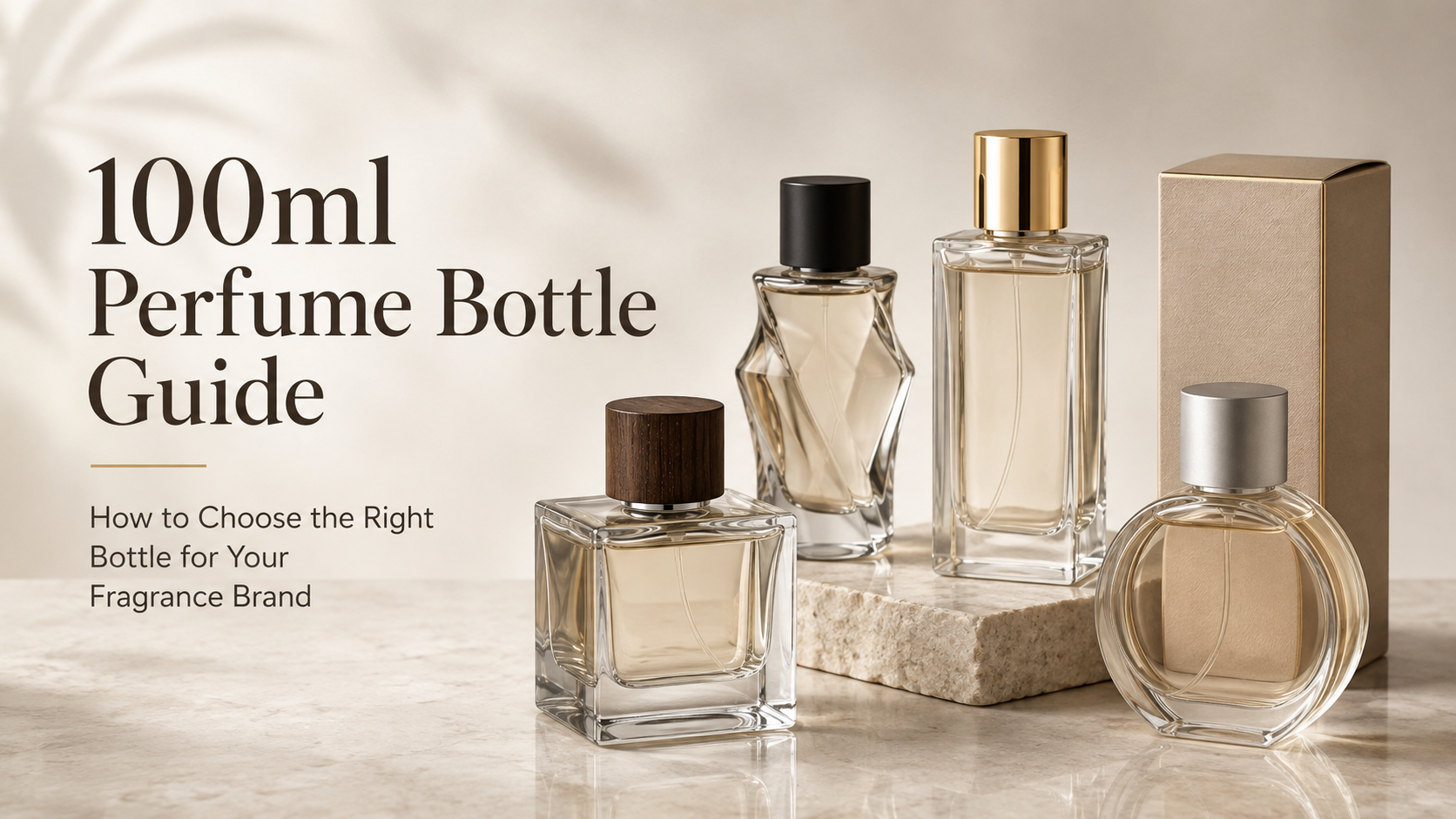
Start With Your Fragrance Personality
Your fragrance family is the clearest starting point. Packaging does not need to illustrate every note literally, but the scent and bottle should feel as though they belong to the same story.
Fresh and Minimalist
Citrus, aquatic, green, aromatic, and light woody fragrances suit a clean, energetic style. They often work well for daytime, warm weather, and the office.
Restrained packaging supports that mood. Clear or pale-tinted glass feels light, while a rectangular or softly rounded bottle creates order. Fine typography, a satin silver collar, and a simple cap keep the identity crisp.
Elegant and Classic
Floral, powdery, musk, amber, and soft woody compositions complement a polished, timeless style. They suit tailored clothing, formal daytime events, or a signature look built around quality.
Balanced proportions, clear or warm glass, and a well-finished cap suit this direction. Subtle hot stamping or light frosting can add refinement, while too many effects may weaken its quiet confidence.
Bold and Sophisticated
Oud, leather, tobacco, spice, incense, and dark woods create a stronger presence. They suit evening wear, cool weather, and personalities comfortable with intensity.
Dark amber, smoked gray, black, or deep green glass supports this mood. A thick base, architectural shoulders, and a metal or zamac cap add density. Precise proportions and disciplined finishing matter more than simply adding weight or shine.
Romantic and Expressive
Rose, vanilla, fruity floral, and gourmand fragrances can feel warm, playful, intimate, or dramatic. They suit people who use color and fragrance for self-expression.
Round or sculptural bottles, blush tones, jewel colors, and gradients complement this style. A custom cap or metallic accent can become the memorable detail. One strong color effect with clear typography is often more expressive than several competing embellishments.
Match the 100ml Perfume Bottle to Your Style
Packaging changes perception. A clear square bottle may feel precise and contemporary; a curved gradient bottle may feel sensual and artistic. Evaluate how each choice changes the message of a 100ml fragrance bottle.
Bottle Shape
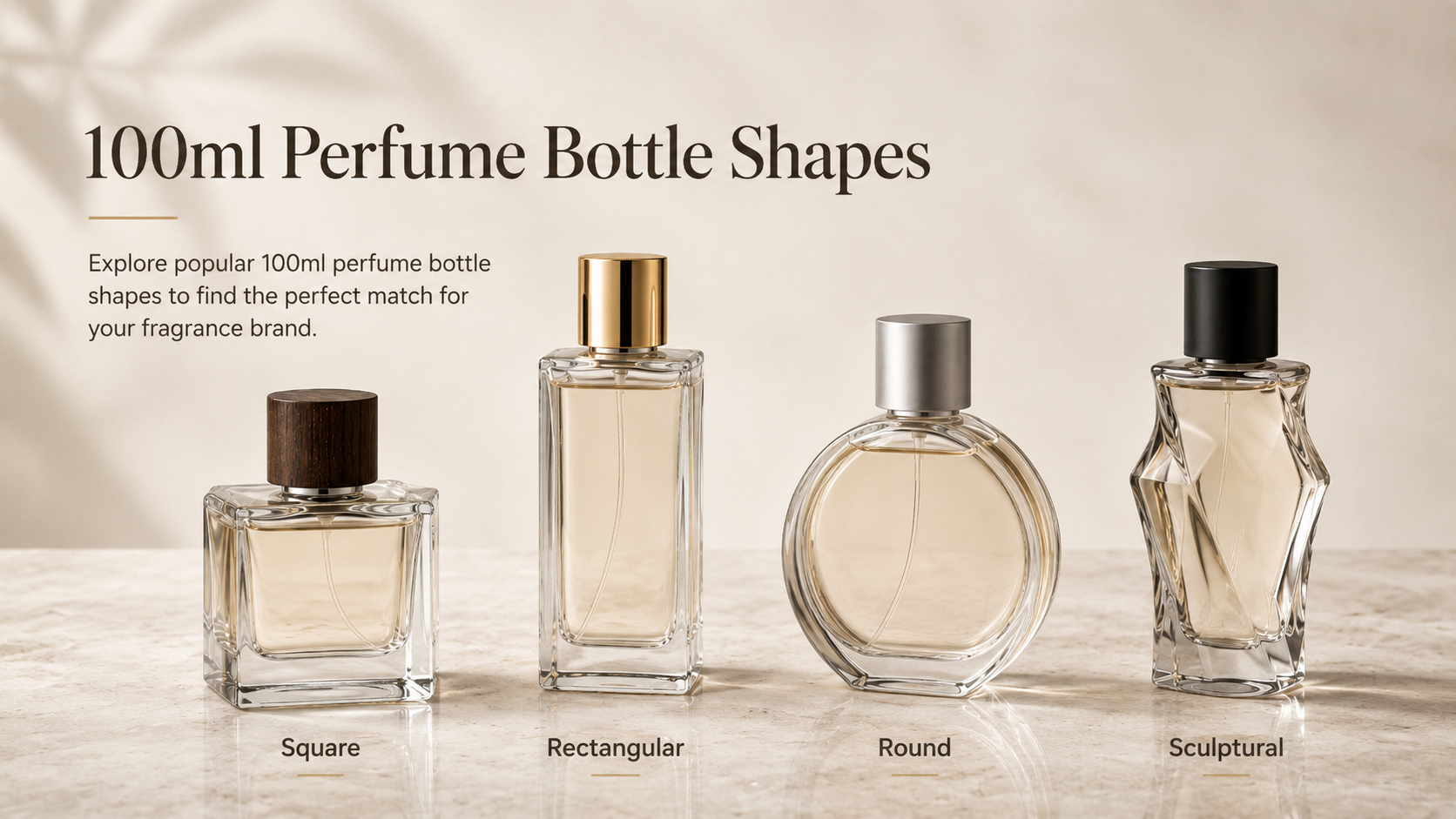
Square bottles communicate stability and modern simplicity. Rectangular formats look architectural and provide useful decoration panels. Round bottles feel softer and more tactile, while oval forms can look graceful.
Sculptural shapes create stronger differentiation but need technical review. Deep curves, uneven weight, narrow contact areas, or unusual shoulders can affect molding, decoration, filling-line handling, packing, and breakage. An artistic bottle should still be comfortable to hold and spray.
Glass Color
Clear glass displays the liquid and supports a versatile identity. Black or opaque glass feels dramatic. Amber suggests warmth and craftsmanship, although packaging should not imply qualities the fragrance does not have.
Gradient color adds movement, while spray coating offers options from translucent tints to solid matte finishes. Assess color under more than one light source because glass thickness, liquid, and coating influence the result.
Bottle Weight and Glass Thickness
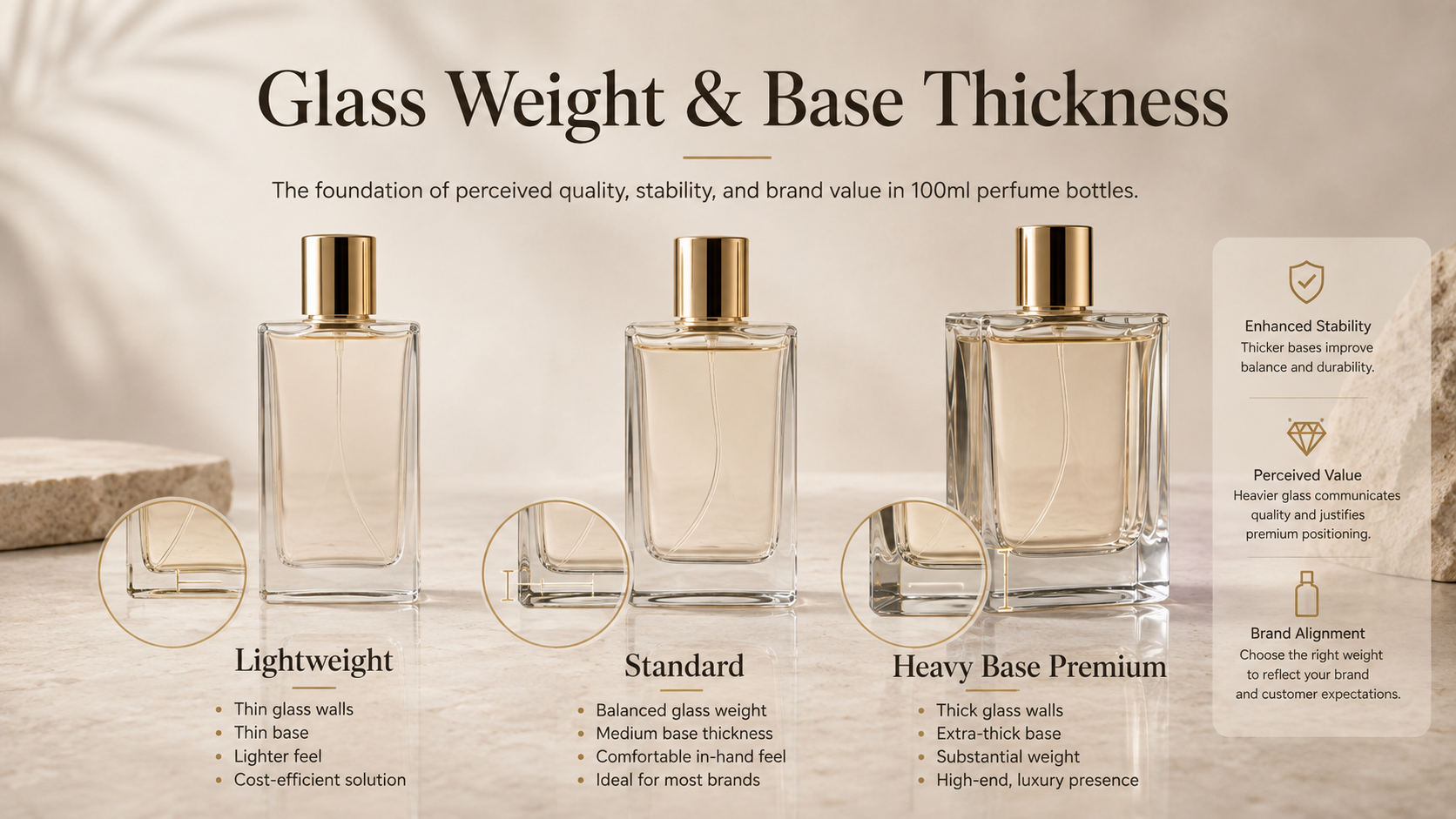
Heavier glass and a thick base can feel stable and substantial, supporting premium positioning when the glass distribution is even and the bottle sits securely.
More weight is not always better. It increases material use, freight, and carton requirements. A lightweight bottle may better suit a minimalist concept. Balance the desired hand feel against protection and total packaging cost.
Cap Design
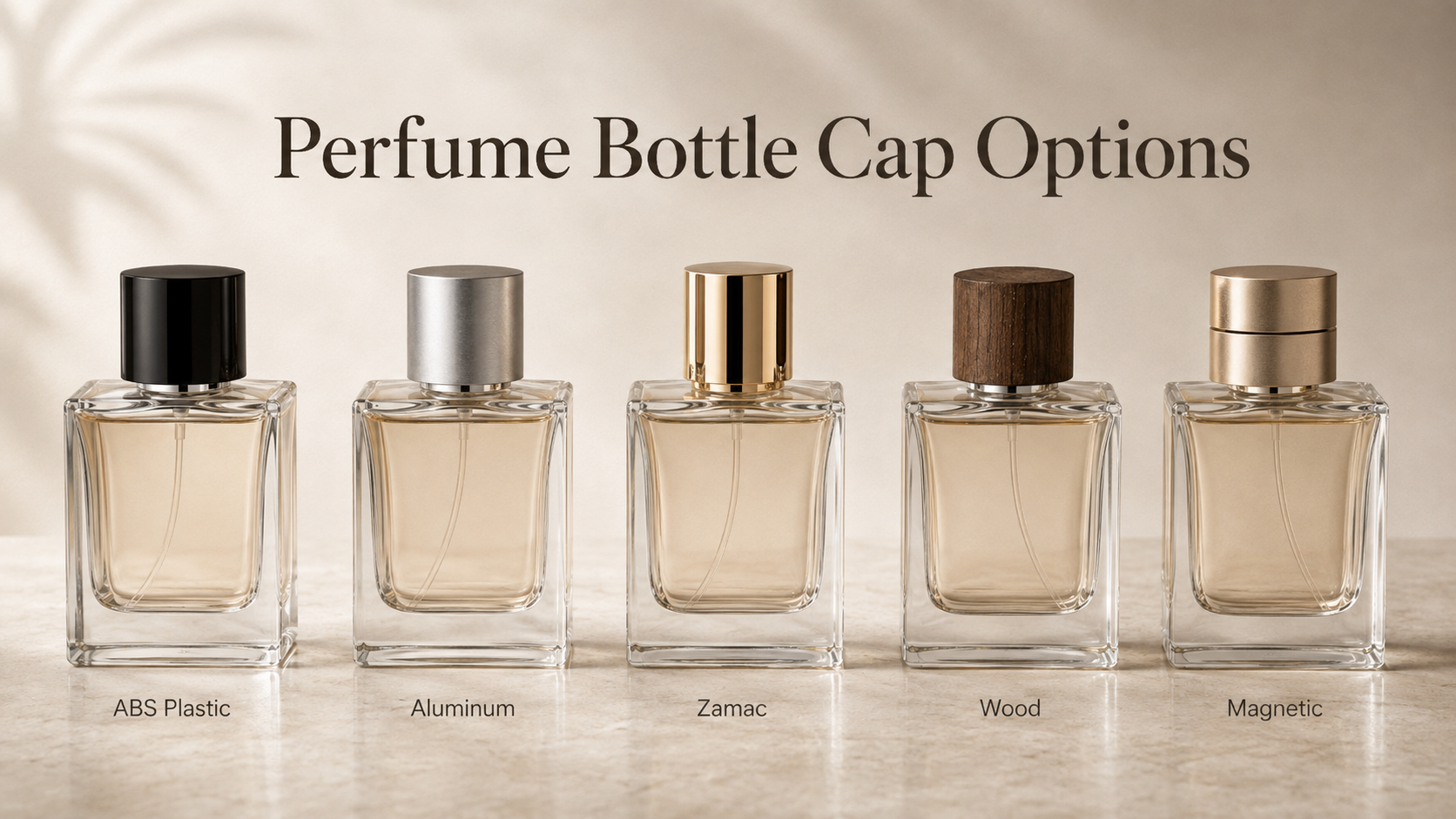
The cap is a major touchpoint. ABS offers broad shape and finish options; aluminum feels precise; zamac provides weight and detail; and wood adds warmth and natural variation. Magnetic caps create a controlled closure when all components are engineered together.
A custom cap can become a signature, but it must fit securely, sit straight, clear the actuator, and match the collar and pump. Poor fit undermines even a beautiful design.
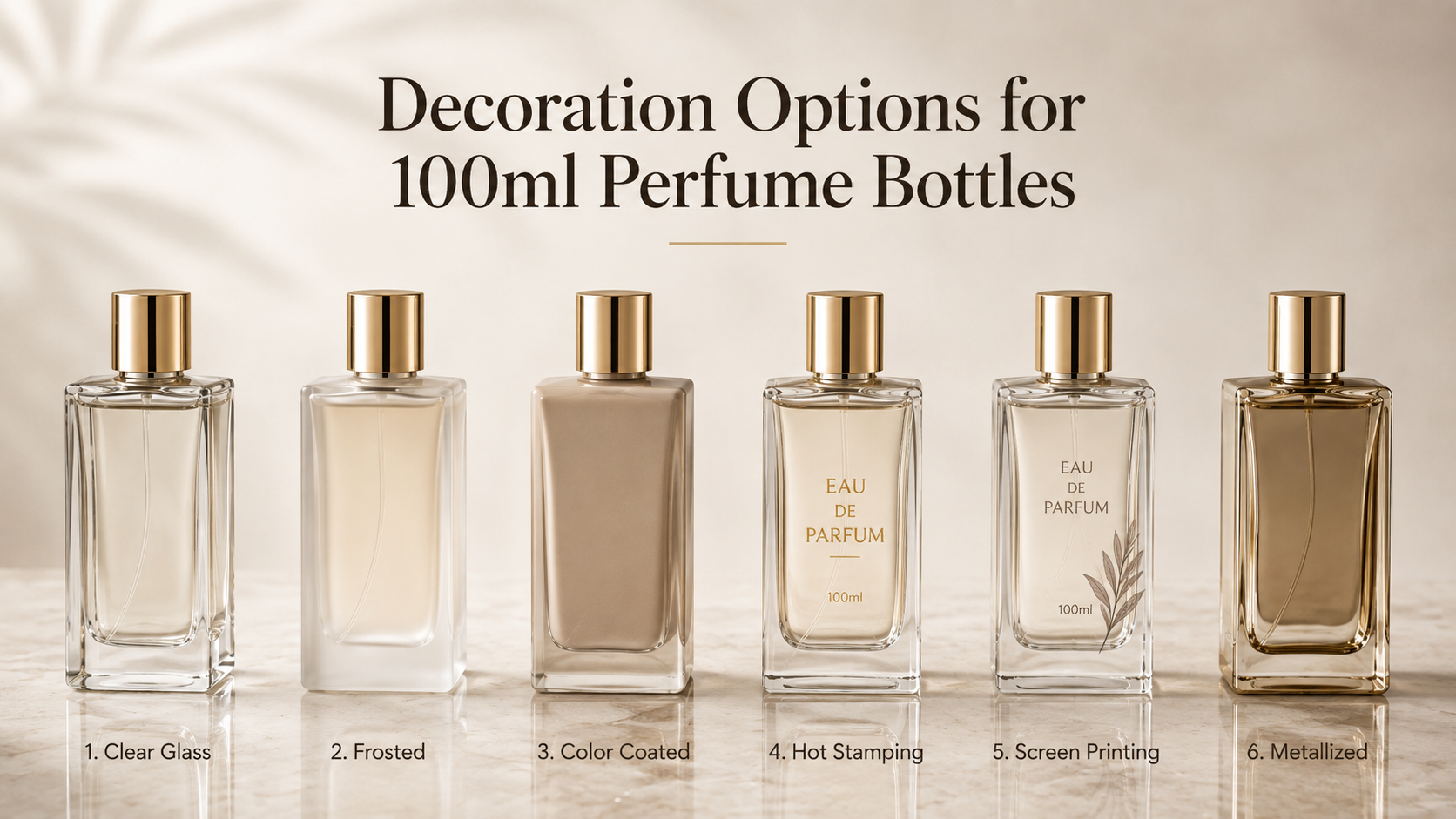
How Decoration Changes the Character of a 100ml Perfume Bottle
Decoration controls visual focus. Screen printing places ink directly on glass for clean logos, names, and line artwork. It looks precise when the design remains legible.
Hot stamping adds a reflective metallic accent but can dominate when overused. Spray coating changes the color atmosphere from transparent tint to opaque matte, while frosting diffuses reflections for a softer appearance.
Metallization creates a mirror-like surface for high-impact concepts. UV printing supports multicolor graphics, and decals can carry complex artwork across compatible curves. Embossing or debossing adds permanent depth to custom glass or paper boxes.
Every effect should serve the brand idea and be tested for color, alignment, adhesion, abrasion, and shape compatibility. Consistent execution matters more than the number of finishes.
Choosing a 100ml Perfume for Different Occasions
For everyday or work, choose comfortable projection and a repeatable profile. Fresh woods, citrus, musk, tea, and restrained florals are common directions. An easy-to-grip bottle fits daily use.
For formal occasions, consider floral, amber, powdery, or polished woody scents. Symmetry, controlled metallic details, and a structured box reinforce refinement.
For evening wear, spice, leather, oud, tobacco, vanilla, or dark woods may suit the atmosphere. Smoked glass and saturated color reinforce the mood, but the scent should still feel natural on you.
For travel, 100ml is less convenient than a smaller bottle and may be subject to airline liquid rules. Protect the bottle and verify current carrier and airport requirements. Frequent travelers may prefer a travel atomizer.
For gifts, prioritize the recipient's usual fragrance family. Clear labeling and a presentation that matches their style make the choice feel intentional.
For a signature fragrance, test it on skin, observe its development, and wear it more than once. A 100ml size is a longer commitment.
100ml vs 50ml Perfume: Which Is Better?
Neither capacity is universally better. The right choice depends on how quickly you use fragrance, how often you travel, and how the brand wants the product to appear.
Decision factor | 100ml perfume | 50ml perfume |
Usage | Better suited to regular wear and signature scents | Useful for rotation, occasional wear, or trying more scents |
Portability | Larger and heavier | Easier to carry and store |
Price and value | Higher initial spend; may offer better value per milliliter | Lower initial spend; less risk if preferences change |
Shelf presence | More visual area and physical impact | Compact and refined |
Packaging possibilities | More room for shape, decoration, and heavier proportions | Encourages concise design and efficient presentation |
Likely target customer | Loyal user, gift buyer, or value-focused repeat wearer | Explorer, traveler, or customer seeking a lower entry price |
Consumers should compare the actual prices and expected usage of the same fragrance. Brands should consider offering both sizes only when the projected demand and component quantities justify the additional packaging complexity.
What Perfume Brands Should Consider When Developing a 100ml Bottle
Effective perfume bottle design begins with the target customer and price position. Define where the fragrance will sell, which visual codes matter, and what customers should notice first. A luxury perfume bottle may prioritize clarity, hand feel, cap precision, and box structure; accessible lines may use color and print while controlling custom parts.
An experienced perfume bottle manufacturer should review technical compatibility as one system. Confirm the neck finish before selecting the pump, collar, and cap. Test spray behavior, cap retention, total height, assembly, and decoration on physical samples.
MOQ also needs component-level planning. At DAXIN, the working reference is 3,000 pieces for stock bottles, 10,000 pieces for custom glass bottles, 10,000 pieces for caps and pumps, 3,000 pieces for paper boxes, 3,000 pieces per color for spraying, 1,000 pieces for silk printing, and 10,000 pieces for electroplating. These are project-planning thresholds, not a substitute for confirming the final specification before quotation.
For perfume bottle packaging, design the box after confirming assembled dimensions and weight. Its insert must secure the bottle and protect decoration. Thick glass, wide shoulders, projecting details, and heavy caps may require more protection and increase freight cost.
Build cost control into the concept. Decide whether the mold, color, cap, decoration, or box creates the most value. One or two recognizable details can be stronger than customizing every component.
Existing Mold or Custom 100ml Perfume Bottle?
An existing bottle mold is usually the lower-risk route for a startup, market test, or time-sensitive launch. Development cost is lower, the bottle geometry has already been established, and samples may be available sooner. A stock design can still become brand-specific through spray color, printing, hot stamping, cap selection, collar finish, and a custom box. The limitation is that another brand may use the same underlying silhouette.
For brands developing custom perfume bottles, a custom bottle mold offers greater control over shape, proportions, base thickness, logo relief, and overall identity. It is appropriate when the bottle needs to become a recognizable asset and projected volume supports the investment. The tradeoffs are higher development cost, a longer timeline, technical revisions, mold trials, and a higher glass MOQ.
Before choosing, compare expected order volume, launch date, budget, filling-line requirements, shipping configuration, and the commercial value of visual exclusivity. A well-decorated existing bottle can be the smarter first launch; a custom mold can become more valuable once the brand has validated demand and clarified its long-term design language.
Final Checklist: How to Choose the Right 100ml Perfume
Before purchasing or approving a new design, ask:
• Do I enjoy the fragrance on skin after the opening notes fade?
• Does the scent fit my regular lifestyle, climate, and occasions?
• Will I use 100ml often enough to justify the size?
• Do the bottle shape, color, weight, and cap express the same personality as the fragrance?
• Is the atomizer comfortable and consistent to use?
• Is the bottle easy to hold, store, and protect?
• For a brand project, are the bottle neck, pump, collar, cap, decoration, and box compatible?
• Do the MOQ, timeline, transport risk, and total packaging cost fit the launch plan?
• Would an existing mold or a custom mold create the better commercial balance?
Final Thoughts
The right 100ml perfume should make sense both as a scent and as an object you will live with. Start with the fragrance family and the settings in which you expect to wear it. Then consider how the bottle shape, glass color, weight, cap, decoration, and box reinforce—or contradict—that personal style.
For fragrance brands, the same principle becomes a development discipline: the perfume and its packaging should be created as one complete brand experience. If you are developing a new 100ml fragrance, working with an experienced perfume packaging supplier can help you coordinate the glass bottle, pump, collar, cap, decoration, and outer packaging as one compatible system.
Perfume Bottle FAQs:
1. Is 100ml a good size for perfume?
Yes, 100ml is a good size for a fragrance you wear regularly or already know you enjoy. It offers substantial capacity and strong shelf presence. If you rotate many fragrances, travel often, or are still testing a scent, 50ml may be more practical.
2. How long does a 100ml perfume last?
It depends on pump output and frequency of wear. A 100ml bottle can last from several months with generous daily use to several years in a larger rotation. Store it away from heat and direct sunlight.
3. Is 100ml perfume better than 50ml?
Not automatically. A 100ml bottle suits frequent use and may offer better value per milliliter, while 50ml is more portable and requires less commitment. Compare your routine and the actual prices.
4. What is the standard size of a 100ml perfume bottle?
There is no single standard. External dimensions vary with shape, glass distribution, base thickness, neck, pump, and cap. Brands should confirm capacity and assembled dimensions from technical drawings and samples.
5. What type of glass is used for perfume bottles?
Most commercial perfume bottles use molded soda-lime glass. Clarity, color, weight, and finish vary by design and supplier. Brands should inspect samples and test compatibility with the intended decoration and closure.
6. Can 100ml perfume bottles be customized?
Yes. Existing bottles can use coating, frosting, printing, hot stamping, decals, custom caps, and boxes. A custom mold provides more control over shape and embossed details but requires more time, investment, and volume.
7. How do perfume brands choose bottle designs?
Brands begin with the target customer, fragrance concept, price position, sales channel, and expected volume. They then balance visual identity with bottle weight, neck finish, pump and cap compatibility, decoration feasibility, MOQ, box protection, transport risk, timeline, and cost.