Case Study: A 100ml Gradient Perfume Bottle with a Gold Zamak Cap
Case Study: A 100ml Gradient Perfume Bottle with a Gold Zamak Cap
From a two-page brief to a shelf-ready package in 11 weeks — without changing the silhouette the brand had already approved.
At a glance | |
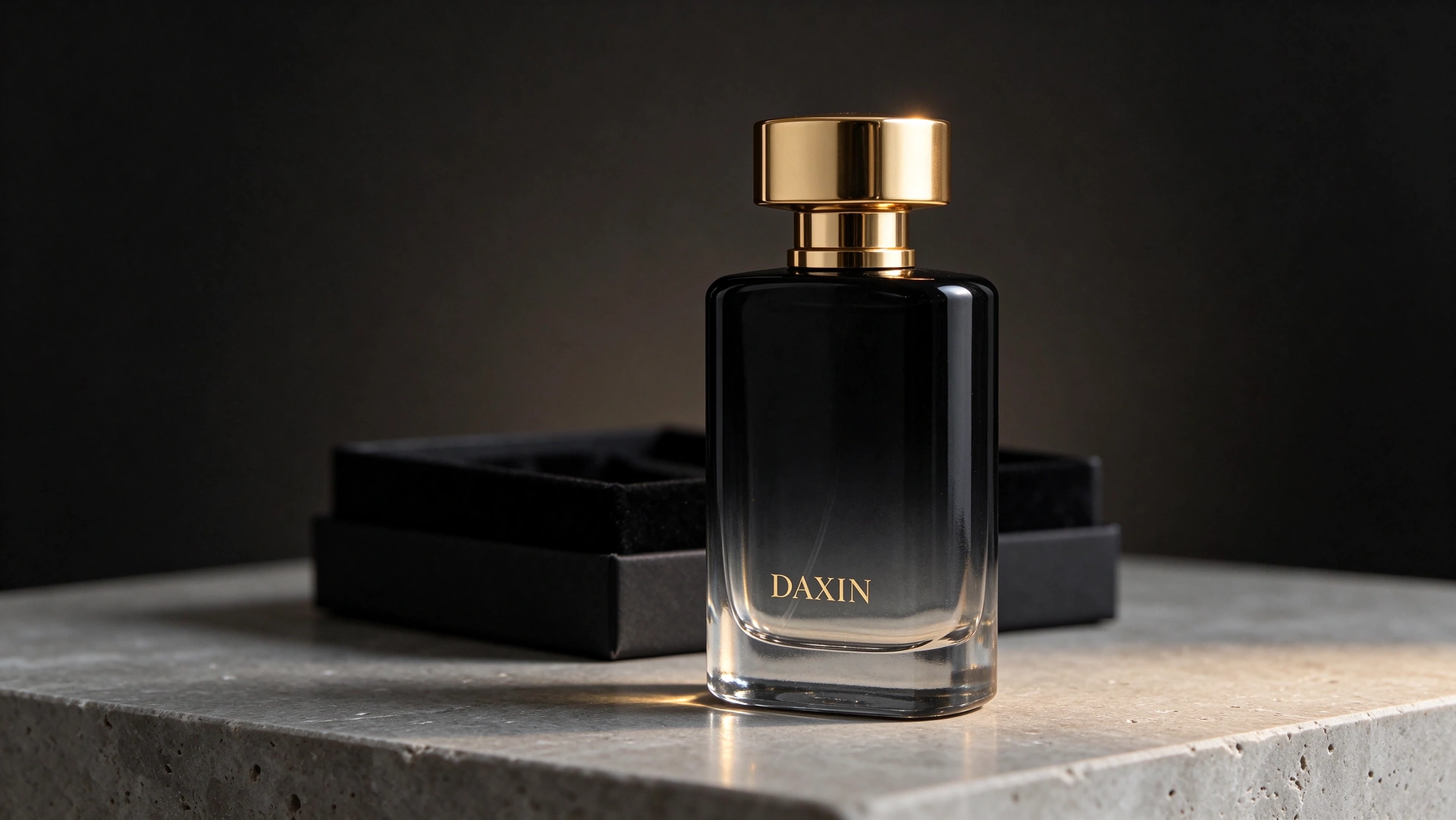
Capacity | 100ml, with a 50ml derivative on the same neck |
Neck / closure | FEA15 crimp |
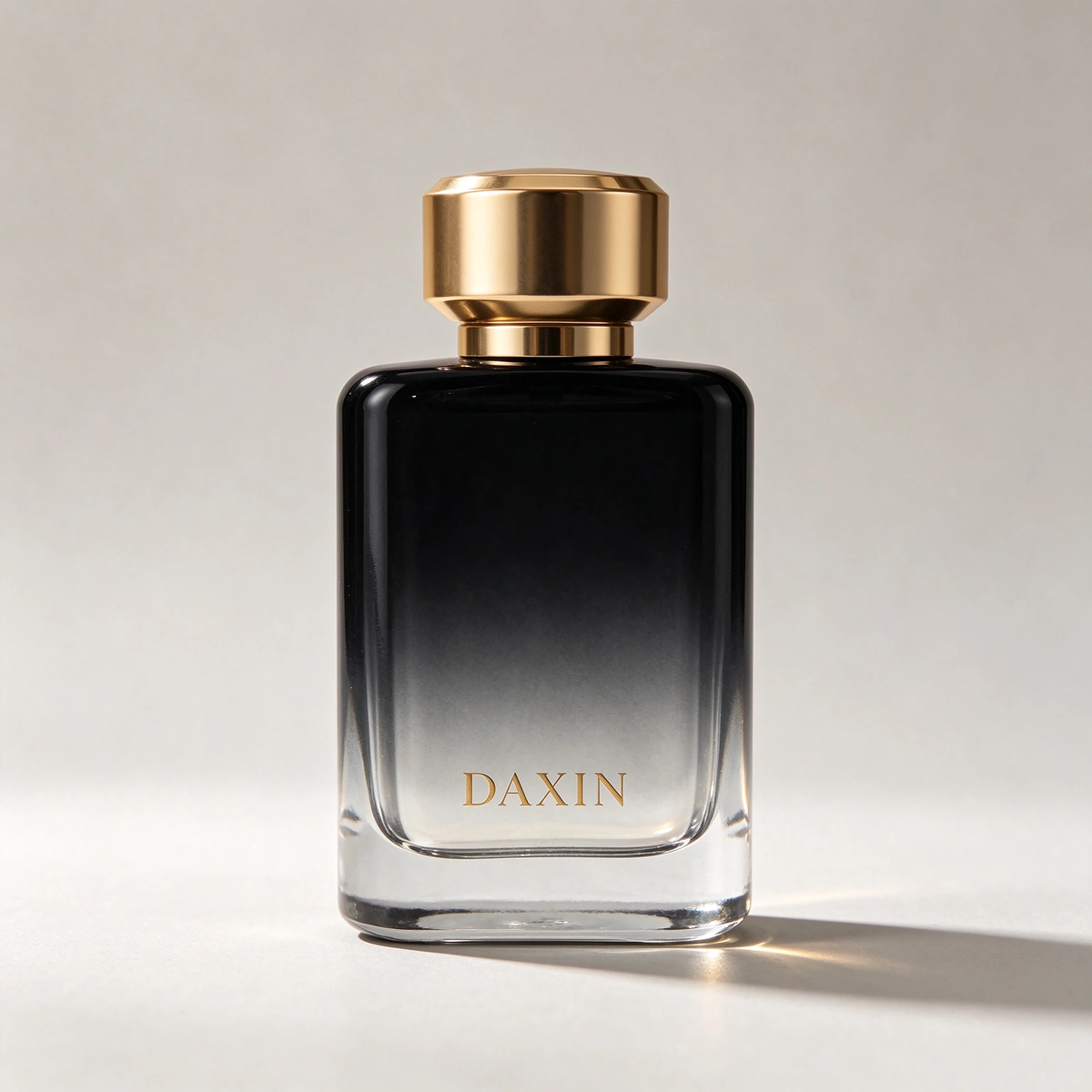
Glass | Extra flint, thick base, rounded rectangular body |
Cap | Heavyweight Zamak, gold electroplated |
Decoration | Gradient spray coating + hot-stamped logo |
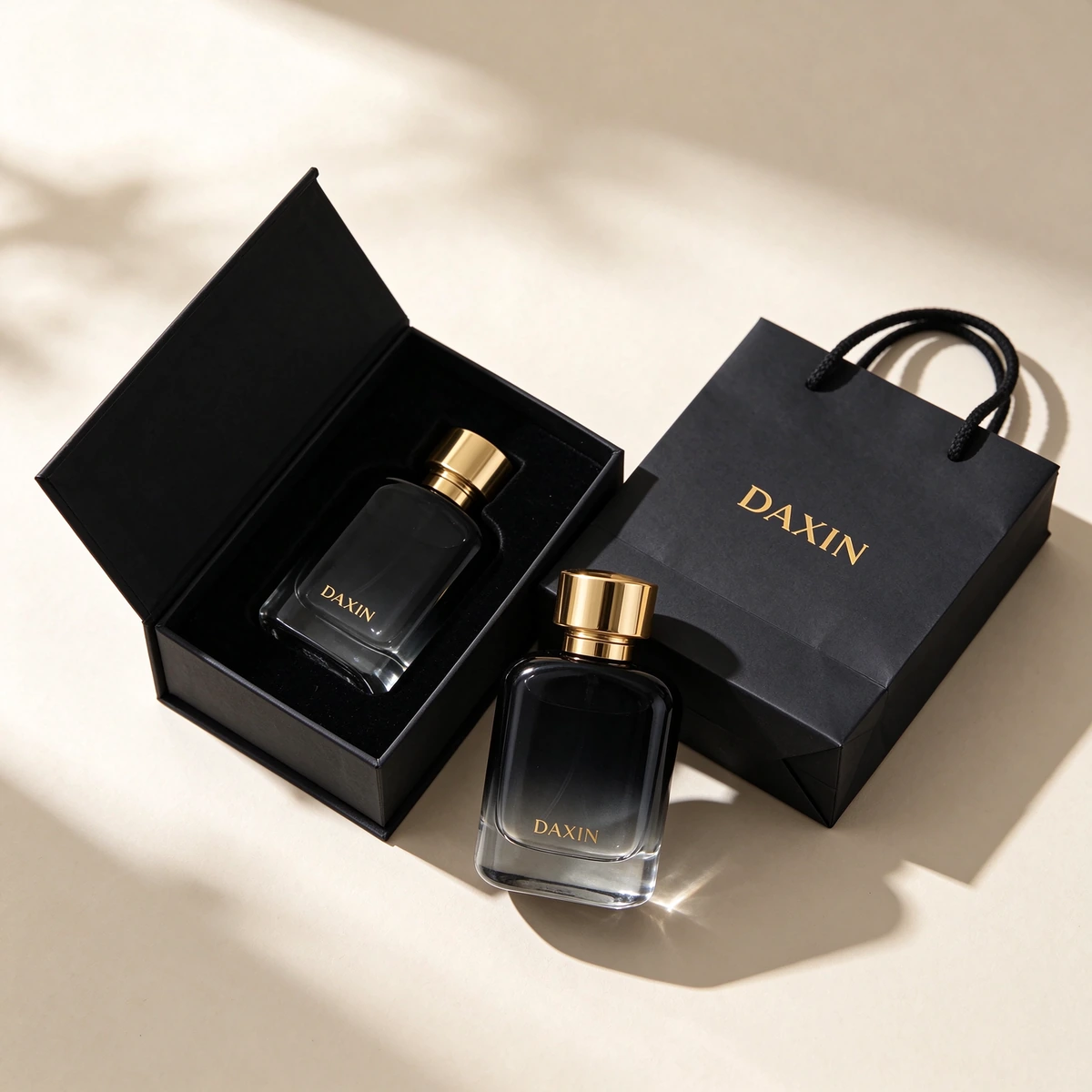
Secondary | Rigid gift box with velvet insert, matching tote |
MOQ | 10,000 pcs |
Lead time | 15–20 days mold + 25–30 days production |
Compliance | SGS, CE, RoHS, TUV, Intertek |
1. Project Background
The gradient coating broke down at the transition line, leaving a hard edge where the black faded into clear glass.
The proposed cap was visually correct but too light in hand, so the package read as "premium design, budget execution" on shelf.
The bottle was top-heavy when filled. It stood fine empty and wobbled on the filling line once the pump and cap were added.
The launch date was fixed by a retail window, and the brand had already shot campaign imagery against the approved silhouette. Redesign was not on the table. The job was to make the existing design manufacturable, repeatable, and shippable.
2. The Brief
Requirement | Why it mattered | Risk if missed |
Silhouette unchanged | Campaign assets and retail plan were already locked | Re-shoot, delay, lost media spend |
Gradient from opaque black to clear, no hard transition line | The fade is the brand's main visual signature | Visible banding on every unit |
Gold cap with real weight | Perceived value at the shelf, in hand, and unboxing | Package feels cheaper than the juice |
FEA15 crimp neck | Standard pump supply, second-source flexibility | Single-source pump, no fallback |
Alcohol resistance | Fragrance is ~70–80% ethanol; it attacks weak coatings | Coating lift, blistering, label failure |
Transit durability | Export cartons, sea freight, e-commerce parcels | Breakage and leakage claims |
10,000 pcs first order, on a fixed date | Working capital and launch timing | Stock-out at launch |
3. The Solution
Component | Material and spec | Decoration |
Glass bottle | 100ml extra flint glass, FEA15 neck, weighted base | Frosting option, custom spraying, high-flint upgrade |
Sprayer / atomizer | High-precision aluminium pump, FEA15 crimp | Gold, silver, matte black, shiny finishes |
Collar | Matching aluminium collar | Seamless fit to the pump |
Cap | Heavyweight Zamak cap | Electroplating, laser engraving, magnetic option |
Gift box | Rigid box with custom velvet / EVA insert | Hot stamping, screen printing, embossing |
The design intent stayed intact: the same silhouette, the same fade, the same cap geometry. What changed was the glass body weight distribution, the coating process, the cap's alloy and plating thickness, and the insert geometry that holds the bottle still in transit.
4. Craft and Technical Points
4.1 Glass body and base weight
Extra flint also matters for decoration. Fewer seeds, bubbles and striae in the glass means the coating sits on a clean surface, which is the difference between a smooth fade and a mottled one.
4.2 FEA15 crimp neck
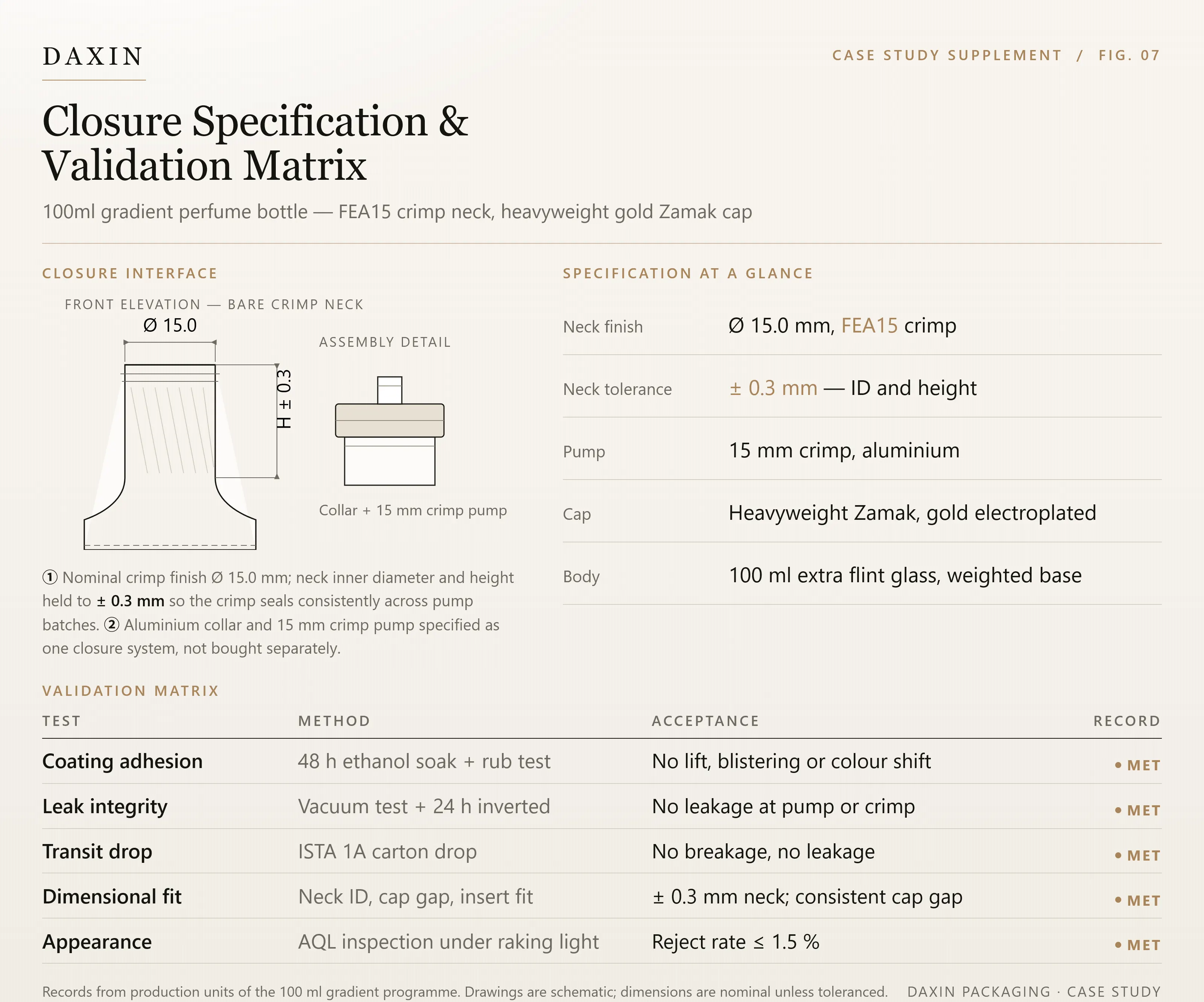
FEA15 is the most widely used crimp standard for fragrance pumps in Europe and the Middle East. Specifying it did two things: it opened the pump to multiple qualified suppliers instead of one, and it meant the brand's contract filler could run the bottle on existing equipment without new change parts. Neck inner diameter and height were held to ±0.3mm so the crimp seals consistently across pump batches.
4.3 Cap: Zamak, not plated plastic
We also dimensioned the cap's inner fit against the collar so the cap sits with a consistent gap all round. A 0.4mm variation there is the difference between "machined" and "loose" in the hand.
4.4 Gradient coating
Mask the clear zone and control the spray angle and distance so the fade is built from overlapping passes rather than one hit.
Build the gradient in layers, going lighter with each pass toward the base, then cure between passes.
Cure at a controlled temperature so the coating cross-links fully; under-cured coating is what lifts when ethanol touches it.
Inspect the transition line under raking light, not diffuse light — banding that is invisible under flat lighting is obvious on shelf.
4.5 Hot-stamped logo on a curved surface
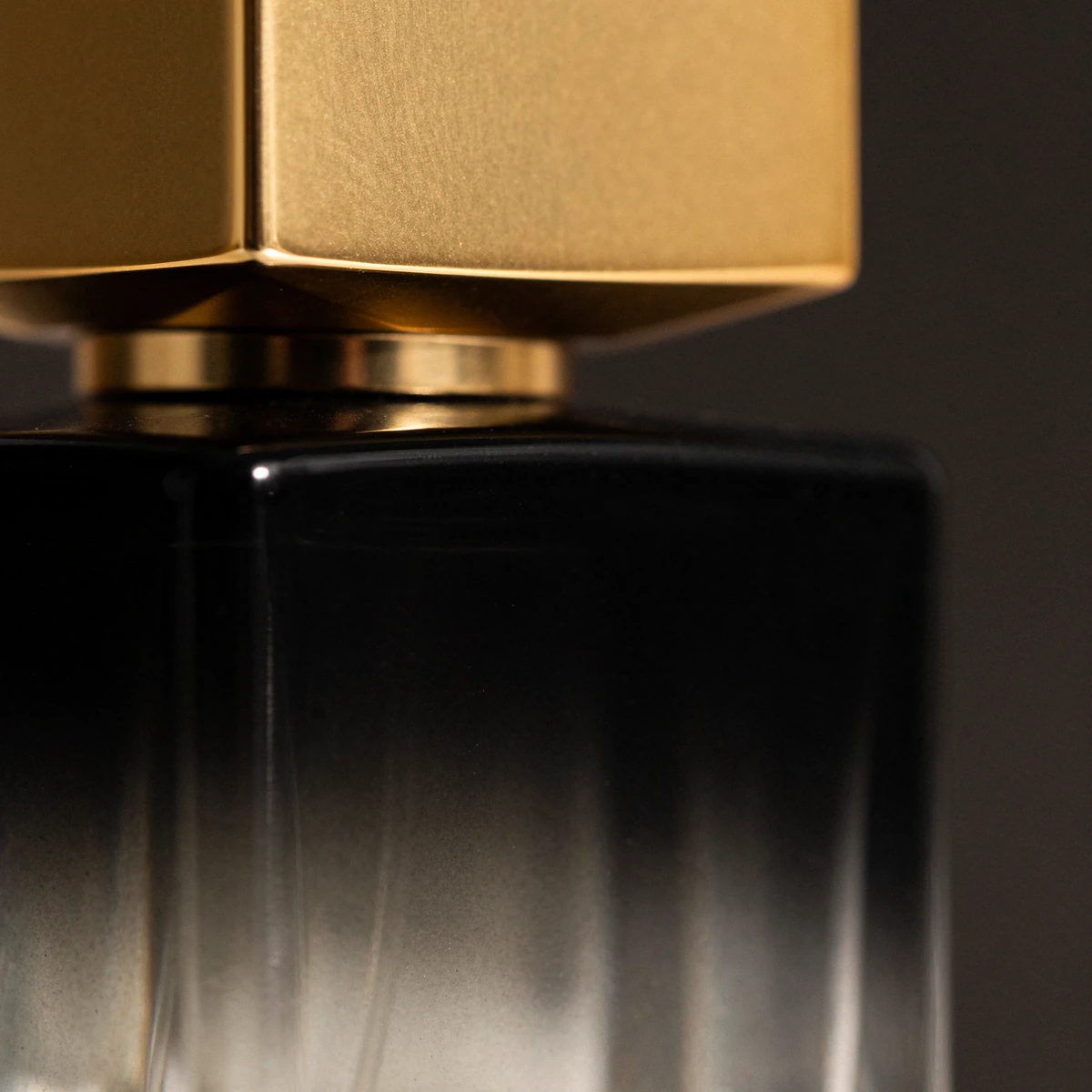
The logo sits on a gently curved panel, so a flat die would print unevenly. We used a flexible silicone die with a matching radius, plus a locating jig that references the neck rather than the base — the neck is the tightest dimension on the bottle, so registration repeats from unit to unit.
4.6 Secondary packaging
Test | Method | Acceptance |
Coating adhesion | 48h ethanol soak + rub | No lift, blistering, or colour shift |
Leak | Vacuum test + 24h inverted | No leakage at pump or crimp |
Drop | ISTA 1A carton drop | No breakage, no leakage |
Dimensional | Neck ID/height, cap fit, insert cavity | ±0.3mm neck, consistent cap gap |
Appearance | AQL inspection under raking light | Reject rate under 1.5% |
5. Execution Process
Stage | Work | Duration |
1. Brief and technical review | Design intent review, risk list, neck and closure decision | Week 1 |
2. 3D and technical drawing | Engineering drawing from the approved render, hand sample in stock glass | Week 1–2 |
3. Mould and first shots | Mould build, first-off samples, base weight and crimp validation | 15–20 days |
4. Decoration trials | Gradient passes, cure profile, hot-stamp die and jig | 5–7 days |
5. Validation and pilot run | Full test plan on pilot units, insert fit, carton drop | 1 week |
6. Mass production | 10,000 pcs, in-line AQL inspection | 25–30 days |
7. Packing and shipment | Insert assembly, carton configuration, export documents | 1 week |
Each stage ended with a signed-off sample. Nothing moved forward on a verbal approval, because the two failures the brand had already experienced both came from a stage that was never formally closed.
6. Results
Target | Achieved |
Silhouette unchanged from approved design | Met — no re-shoot required |
Gradient with no visible transition band | Met — banding eliminated, verified under raking light |
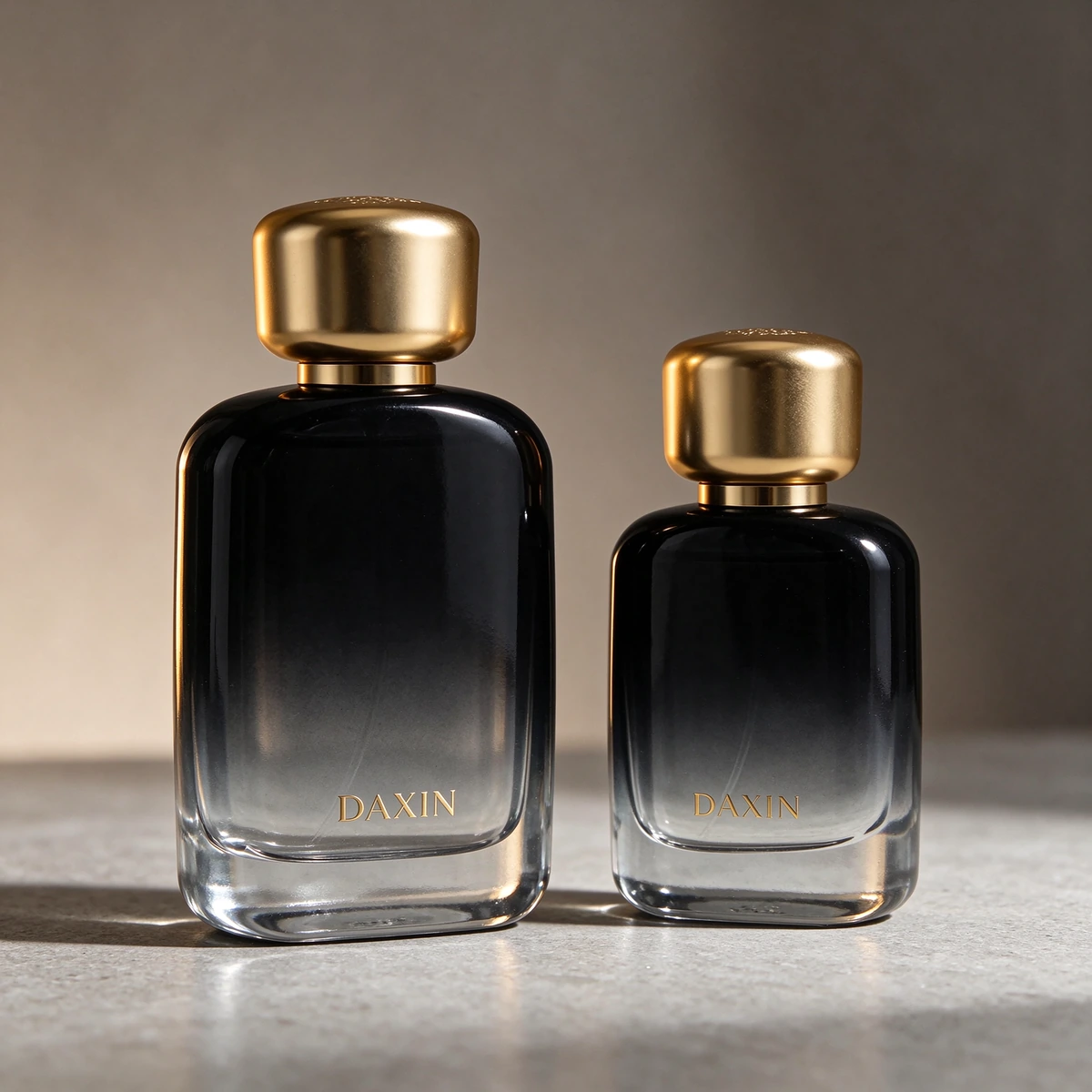
Cap with genuine weight and premium plating | Met — heavyweight Zamak, gold electroplated |
Coating survives ethanol contact | Met — 100% pass on 48h soak and rub test |
No leakage or breakage in transit | Met — zero failures across ISTA 1A carton tests |
Decoration reject rate | Held under 1.5% at AQL inspection |
First order of 10,000 pcs on schedule | Met — shipped inside the retail window |
The same neck and cap were reused for a 50ml derivative six months later, with no new mould and no new pump qualification.
The filler reported no line stoppages for wobble or crimp rejects during the first production run.
The gradient process was documented as a repeatable recipe, so a reorder does not depend on the original operator being on shift.
7. What Made This Project Work
We engineered under the design, not around it. Every change was invisible to the customer's eye: base weight, alloy, plating thickness, cure profile, insert cavity.
The neck was decided early. FEA15 crimp gave the brand pump competition and filler compatibility before decoration was even discussed.
Coatings were tested with the real aggressor. Ethanol, not water, on production units, not lab coupons.
Packaging was treated as part of transit protection. The insert was dimensioned to the measured bottle, not the nominal drawing.
Every stage closed with a signed sample. The project never carried an unapproved assumption into the next step.
8. Related Products and Entry Points
Perfume Bottle collection — 30ml, 50ml and 100ml glass perfume bottles across square, rectangular, round, cylindrical and sculptural shapes, with pump and cap options.
Custom Design Perfume Bottle — OEM/ODM projects with custom moulds, crown caps, gemstone caps and leather-finish bodies.
100ml Gradient Perfume Bottle with Box — the closest stock build to this case: black-to-clear gradient, matte square cap, rigid gift box.
100ml Matte Spray Perfume Bottle — tall rectangular body in black, white or white-blue matte coating.
Perfume Packaging — pumps, collars, caps and boxes specified as one system rather than bought separately.
More case studies — packaging rescue, multi-SKU consolidation and other perfume bottle projects.
Planning a Similar Bottle?
Send us the silhouette, the capacity and the market you are selling into. We will come back with a component breakdown, a decoration route, a mould timeline and a quote at your order quantity — before anything is cut.