
Premium Without Overspending
Premium Without Overspending
A premium perfume package is not the sum of the most expensive version of every component. It is a deliberate allocation of money, risk and attention toward the few decisions that make the brand feel unmistakable.
The anonymized fragrance company behind this project framework arrived with a familiar ambition: a bottle that would feel substantial on a retail shelf, photograph well, deliver a confident first touch and support a credible luxury price position. The initial specification also read like a catalogue of customization—new glass geometry, a metal cap, a bespoke pump and collar, layered decoration, a rigid presentation box and a fitted insert. Every line sounded premium when considered alone.
The commercial brief was less forgiving. The first order had to respect an unconfirmed target quantity and price range, the launch calendar could not absorb unlimited development rounds, and the brand needed a solution it could reorder as demand grew. Each exclusive component would create its own tooling, minimum order, sample cycle, supplier dependency and leftover-inventory profile. The question therefore changed from “Can every part be customized?” to “Which custom decisions will the consumer actually reward?”
DAXIN’s role in this type of review is not to strip ambition out of the project. It is to protect the brand idea while exposing the commercial consequences hidden inside the render. That means comparing an existing bottle with a new mold, testing whether decoration can carry the identity, deciding whether cap tactility deserves more of the budget, standardizing functional interfaces when appropriate, and judging price through the total route rather than one component quotation.
The narrative below is a decision model pending internal project confirmation. It intentionally avoids exact customer details, savings, MOQs, lead times and performance claims. Its value is the method: customer request → cost, MOQ and risk implication → realistic alternatives → design decision → consumer impact → commercial impact.

More customization does not automatically mean more premium. It means more commitment. The brand must decide which commitments create visible value.
The central value-engineering principle
01 · The Brief
“We want it to look luxury—but the numbers still have to work”
The desired package needed the visual discipline of a premium fragrance launch: a confident silhouette, controlled glass clarity, a cap that felt intentional, precise metallic detail and an outer pack that did not undermine the bottle at the last moment. The target market, channel and final retail context remain [FACT CHECK / DAXIN TO CONFIRM], but the underlying tension is common to founders, product developers and procurement teams: design is judged by consumers while the route to design is constrained by volume, cash, time and supply.
Premium packaging is therefore a business decision before it is a styling exercise. A proprietary bottle may create powerful shelf recognition, but it also concentrates budget in a glass tool and asks the forecast to support that choice. A zamac cap may create immediate tactile substance, but it changes component cost, freight weight and the size of the inventory commitment. A rigid box can stage an impressive reveal, but it can also increase dimensional weight and consume storage space. None of these choices is wrong. Each needs a reason connected to the brand position.
The review began by separating requirements into three groups. Non-negotiable brand signals were the aspects that needed to look or feel distinctive. Functional requirements covered spray performance, closure fit, assembly and protection. commercial constraints covered project budget, component-level minimums, launch timing, supplier coordination and repeat-order feasibility. A proposal would be judged on all three groups, not on its isolated beauty.
02 · The First Mistake
Treating every component as an opportunity to customize
A perfume package appears simple when assembled. Under the cap, however, it is a stack of decisions: glass body and neck, pump, dip tube, collar, cap shell and insert, surface decoration, carton and internal fitment. If each element becomes proprietary, the number of relationships grows faster than the visible part count. The custom cap must fit the selected collar. The collar must respect installed pump height. The pump must suit the bottle neck and fragrance delivery. The decorated bottle must survive the insert and transit pack without abrasion.
Customization also creates administrative interfaces. A new component can mean another drawing, tool ownership decision, physical master, color approval, purchase order, inspection standard and reorder lead time. A component that appears inexpensive in a quotation can be costly to coordinate if it arrives from a separate supplier, has an inflexible batch size or creates an assembly operation that nobody owns.
The first correction was therefore conceptual: stop equating the number of bespoke parts with luxury. Consumers do not inspect a bill of materials. They experience proportion, balance, finish, tactility, spray and opening sequence. The project should be complex only where complexity changes that experience or protects performance.
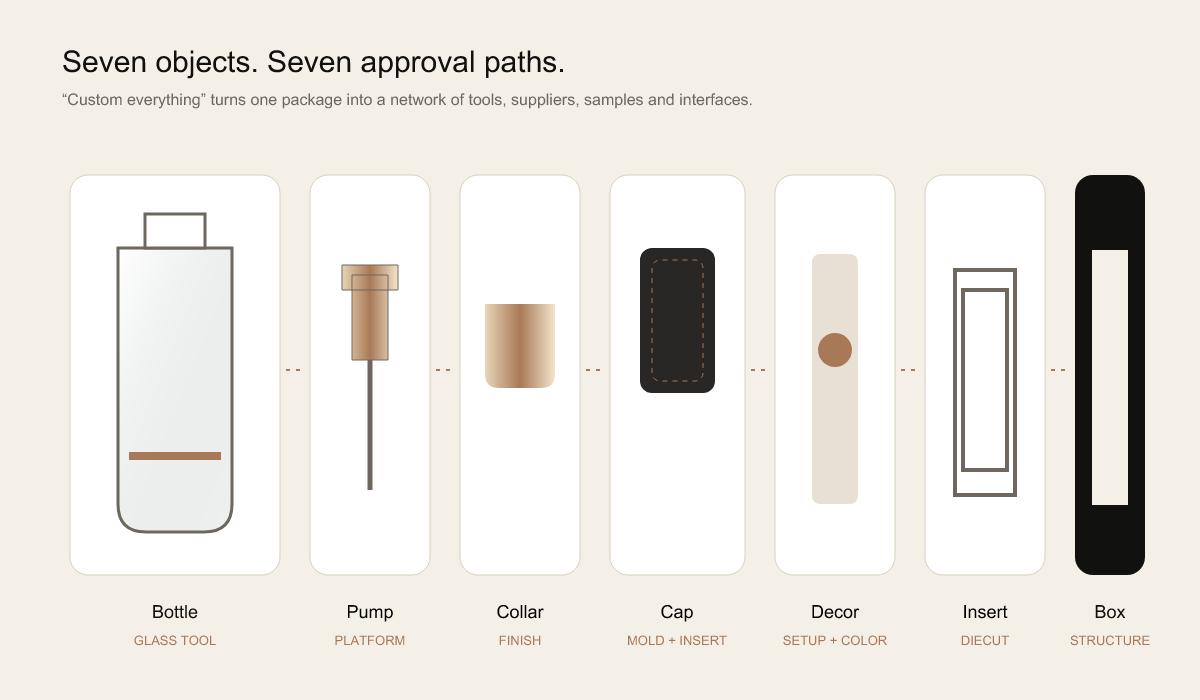
Custom everything, explained. Seven visible objects can create seven tooling, sample, MOQ and approval paths before compatibility between them is considered. SVG technical diagram.
03 · The Method
Value engineering does not mean making the package cheaper
In premium fragrance packaging, value engineering means preserving the characteristics that customers can see, touch and associate with the brand while simplifying or standardizing elements whose added cost does not create proportional consumer value. It is not a race to the lowest specification. A thin, unstable bottle or weak actuator would reduce value even if it reduced price. So would a finish that photographs poorly, a cap that rattles or a carton that collapses at retail.
The method asks two linked questions. First, what creates perceived value? This can include silhouette, glass distribution, cap feel, finish, logo precision and opening experience. Second, what protects delivered value? This includes the neck, pump dosage, sealing interface, decoration adhesion, insert support and repeatable quality. Some elements sit in both groups; others are commercially important precisely because the consumer never notices them when they work.
A component passes the value-engineering review when the design benefit, future usefulness and brand ownership justify its tooling, minimum, sampling, timing and risk. If the benefit is uncertain, the correct answer may be to prototype or phase the investment rather than either approve or reject it immediately. This creates a more honest brief for a packaging project management conversation.
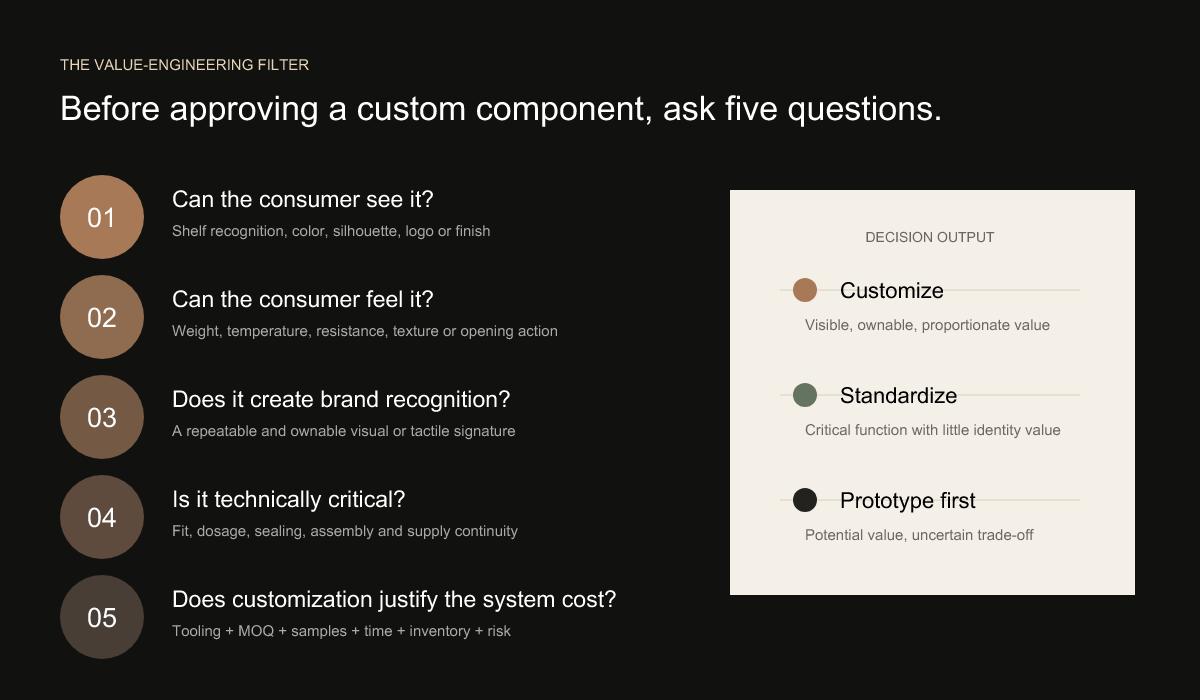
The signature decision filter. Consumer visibility, tactility, brand recognition, technical importance and total system cost are reviewed together. SVG technical diagram.
04 · Consumer Perception
Spend the differentiation budget where the customer can perceive it
A buyer encountering perfume packaging moves through a sequence. At distance, silhouette, proportion, color and the relationship between bottle and cap create recognition. In the hand, weight distribution, edge comfort, cap temperature and removal resistance shape quality. During use, actuator feel and spray performance confirm or contradict the promise. When the package is opened or returned to a shelf, carton structure and fit reinforce the memory.
These moments explain why customization priority should not follow component price. A small cap may carry more consumer attention than a much larger hidden insert. A precise screen-printed mark may create more recognition than an invisible custom pump component. Conversely, the pump can deserve a higher engineering priority than its visibility suggests because a poor spray immediately damages the product experience.
The practical distinction is visible identity versus hidden engineering. Visible identity invites selective differentiation. Hidden engineering invites proven platforms, controlled interfaces and validation. This is a framework, not a universal rule: a patented dispensing experience, refill system or exposed mechanical detail could make a normally hidden part central to the brand. But the exception should be stated, not assumed.
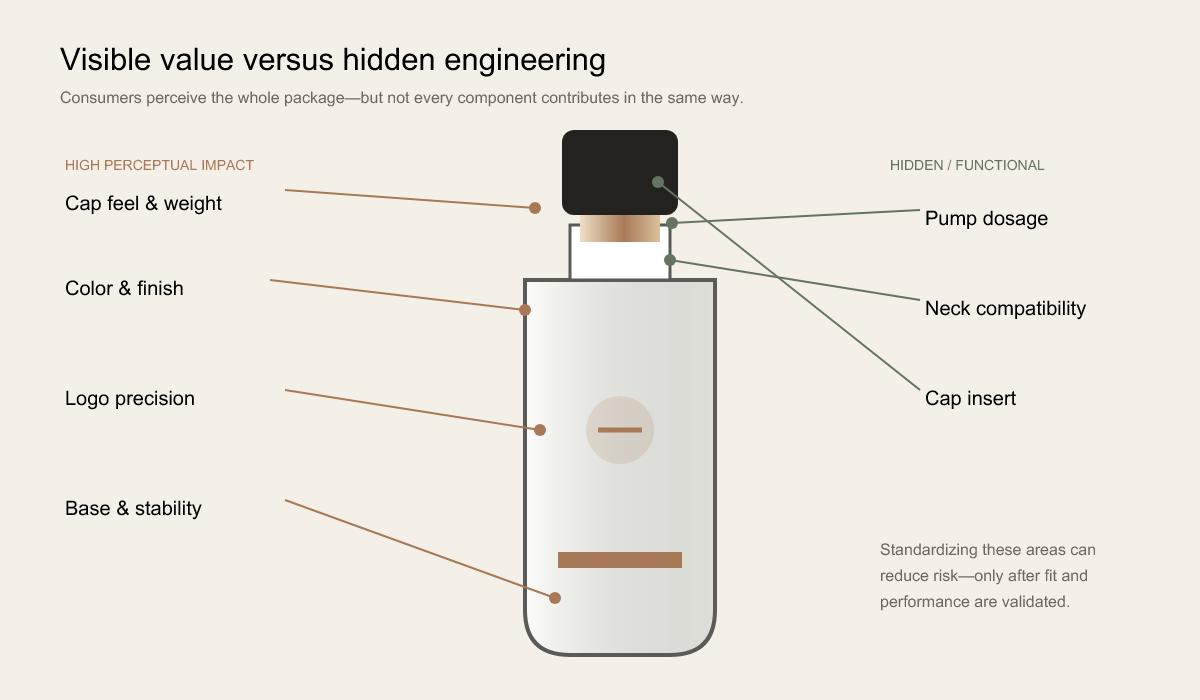
Perception map. The cap, finish, logo and base help communicate identity; the neck, pump and insert protect function even when they are largely unseen. SVG technical diagram.
05 · Bottle Decision
Existing mold, modified stock or a fully custom perfume bottle?
The bottle decision has disproportionate influence because glass geometry affects brand recognition, decoration area, fill volume, weight, carton dimensions, molding route and component interfaces. A fully custom bottle is rational when the proprietary silhouette is a durable brand asset—something the customer recognizes across campaigns and future fragrances. It allows exact control over shoulder, base, footprint and proportion, but asks the project to fund tooling, engineering, trial sampling and production validation.
An existing perfume bottle platform offers known geometry and a faster route to physical samples. It can reduce early commitment and help a brand validate demand. Its limitation is not that it must look ordinary; it is that the structural silhouette may also be available to other buyers. The brand must create ownership elsewhere.
The commercially powerful middle route is a modified stock bottle: existing glass structure combined with a coordinated custom finish, cap, decoration and carton. Because the customer’s initial silhouette was not yet confirmed as the primary recognition asset [FACT CHECK / DAXIN TO CONFIRM], this route deserved serious evaluation before approving a new glass mold. It redirected budget from invisible development complexity toward the aspects people would see and touch.
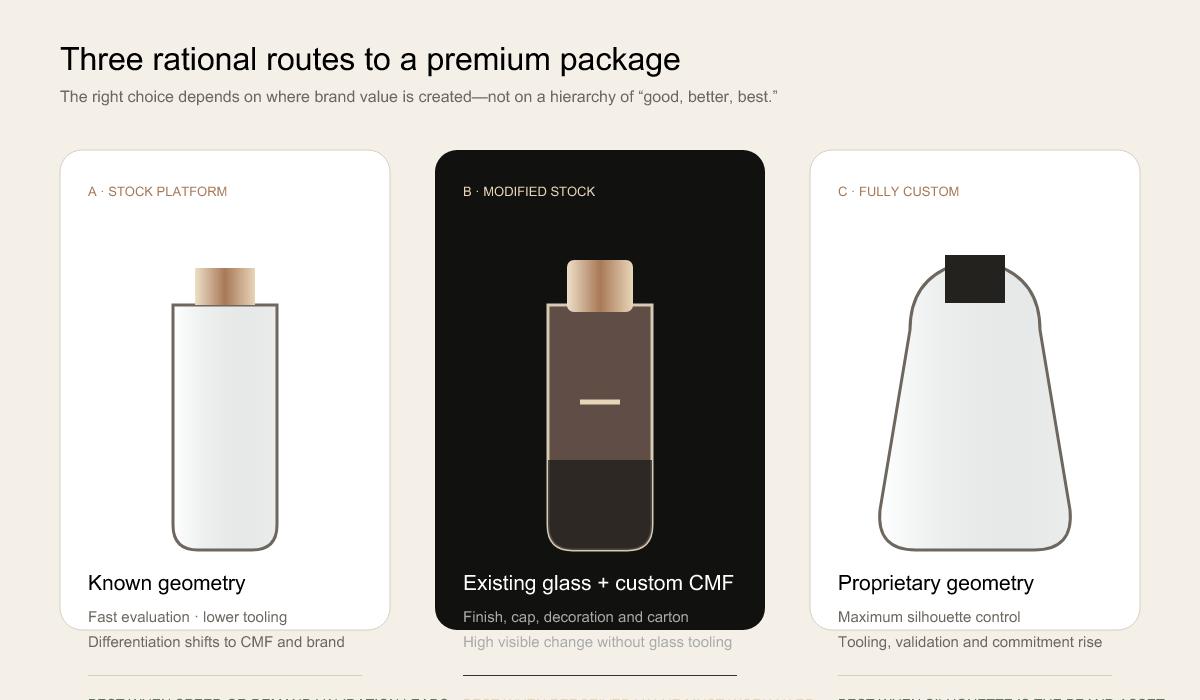
Three rational routes. Stock is not shown as inferior; modified stock can concentrate value in CMF, while full custom is strongest when silhouette justifies the commitment. SVG technical diagram.
Stock vs modified stock vs fully custom perfume bottles
| Factor | Stock Bottle | Modified Stock Bottle | Fully Custom Bottle |
| Tooling | Existing structural tool; project-specific decoration tooling may remain | No new glass mold; possible cap, artwork or finishing setup | New glass tooling and associated engineering or validation |
| Speed | Usually the shortest structural evaluation route when stock is available | Adds CMF and component sample cycles | Includes geometry, tooling, trials and approval dependencies |
| MOQ logic | Influenced by availability and chosen decoration | Often driven by the least flexible custom finish or component | Must support glass production and all downstream components |
| Exclusivity | Limited at the glass-geometry level | Visual identity can be strong; structure remains non-exclusive | Potentially strongest structural ownership, subject to agreements |
| Design freedom | Proportion and decoration area are fixed | High freedom in color, finish, cap, artwork and box | Highest silhouette and proportion control within manufacturability |
| Development risk | Lower structural uncertainty; compatibility still requires checking | Concentrated in CMF, assembly and component fit | Higher because geometry, tooling and production repeatability are new |
| Scalability | Depends on platform continuity and supplier planning | Can scale well with controlled files and finish masters | Strong ownership when future volume supports the tool |
| Best commercial fit | Demand testing, speed or a design led by graphics and cap | High perceived differentiation without new glass geometry | A recognizable silhouette central to long-term brand equity |
06 · The Middle Ground
Stock glass becomes distinctive when CMF behaves as a system
CMF—color, material and finish—is sometimes treated as decoration applied after the “real” design is complete. In perfume packaging it can be the design. A translucent smoke gradient changes perceived volume and shadow. A warm matte coating turns the same geometry into a softer object. A small metallic mark can create an intentional focal point. A cap with a different material temperature or weight changes the first touch.
The value-engineered route considered the existing glass platform as a reliable canvas rather than a compromise. Differentiation could be distributed across controlled spraying, translucency, screen printing or hot stamping, then reinforced by a cap and carton designed as one composition. DAXIN’s decorating and finishing page provides the capability context; the exact processes, color references and adhesion requirements for the anonymized project remain to be confirmed.
This route has limits. Existing shoulders, sidewalls and bases may constrain masking and artwork. Deep push-ups, sharp corners or recessed areas may be difficult to finish consistently. A coating cannot create the patentable or instantly recognizable silhouette of new glass. CMF also has its own batch minimum, color-tolerance and sample obligations. Value engineering is not pretending decoration is free; it is comparing where its cost produces more visible change than structural tooling.
07 · Glass Weight
Heavier glass has value—but that value has diminishing returns
Fragrance brands often use weight as shorthand for quality. A thicker base can improve stability, create richer refraction and make a bottle feel substantial when lifted. Weight can be especially useful when the external geometry is restrained and the brand needs physical presence rather than decorative complexity.
Yet “heavier” is not an unconstrained target. Extra glass affects unit mass, carton board requirements, insert support, master-case weight, pallet loading and freight. A very thick base can also complicate glass distribution and visual quality if the geometry is pushed without regard for molding behavior. Sustainability goals may further change the acceptable balance between perceived substance and material intensity.
The engineering target should therefore be perceived weight, not maximum weight. Proportion, low center of gravity, stable footprint, cap density and the way the bottle settles into the hand all influence that perception. A balanced bottle with a well-judged base and confident cap can feel more resolved than a heavier bottle whose mass seems arbitrary. The selected weight and glass distribution for the actual case require DAXIN confirmation.
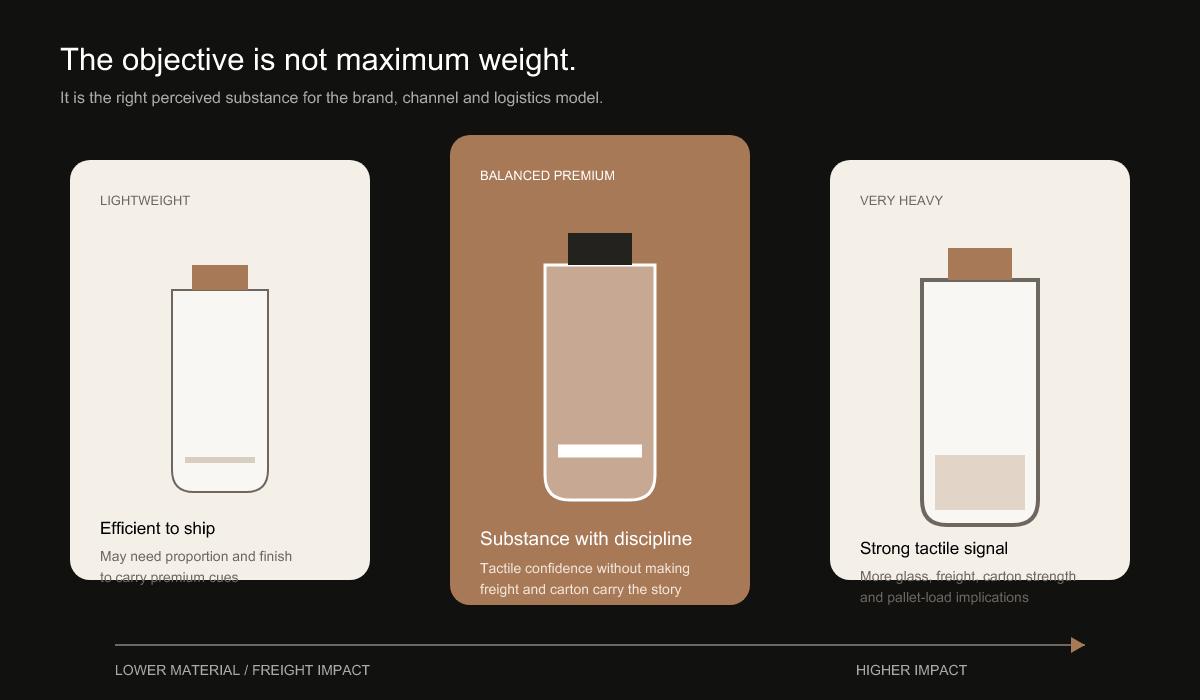
Weight trade-off. More glass can strengthen tactility while also increasing packaging and logistics consequences; the optimum is position-specific. SVG technical diagram.
08 · Cap Strategy
The cap can be a better place to spend the customization budget
The cap occupies less visual area than the bottle, but consumers touch it repeatedly. Its weight, temperature, alignment, removal force and sound can either concentrate perceived quality or expose a mismatch. It also sits at the top of the silhouette, where a distinctive proportion can be recognized in photography and on shelf.
This creates a valuable alternative: combine a proven glass platform with a more distinctive cap. A weighted ABS construction, a clean aluminum shell or a sculptural zamac form can create tactile and visual ownership while avoiding new glass geometry. A custom insert can adapt the outer cap to a standardized closure envelope—provided retention, vertical position, rotational alignment and material behavior are validated.
The trade-off is that the cap is not an isolated sculpture. A very heavy cap can make the package top-heavy. A wide cap can collide with shoulder geometry or carton clearance. A metal finish that looks luxurious in a render can disagree with hot stamp or collar once each is produced on a different substrate. For this reason the cap budget should include physical fit and CMF approval, not only the shell quotation.
A stock glass bottle with a memorable cap can create more differentiation than a custom bottle with a generic closure—when the cap truly carries the brand idea.
A strategic option, not a universal rule
09 · Material Choice
Zamac vs aluminum vs ABS: cost is only one dimension
ABS offers broad shape and decoration flexibility at relatively low weight. It can be colored, coated or metallized, and an internal weight can tune tactility without changing the visible shell. Its perceived value depends on wall design, seam control, surface execution, insert quality and the way it engages with the bottle.
Aluminum provides a naturally metallic skin and a cool initial touch. It can support a clean, precise design language without the mass of zamac. Manufacturing route, wall thickness, forming limits, anodizing or finishing choices and the relationship with an internal plastic structure all influence the result. It is not simply “metal, therefore premium.”
Zamac can deliver substantial weight, compact density and more sculptural forms. That makes it powerful for brands whose cap is a collectible object or signature. It can also require meaningful tooling, finishing control and shipping consideration. The right recommendation emerges from brand positioning, tactile target, geometry, quantity and budget—not from a universal material ranking. DAXIN’s pages for zamac lids and plastic lids offer adjacent sourcing context.
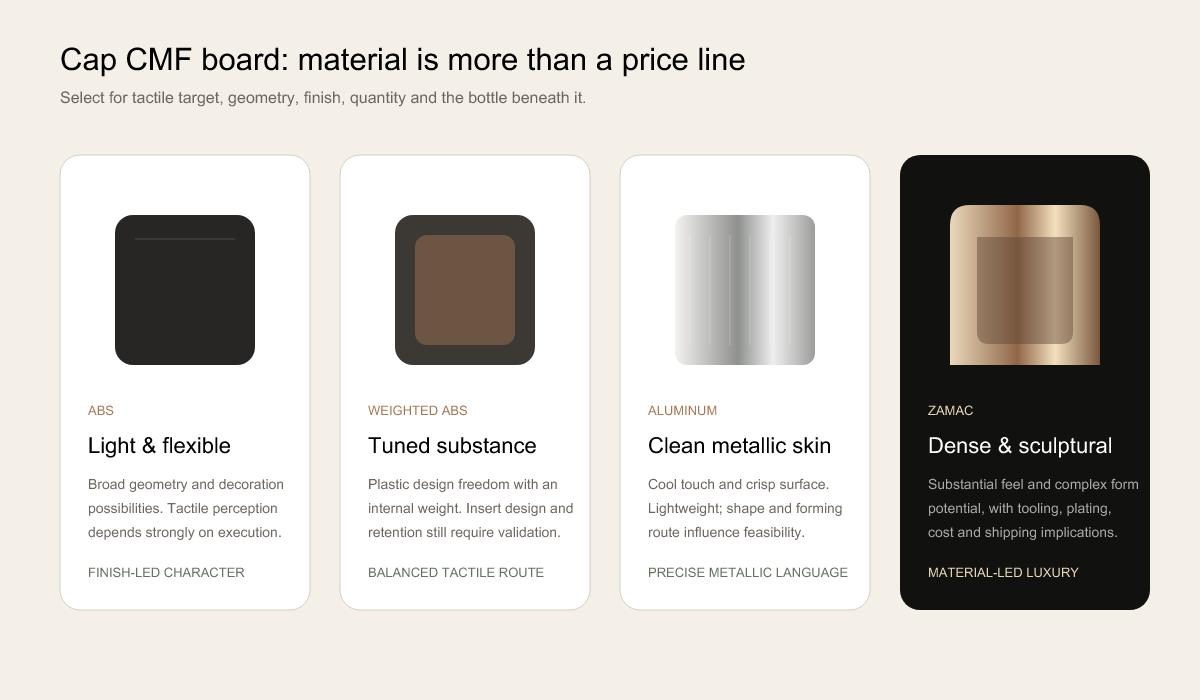
Cap CMF board. Material character, geometry, internal structure and surface finish must be assessed together. SVG technical diagram.
Perfume cap material comparison
| Cap Material | Perceived Weight | Design Freedom | Finish Options | Cost Implication | Best Fit |
| ABS | Generally lighter; execution can make it feel deliberate | High for many molded geometries and insert arrangements | Color, coating, metallization, print and texture depending on design | Often lower commitment than metal routes, but tooling and finish still matter | Graphic, color-led or geometry-led designs where low mass is acceptable |
| Weighted ABS | Tunable through an internal weight | High, with added internal-structure requirements | Similar visible options to ABS | Additional part, assembly and retention considerations | Brands seeking balanced tactility without a fully metal outer cap |
| Aluminum | Metallic touch with relatively low mass | Dependent on forming and shell geometry | Anodized, brushed, polished or coated effects where feasible | Metal process and internal component must be evaluated together | Clean, precise, contemporary metallic language |
| Zamac | Typically substantial and dense | Strong sculptural potential within tooling and casting limits | Plating, coating and surface detailing depending on part design | Higher tooling, part-mass, finish and logistics implications | A cap intended as a tactile signature or collectible object |
10 · Functional Platform
Should the perfume pump be customized?
The pump is mostly hidden after assembly, but it is one of the least forgiving places to make a symbolic customization. Spray dosage, plume, actuator resistance, gasket compatibility, crimp quality, installed height, dip-tube length and supply continuity affect use and assembly. A novel outer actuator or exposed finish may justify development; a custom internal platform that creates no meaningful user difference may only increase risk.
The strong default framework is: standardize invisible engineering, customize visible identity. Here “standardize” does not mean select a random off-the-shelf pump. It means choose a proven and available pump family compatible with the neck, formula, filling method, intended dosage and cap system, then define the installed result. DAXIN’s perfume sprayer options provide a starting point, not automatic approval for a specific product.
A standardized platform can simplify replacement, reorder planning and supplier continuity. It can also make the cap and collar easier to engineer because the installed envelope is known. The project should customize the pump only if the spray experience, exposed actuator, refill concept or another deliberate feature creates sufficient consumer or functional value. Formula compatibility and performance requirements for the anonymized case remain to be confirmed.
11 · Decoration ROI
Large visual change without changing the bottle mold
Decoration is often one of the highest-leverage uses of budget because it changes the consumer-facing surface directly. Spraying can introduce opaque color, translucency or gradient depth. Frosting or matte coating alters light and tactility. Screen printing can establish a crisp graphic rhythm. Hot stamping or a small metallic element can focus attention without covering the glass.
The value comes from restraint and coordination. Five unrelated effects can look less premium than one controlled finish with exact logo placement. A finish should support the bottle geometry and cap material rather than compete with them. Artwork must respect printable areas, corner radii and process limits. Metallic details on glass, cap, collar and carton should share a visual intent even when substrate differences make a perfect physical match impossible.
Decoration also brings minimum batches, setup, color matching, masking, adhesion testing, curing and sample rounds. A project that chooses existing glass to avoid tooling must not ignore those obligations. Its advantage is that development risk is concentrated on the visible surface rather than divided between a new structure and a new surface at the same time.
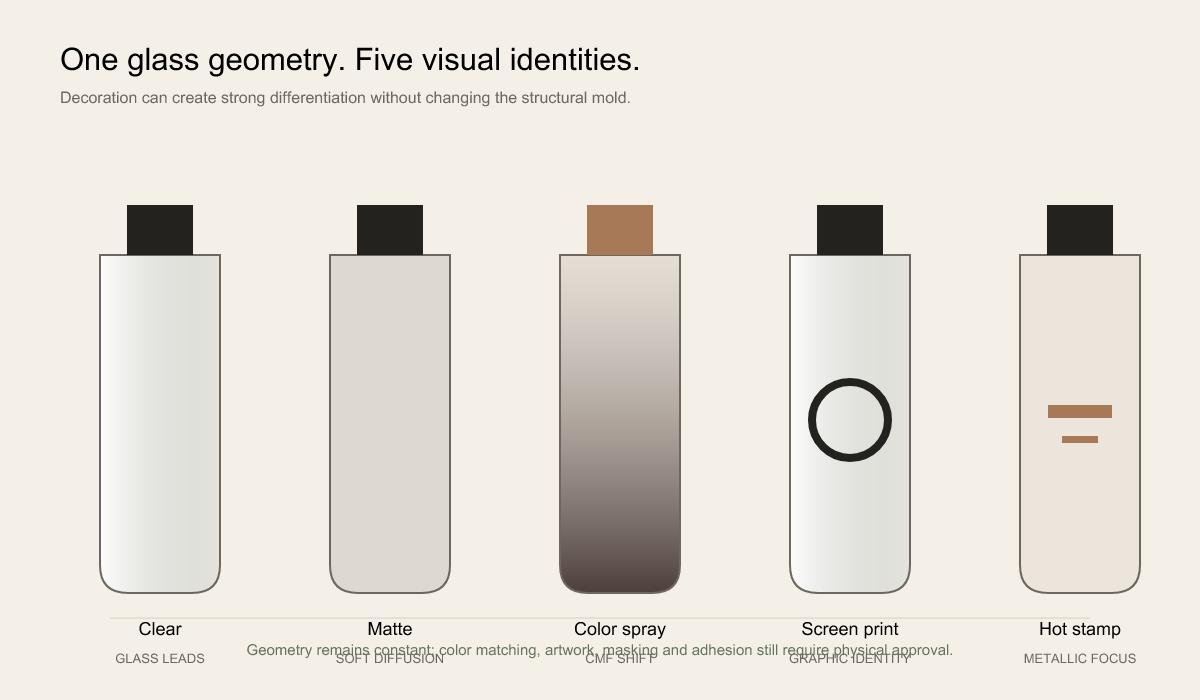
Decoration transformation. The structure stays constant while light, color and graphic identity change; physical color and adhesion approval remain essential. SVG technical diagram.
12 · The 80/20 Lens
Which few decisions create most of the premium perception?
The “80/20” idea is a decision lens, not a measured law. It forces a team to rank impact rather than give every line item equal emotional weight. For many perfume projects, silhouette, base, cap, color, finish, logo precision and opening experience carry a large share of perceived quality. Hidden pump internals and cap retention details may be critical to function but do not automatically need proprietary geometry.
The ranking changes by concept. A refillable fragrance may make the closure mechanism part of the story. A minimalist clear bottle may depend almost entirely on glass distribution and a tiny print mark. A richly decorated regional concept may place more identity in the cap and carton than in the bottle. The value matrix therefore uses qualitative judgments and explanation rather than fake universal scores.
The matrix also distinguishes consumer visibility from functional importance. Low visibility must never be read as low priority. The pump and neck can be high-importance, low-visibility components whose best strategy is robust standardization. In contrast, decoration can be high visibility with lower structural importance, making it a strong branding candidate but not a substitute for engineering.
Perfume packaging value matrix
| Component | Consumer Visibility | Functional Importance | Customization Cost / Risk | Branding Value | Recommended Strategy |
| Glass bottle | High | High | Medium to high when geometry is new | High when silhouette or glass distribution is recognizable | Customize when structure owns the identity; otherwise evaluate stock + CMF |
| Neck | Low after assembly | High | High if a nonstandard interface is introduced | Usually low unless deliberately exposed | Prefer a proven interface that supports pump and cap availability |
| Pump | Low to medium | High | Medium to high for a new platform | Medium when spray or actuator is part of experience | Standardize the platform unless a distinctive function earns development |
| Collar | Medium | Medium | Medium because fit and finish interact | Medium as a transition between glass and cap | Use a compatible platform and customize surface or proportion selectively |
| Cap | High | Medium to high | Medium to high by material and tool | High because consumers see and touch it | A strong candidate for selective tooling or material investment |
| Decoration | High | Medium | Medium; setup and repeatability matter | High for color, logo and recognition | Use as a high-leverage differentiator with physical masters |
| Box | High before opening | Medium to high for protection | Medium; structure and print have separate effects | High for retail story and reveal | Customize the experience while controlling size and protection |
| Insert | Low to medium | High for retention and protection | Low to medium depending on material and structure | Usually lower unless visible during opening | Engineer for fit, protection and pack efficiency before ornament |
13 · Minimum Orders
“What is your MOQ?” is usually the wrong question
A complete perfume package does not move through one production process. An existing glass bottle can have one availability condition, a sprayed finish another batch requirement, a custom cap another production threshold, a pump another supply rule and a printed box another efficient quantity. Tooling can create a commitment before any finished units are ordered. Color variants can split otherwise useful volume into smaller batches.
The better question is: which component creates the highest or least flexible MOQ constraint in this packaging system? That question reveals whether the requested package fits the first-order forecast. It also points toward the right redesign. If a custom cap is the bottleneck, the brand can consider an existing cap with a project-specific finish, share the cap across future fragrances, phase the custom tool, or accept extra inventory because the cap carries enough brand value.
MOQ should be mapped at component and process level before the final concept is frozen. The map should include glass, each decoration operation, cap shell and insert, pump and collar, box, insert and any assembly or accessory. Exact DAXIN quantities must come from a current quotation; this case study deliberately avoids publishing unverified universal numbers.
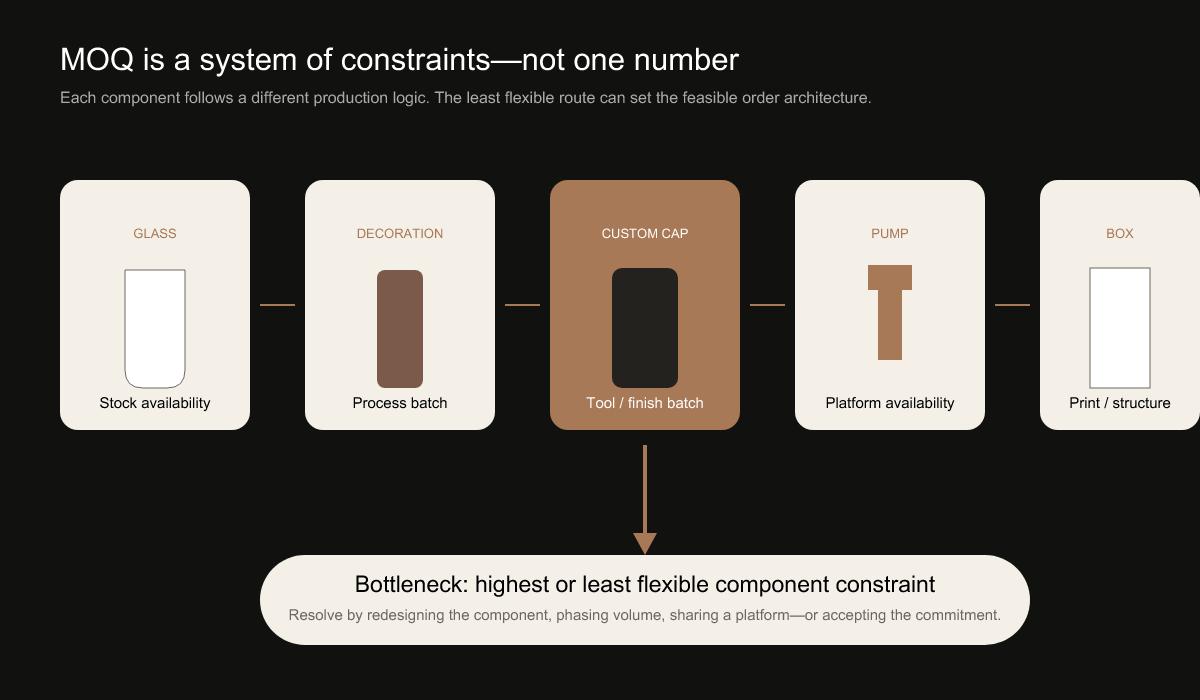
MOQ bottleneck logic. The highlighted cap is an illustrative constraint, not a DAXIN quantity claim; a real project may be governed by any component or process. SVG technical diagram.
14 · Bottleneck Review
The least flexible component can decide whether the project is commercially feasible
Consider a project in which an existing bottle is available at a quantity compatible with the launch, the planned coating can run at a different batch size, the custom cap requires a larger commitment, the pump is ordered in another increment and the carton supplier has separate print economics. No single number describes that system. The brand may receive more caps than decorated bottles, more pumps than boxes or leftover inserts that cannot be reused.
The first response should not be to negotiate every number downward in isolation. A small run that disrupts an efficient process can raise unit cost or reduce production stability. Instead, the team should identify which mismatch creates working-capital exposure and whether architecture can absorb it. A common pump might serve future projects. An undecorated cap shell might be finished later. A neutral insert might work across two box artworks. These options require supplier confirmation, but they show why component commonality has financial value.
The bottleneck can also be time rather than quantity. A component may have an acceptable MOQ but an unavailable production window. Another may require a color sample that sits on the critical path. Procurement should therefore map minimum, lead time, shelf life where relevant, storage volume and reuse potential together. This turns MOQ from a frustrating sales question into a design input.
15 · Tooling Allocation
Spend tooling money on repeatable brand assets
A packaging budget can fund a custom glass mold, cap mold, metal ornament, insert die or no new structural tool at all. The correct choice is not the most visible line on a supplier proposal. It is the tool whose output remains valuable across enough consumer interactions and future orders.
A custom bottle mold can be powerful when silhouette is protected and repeatable across a range. A cap mold can concentrate investment in the object consumers touch. A small metal ornament can create a recognizable focal point while allowing the bottle and cap structure to remain standard. A custom insert can be justified when it protects an unusual bottle or creates a controlled reveal, but decorative complexity hidden under the product may not earn its cost.
Every tooling proposal should be reviewed against consumer visibility, brand distinctiveness, forecast volume, reuse across SKUs, ownership or exclusivity terms, lead time, production validation and technical risk. DAXIN’s in-house molding information is relevant to the custom route, but the actual mold type, ownership terms and schedule must be confirmed for a specific project.
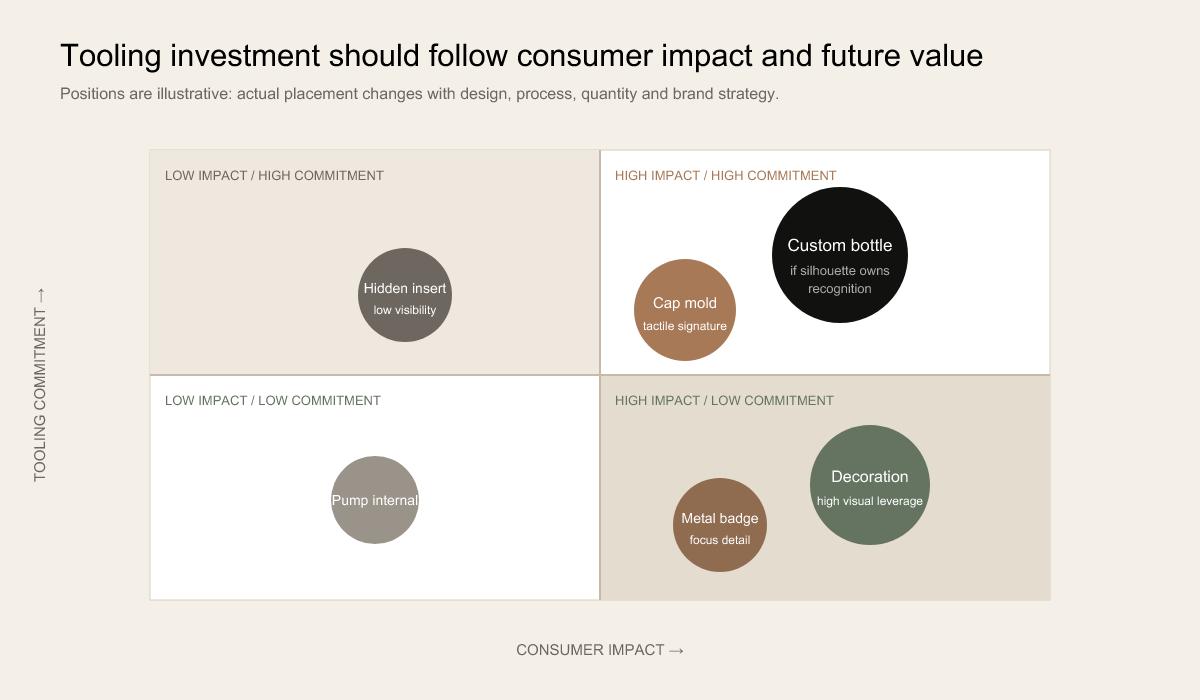
Tooling matrix. Placement is conceptual and must move with the design; it prevents teams from funding a high-commitment, low-impact feature by habit. SVG technical diagram.
16 · Commercial Comparison
Lowest cost per bottle does not equal lowest total packaging cost
A low bottle price can be genuine and still produce an expensive project. If the bottle requires a separate cap supplier, another freight movement, two additional sample rounds, local assembly and a new inspection handoff, the difference on the component line may disappear. If a mismatch is discovered after decoration, the cost is no longer only the replacement part; it includes finished inventory, rework, schedule loss and attention diverted from the launch.
Total project cost includes tooling, samples, components, finishing, freight, quality control, coordination, assembly, rework exposure, inventory and delay. Some categories are visible in supplier quotations. Others appear in the brand’s internal labor, warehouse, launch plan or write-offs. Value engineering makes these hidden categories comparable before a final route is selected.
This does not mean a single-source proposal is automatically best. Specialist suppliers can create important material or technical value. The question is whether that value exceeds the interface cost and whether responsibility for drawings, masters, logistics, inspection and final assembly is clear. DAXIN’s supply-chain and quality management pages describe relevant capabilities; project-specific inspection plans and results require records.
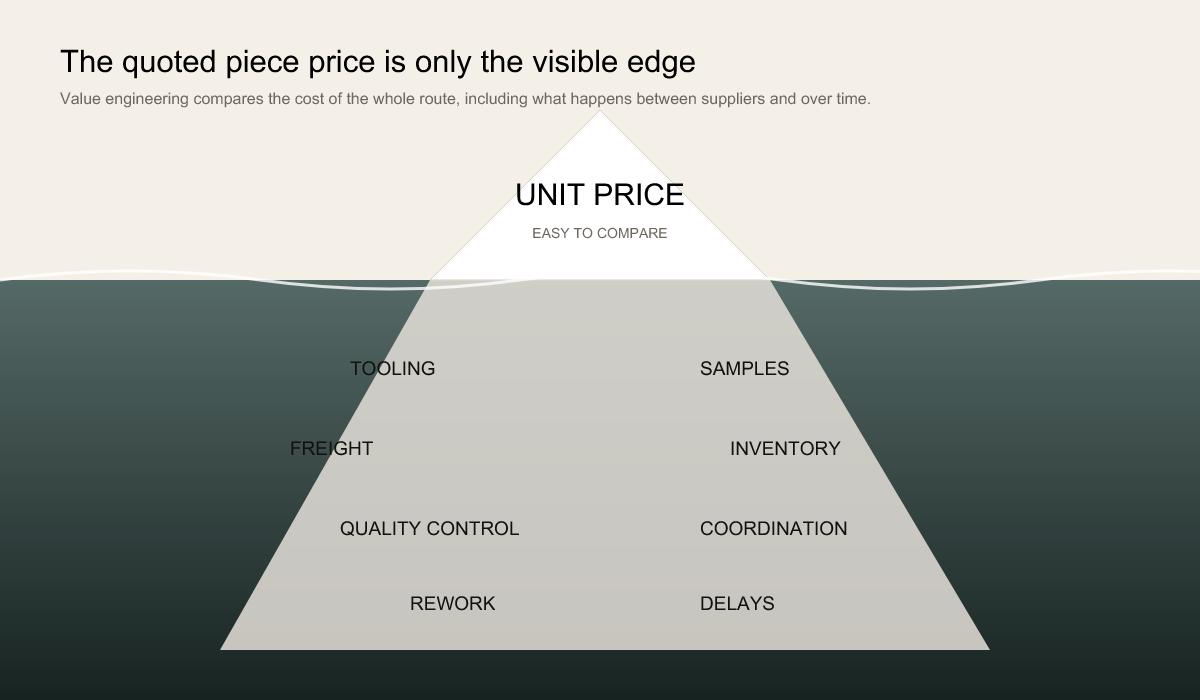
The cost iceberg. Unit price is easiest to compare, while the commercial result is often decided below the quotation line. SVG technical diagram.
Total perfume packaging cost categories
| Investment Route | Consumer Impact | Often Overlooked? | Why It Matters |
| Component price | Yes | Rarely | Necessary baseline, but meaningful only with specification and quantity context |
| Mold and tooling | Usually | Ownership, maintenance and future modification may be | Creates upfront commitment and can become a reusable asset |
| Samples | Partly | Internal review time and repeated freight often are | Each round can add decision time and reveal new dependencies |
| Decoration setup | Sometimes | Masters, matching and approval effort may be | Controls the most visible surfaces and affects repeatability |
| Freight and packing | Often separated | Dimensional weight, extra movements and protective upgrades may be | Heavy glass and large boxes can reshape landed economics |
| Inspection | Varies | Coordination and disposition of nonconforming goods may be | Complex packages need clear acceptance at component and assembly level |
| Assembly | Varies | Fixtures, handling, scratch prevention and yield often are | A beautiful set of parts is not yet a repeatable package |
| Inventory | No | Frequently | Inflexible minimums can trap cash in exclusive leftover components |
| Delay | No | Frequently | Missed retailer or campaign windows can outweigh a small piece-price saving |
| Rework | No | Frequently | Late incompatibility multiplies cost across already-finished parts |
17 · Hidden Cost
Separate value-adding complexity from non-value-adding complexity
Complexity earns its place when it improves recognition, tactility, performance or protection. A custom cap geometry that consumers recognize and reuse across the line can be value-adding complexity. A second metallic finish that looks almost identical but requires another supplier, another master and another sample cycle may be non-value-adding complexity.
Every additional material, supplier, color, component, mold, finish and SKU creates a dependency. Dependencies need specifications, owners, dates and acceptance criteria. They can also create failure paths: a late cap delays box fit approval; a revised coating changes hot-stamp adhesion; a pump substitution changes installed height. Complexity cost is therefore partly financial and partly probabilistic—the package has more ways to become late, incompatible or difficult to reorder.
The remedy is not minimalism for its own sake. It is an explicit complexity ledger. For each exceptional component, the team records the consumer or technical value, the new dependency it creates, the person who owns the interface and the future reuse plan. If the value cannot be stated clearly, simplification deserves consideration.
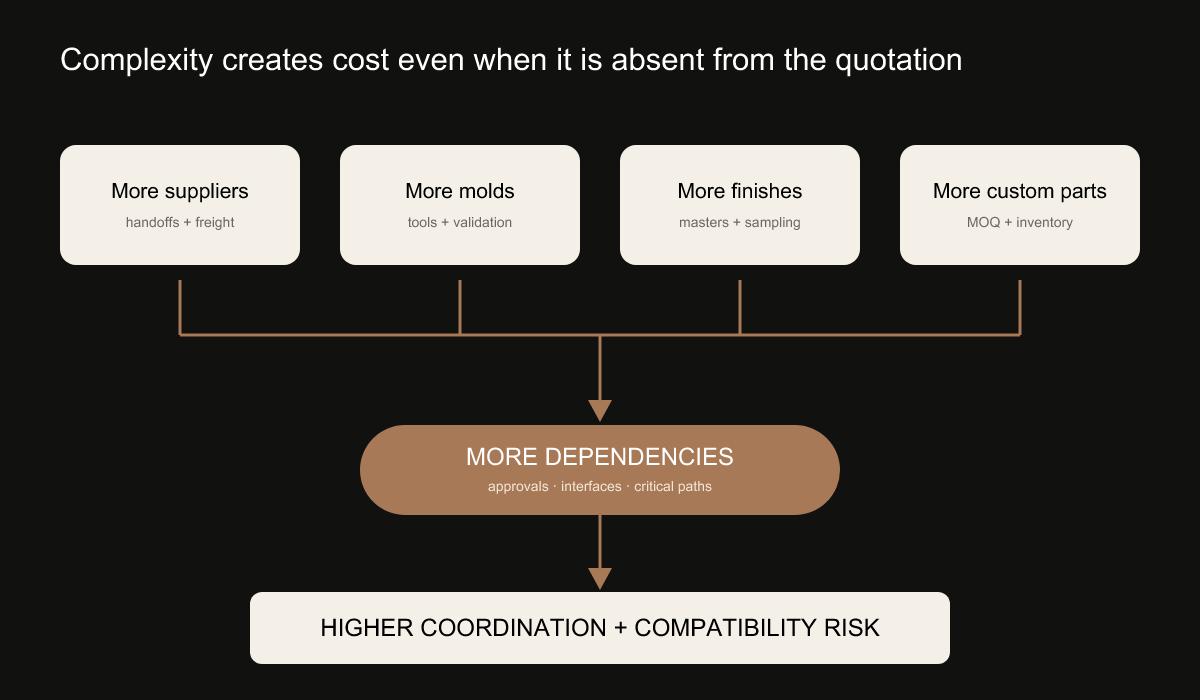
Complexity cost. More parts are not automatically a problem; unmanaged or unrewarded dependencies are. SVG technical diagram.
18 · Time-to-Market
Lead time is also a cost
A cheaper component that delays a launch can be commercially expensive. Tool engineering, mold manufacture, trial production, surface samples, compatibility testing and final approval occur in a dependency chain. Some tasks can run in parallel; others cannot begin until an interface or physical sample is frozen.
A brand with a fixed retailer line review, campaign shoot or seasonal launch values time differently from a founder validating a concept without a hard date. In the first case, an existing bottle plus custom CMF can protect the launch window. In the second, a custom bottle may be worth the longer route because the silhouette is central to the business. Value engineering should expose that choice rather than quietly turning speed into a universal objective.
The schedule should show relative phases, approval owners and the critical path. It should also include decision time on the customer side. A sample sitting unreviewed is still a project delay. No exact duration is published here because actual tooling, capacity, sampling and production availability must be confirmed when the specification is known.
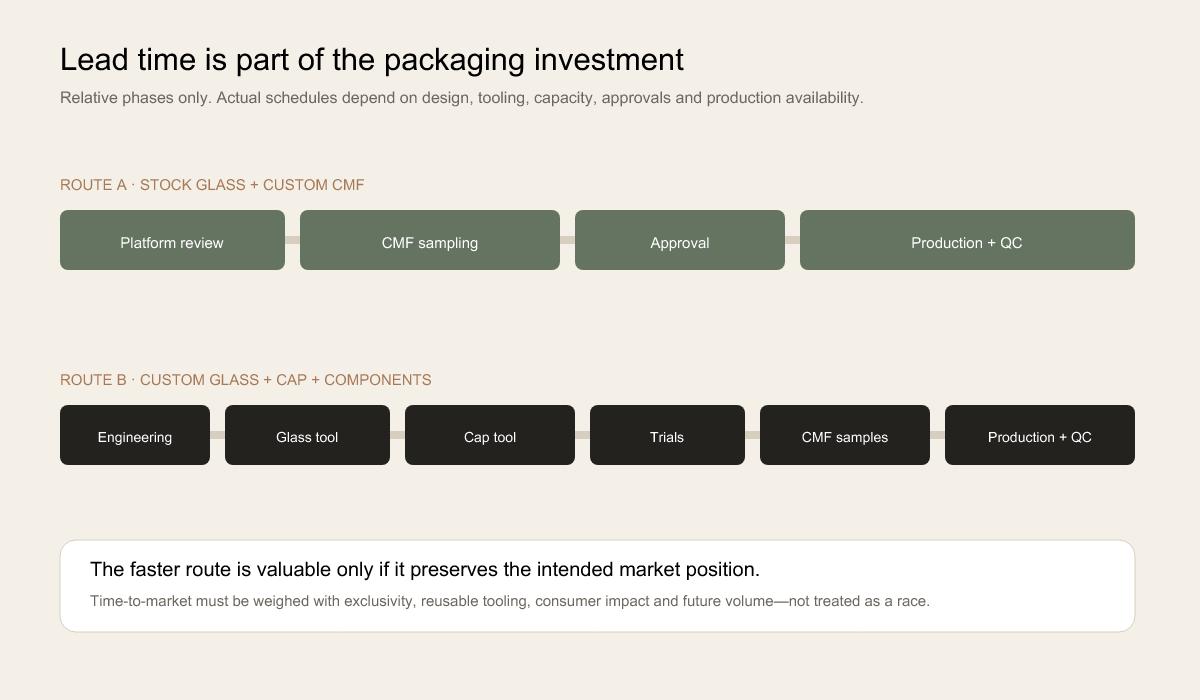
Relative development routes. The diagram compares phases, not calendar days; project scheduling belongs in the value equation. SVG technical diagram.
19 · Long-Term Architecture
Design for the first order—and the fifth order
The cheapest first-order route can become fragile if it depends on a temporary stock lot, undocumented color match or one person’s memory of the assembly. Conversely, a high tooling investment can remain stranded if it solves a one-time aesthetic without supporting future capacities or fragrances. The packaging architecture should be reviewed as a repeatable commercial system.
For repeat orders, the team needs controlled drawings, artwork, color standards, physical masters, approved component references, assembly instructions and ownership of revisions. Supplier continuity and substitution rules matter. If a pump becomes unavailable, the brand should know which dimensions and performance attributes are critical before a replacement is proposed. If a coating is reordered, the approved reference should be more robust than a phone photograph.
Tooling is evaluated against expected lifetime volume, not only the first purchase. A custom cap that can serve five launches may be more rational than a cheaper exclusive accessory that changes for each SKU. An existing bottle can also be a long-term platform when its CMF system is carefully governed. Scalability is not synonymous with custom or stock; it comes from decisions that remain controllable.
Repeatability is a design outcome
A package is scalable when the intended appearance and performance can be reproduced without reconstructing the project history. Documentation and component commonality are therefore part of premium design, even though consumers never see them.
The fifth-order test
Can the same approved components still be sourced?
Are physical color and finish masters controlled?
Who owns the molds, drawings and revisions?
Can a future fragrance share functional parts?
Is substitution governed by performance and dimensions?
Will leftover components remain usable?
20 · Working Capital
Exclusive components create exclusive inventory risk
If every component is unique to one fragrance, leftover stock has few paths to future value. A changed artwork can strand printed caps. A revised bottle can strand inserts. A discontinued finish can leave pumps whose color no longer matches. The cost is not only storage; it is working capital tied to a specification the brand may not use.
Selective commonality can reduce that exposure without creating a generic consumer experience. Several fragrances might share a pump platform, cap insert, collar geometry or undecorated carton structure while differing in coating, artwork, outer cap finish or sleeve. Common components pool demand and can make replenishment more resilient. The multi-SKU implications must still be planned carefully, but the commercial purpose here is inventory flexibility rather than collection coordination.
Brands should ask whether each exclusive component can be reused across a future capacity, limited edition or refill, whether it can be decorated late, and whether neutral stock can be held before final artwork. These are feasibility questions, not guarantees. The preferred approach depends on shelf life, material, finishing route, supplier practice and forecast confidence.
21 · Value-Engineered Direction
Preserve premium perception; remove complexity that cannot defend itself
The plausible final architecture kept the highest-value consumer-facing decisions and challenged the rest. An existing glass platform could be retained if physical evaluation confirmed its proportions, base, decoration area and quality were appropriate. Differentiation would move into a controlled smoke or matte finish, precise logo treatment, a more tactile cap and a disciplined carton. The pump platform and hidden interfaces would remain proven and compatible rather than novel for appearance’s sake.
Tooling would be approved only where it created a reusable signature—potentially the cap or a focused brand element—while the glass mold decision could be phased until forecast, ownership value and silhouette importance were clearer. Physical color and finish standards would connect glass, cap, collar and carton. The packaging would be reviewed assembled, packed and ready for future reorders rather than approved as attractive isolated samples.
This direction is a recommendation framework, not a claim about a completed customer outcome. Final selected bottle, cap material, decoration, carton, tooling route, quantity and measured savings are [FACT CHECK / DAXIN TO CONFIRM]. The commercial result it seeks is clear: budget concentrated where the consumer can reward it, with unnecessary MOQ, inventory and development dependencies removed.
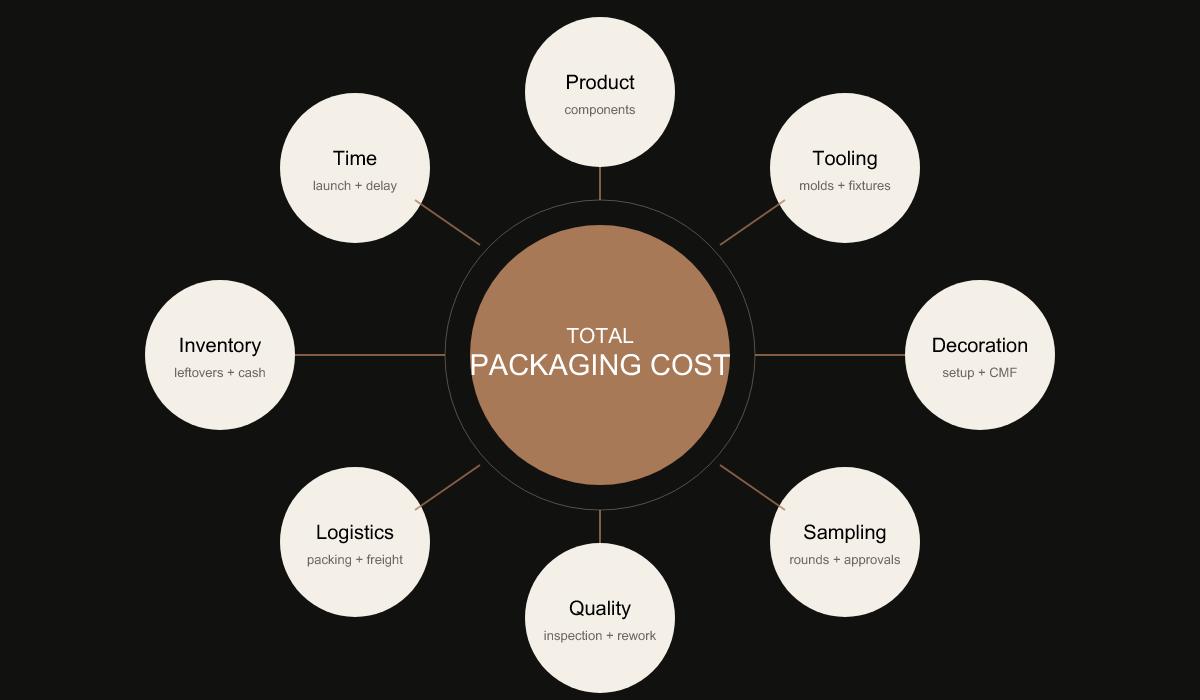
Total packaging cost framework. The final route must make sense as a product, a supply system and a schedule. SVG technical diagram.
22 · Deliberate Restraint
What we chose not to customize—and why that is a premium recommendation
Supplier case studies usually celebrate everything added. Value engineering also documents what was removed. The pump internals did not need a proprietary platform if a proven option could deliver the required spray, fit the selected neck and remain available. Customizing an invisible mechanism without a defined user benefit would create qualification and replacement risk without strengthening recognition.
The neck did not need to become an exclusive interface if a compatible standard could support the pump, collar and cap architecture. A novel neck hidden under the closure would make future sourcing harder while offering little consumer value. The insert did not need elaborate hidden decoration if its real job was to retain, protect and present the bottle cleanly. Decoration budget should be visible during opening, not buried after the product is removed.
A new bottle mold did not need automatic approval merely because it was technically possible. If the brand’s strongest signals were finish, cap and graphic precision, new glass would consume tooling and time without proportional shelf impact. The decision could be revisited when volume, demand evidence or a truly ownable silhouette justified it.
Saying “this part does not need a custom tool” is not a refusal to innovate. It is commercial integrity. It protects budget for the features that consumers experience, reduces the number of minimums and masters the brand must manage, and leaves a clearer route to reorder. The best supplier response is not always the longest list of capabilities; it is an architecture that explains why each capability should or should not be used.
23 · Buyer Lessons
Ten decisions perfume brands should carry into the next brief
1. Premium does not mean custom everything
Consumers experience a coherent object, not a count of bespoke components. Customization is valuable when it creates recognition, tactility, function or protection; otherwise it can add commitment without adding perceived quality.
2. Customize what the customer notices
Rank silhouette, cap, color, finish, logo and opening experience by their role in the brand. A smaller high-touch component may deserve more attention than a large hidden structure.
3. Standardize what the system depends on
Proven neck, pump and insert platforms can reduce qualification and reorder risk when they do not need to carry visible identity. Standardization still requires compatibility and performance validation.
4. Evaluate MOQ at component level
Map glass, every decoration, cap, pump, collar, box and insert separately. The least flexible requirement—not the bottle quantity alone—often determines working-capital exposure.
5. Bottle weight has diminishing returns
Substance and stability can support premium positioning, but more glass also affects carton strength, freight and material use. Target the right perceived weight rather than the maximum physical weight.
6. Decoration can outperform new tooling
When structural silhouette is not the key brand asset, controlled CMF and precise artwork can create a larger visible change per unit of development complexity. Decoration still needs process-specific approval.
7. The lowest unit price can create the highest total cost
Count extra suppliers, freight, samples, inspections, assembly, inventory and rework exposure. A component saving should survive the complete route before it is called a saving.
8. Tooling belongs to the future, not only the first order
Assess whether the mold creates a reusable, ownable asset across likely launches. A tool that solves one transient styling decision may never recover its operational complexity.
9. Complexity is a cost category
Every extra material, finish, supplier and mold creates dependencies. Keep the complexity that customers reward or engineering requires, and challenge the rest before approval.
10. Time-to-market belongs in the value equation
A route that misses a retail or campaign window can be commercially expensive even when its components quote well. Choose speed, exclusivity and tooling commitment against the real launch context.

Smart simplification should still look premium. This generated editorial concept visualizes the design direction; it is not a photograph of the anonymized customer project. Generated editorial visual.
The conclusion is not that stock is better than custom, ABS is better than zamac or decoration is better than glass tooling. It is that each decision should earn its place. Good custom perfume packaging is created by knowing exactly where to invest, where to standardize and how each choice changes brand perception, MOQ, total cost, risk and time-to-market.
Buyer Questions
Perfume packaging value engineering FAQ:
Q: Is a custom perfume bottle mold always necessary?
A: No. A custom mold is rational when proprietary geometry creates durable brand value and the forecast supports tooling, validation and minimum-order commitments. If silhouette is not the primary recognition asset, an existing glass platform with custom color, finish, decoration, cap and carton can be more commercially appropriate.
Q: How can I make a stock perfume bottle look unique?
A: Treat the stock bottle as a proven structural platform, then build identity through a coordinated CMF system: coating or translucency, precise artwork, a distinctive cap, controlled metallic details and a carton opening experience. Compatibility, decoration limits and minimums still need physical validation.
Q: What usually determines the MOQ of a complete perfume package?
A: The package rarely has one independent MOQ. Glass availability, decoration batch size, cap production, pump supply, carton printing and insert structure can each carry a different constraint. The highest or least flexible component requirement often becomes the project bottleneck.
Q: Which perfume packaging component is most worth customizing?
A: There is no universal winner. The best candidate combines high consumer visibility or tactility, strong recognition potential, reusability across future orders and a proportionate tooling or MOQ commitment. For one brand this may be the silhouette; for another it may be the cap or decoration system.
Q: Is a heavier perfume bottle more premium?
A: Additional weight can improve stability, tactile substance and shelf presence, but returns are not unlimited. More glass also affects freight, carton strength, pallet loads and material use. The target should be the right perceived weight for the intended brand position.
Q: Which is better for a perfume cap: ABS, aluminum or zamac?
A: Selection depends on geometry, tactile target, surface finish, quantity, budget and compatibility. ABS offers design and decoration flexibility, aluminum provides a clean metallic skin at relatively low weight, and zamac can deliver density and sculptural form with greater tooling and logistics implications.
Q: Can custom decoration replace custom bottle tooling?
A: Decoration can create a major visual change without altering glass geometry, especially when color, transparency, print, foil and cap finish are coordinated. It cannot create a proprietary silhouette or overcome an unsuitable decoration area, so the answer depends on what the brand needs to own.
Q: Why is the cheapest bottle not always the cheapest packaging solution?
A: A low component price may introduce another supplier, freight movement, sample cycle, inspection, assembly handoff, inventory pool or compatibility risk. Comparing total project cost reveals whether the lower price survives after coordination, rework and time are included.
Q: How should a startup fragrance brand allocate its packaging budget?
A: First protect delivery and compatibility, then identify the few visible or tactile decisions that create recognition. Use proven platforms where exclusivity has little consumer value, test demand before large tooling commitments, and preserve controlled files and masters for reorders.
Q: How can brands reduce perfume packaging lead time?
A: Reduce unnecessary tooling, choose available compatible platforms, freeze critical interfaces early, sample representative high-risk conditions first and avoid late CMF or artwork changes. A dependency-based schedule is more useful than a single promised duration.
Q: How should tooling investment be evaluated?
A: Evaluate consumer impact, exclusivity value, expected future volume, ability to reuse the tool, technical risk, validation route, lead-time effect and inventory consequences. Tooling should support a repeatable brand asset, not merely prove that a part can be made.
Q: What information does DAXIN need to evaluate a perfume packaging project?
A: Share bottle capacity, expected quantity, target market, target price range, reference packaging, preferred silhouette, cap and pump direction, decoration ideas, artwork status, launch schedule and any filling-line constraints. Unresolved items can be identified during the architecture review.