A rendering is a design communication tool, not manufacturing proof
Use it to align silhouette, finish intent and brand character. Ask physical samples to prove geometry, assembly, optical behavior and process capability.

The Rescue Brief
1
Starting point
Advanced visual concept and assembled physical samples
2
Core risk
Individually acceptable parts producing an unacceptable system
3
Method
Symptom → evidence → interface → hypothesis → test → correction → verification
4
Objective
Protect design intent while reducing production uncertainty
01 / The physical sample changed the brief
On screen, the package appeared finished. The bottle held an elegant rectangular proportion, the cap sat exactly on the centerline, the champagne-metallic surfaces agreed with one another, and the decoration occupied a disciplined field. The rendering communicated a premium fragrance object with no visible conflict. The physical sample told a different story.
The cap-to-bottle transition did not feel resolved. A collar that had almost disappeared in the digital view became visually prominent under real light. The bottle, pump and cap could be assembled, yet the completed silhouette looked less deliberate than the concept. Color shifted when the same target moved from transparent glass to opaque plastic and reflective metal. Artwork that was balanced on a flat screen behaved differently near a curved shoulder and a real bottle edge. These symptoms form the anonymized rescue scenario used in this draft; the exact project sequence and observed components are [FACT CHECK / DAXIN TO CONFIRM].
The important change was not a new aesthetic direction. The customer already had a strong design direction. The job was to discover why the physical system was failing to express it—and to reduce the chance that a corrected show sample would conceal the same risk until production. That changed the question from “How should this bottle look?” to “Which interaction prevents the assembled package from looking and behaving as intended?”
This distinction matters in custom perfume bottle development. A rendering can communicate proportion, finish intent and brand character. It cannot prove glass distribution, installed pump height, cap retention, coating build, decoration transfer, assembly repeatability or transport protection. Those are physical relationships. They become visible only when materials, processes and tolerances meet.
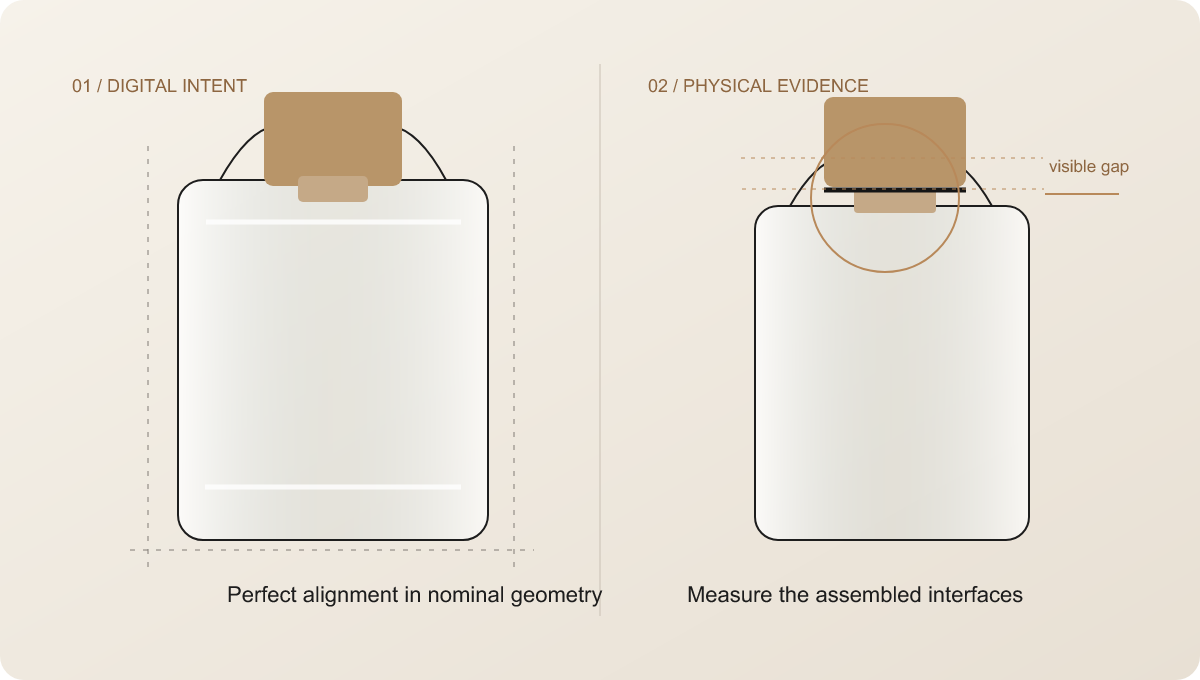
Rendering intent vs physical evidence. The visual concept describes the target; the sample reveals the interfaces that must be measured.
02 / Hidden until assembly
A perfume package is not one object. It is a sequence of connected parts: glass bottle, neck finish, pump gasket and ferrule, actuator, collar, cap or cap insert, decoration and shipping pack. Each part may be drawn by a different team, made from a different material and produced by a different process. CAD often represents each interface at a clean nominal value. Manufacturing creates a distribution around that value.
Glass adds particular complexity. It is formed from a hot, moving material in a mold, not machined as a finished block. Neck geometry, shoulder transition, wall distribution, base mass and cooling conditions are related. A pump ferrule then forms around the bottle's threadless crimp finish during installation. A collar references the installed pump or bottle. A cap insert may reference the collar, actuator or another retention feature. Finally, an operator or assembly machine brings the stack together with its own locating conditions and force.
Problems also appear late when components are approved separately. A bottle supplier checks the neck against its drawing. A pump supplier checks its ferrule. A cap supplier checks outer size and insert depth. Each report may be correct. Yet no report answers the customer's decisive question: does the full fragrance packaging system remain visually and mechanically acceptable across realistic variation? A package must be inspected vertically, through each component, and horizontally, across repeated assemblies.
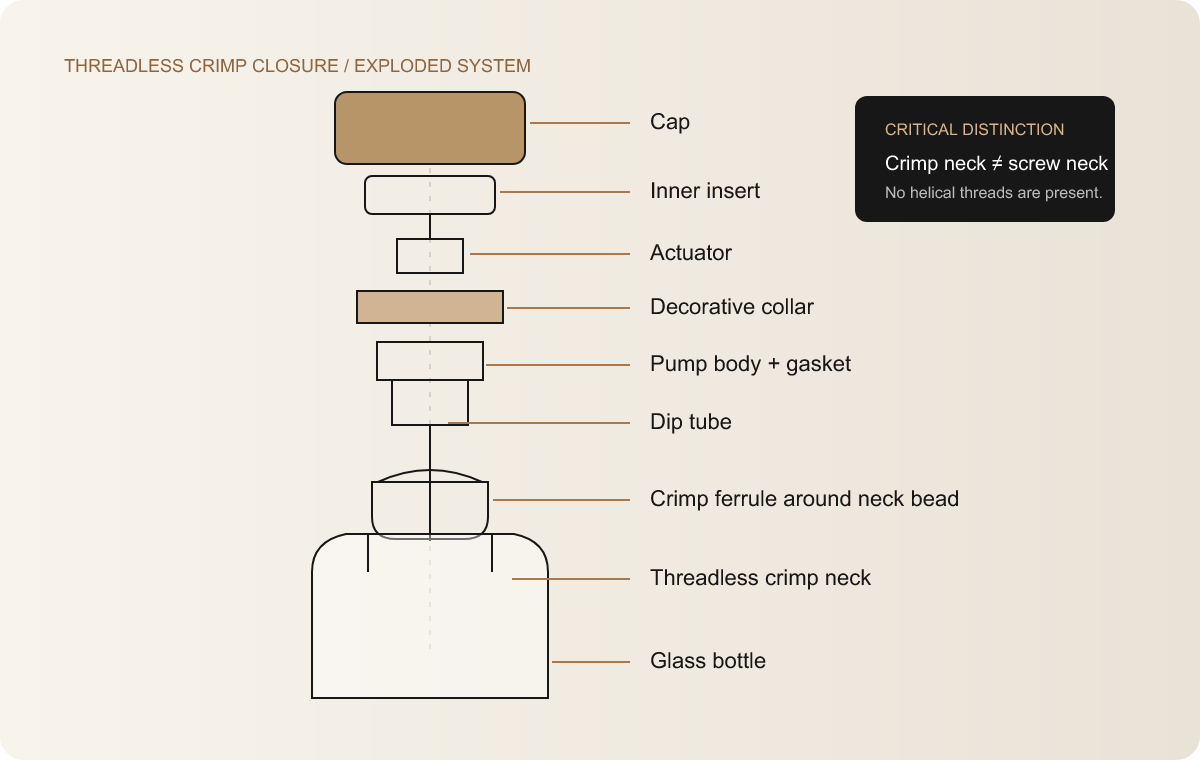
The assembled system. Every arrow represents an interface; a correct crimp-neck illustration has a bead and ferrule, not screw threads.
03 / Restraint before correction
When an assembled perfume bottle looks wrong, the fastest-looking response is often to change the most visible part. That is not necessarily the fastest route to a stable result. A cap that sits high might be responding to the bottle neck, the installed pump, the collar, the cap's internal insert or the assembly sequence. Changing the external cap mold before isolating those variables can preserve the symptom, add tooling work and make the next sample harder to interpret.
The diagnostic method begins by describing the symptom without naming a culprit. “The cap supplier failed” is a conclusion. “The visible circumferential gap is larger on one side and varies between assemblies” is evidence. The second statement can be measured, photographed under consistent light and compared against interface dimensions. It opens several testable hypotheses instead of closing the investigation prematurely.
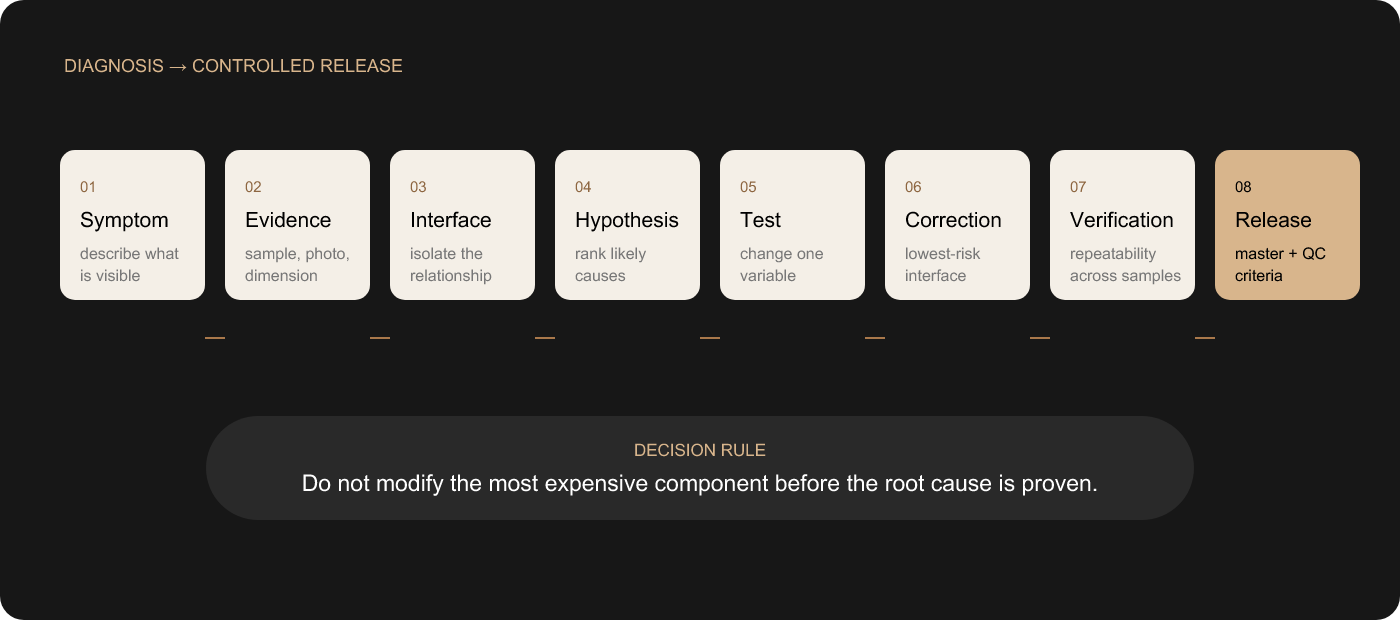
Controlled diagnosis. A corrective action is justified by evidence and released only after repeatability is demonstrated.
04 / The visual interface
Luxury fragrance packaging is unusually sensitive to transitions. The eye does not see a cap, a collar and a shoulder as independent procurement lines. It reads one silhouette. A small change in vertical position can expose more collar, weaken the connection between cap and bottle or make the cap appear undersized. A gap can be uniform and still be too prominent. It can also be nominally narrow but visually poor because one side closes and the other side opens.
This is where technical tolerance and visual tolerance diverge. Technical tolerance asks whether a component lies within an agreed dimensional range and continues to perform its intended function. Visual tolerance asks whether the assembled result remains consistent with a premium design language. A dimension can pass the first test and fail the second. Conversely, an extremely tight visual target that leaves no room for real manufacturing variation can create an unbuildable specification.
The solution is not to demand “zero tolerance.” It is to define the consumer-facing relationship, locate the datums that create it and assign realistic controls to the chain. The target may be a deliberately fine, uniform shadow line rather than no gap at all. The collar may be designed as an intentional visible element instead of an accidental sliver. The cap insert may absorb variation while the outer cap preserves the critical silhouette. These are architecture decisions, not last-minute cosmetic inspection.
In the project framework, cap position was treated as a system output. The exact gap symptom, cap construction and selected correction remain [FACT CHECK / DAXIN TO CONFIRM]. The publishable lesson is independent of those facts: do not alter the glass or external cap until the team knows which datum controls the final visible transition.
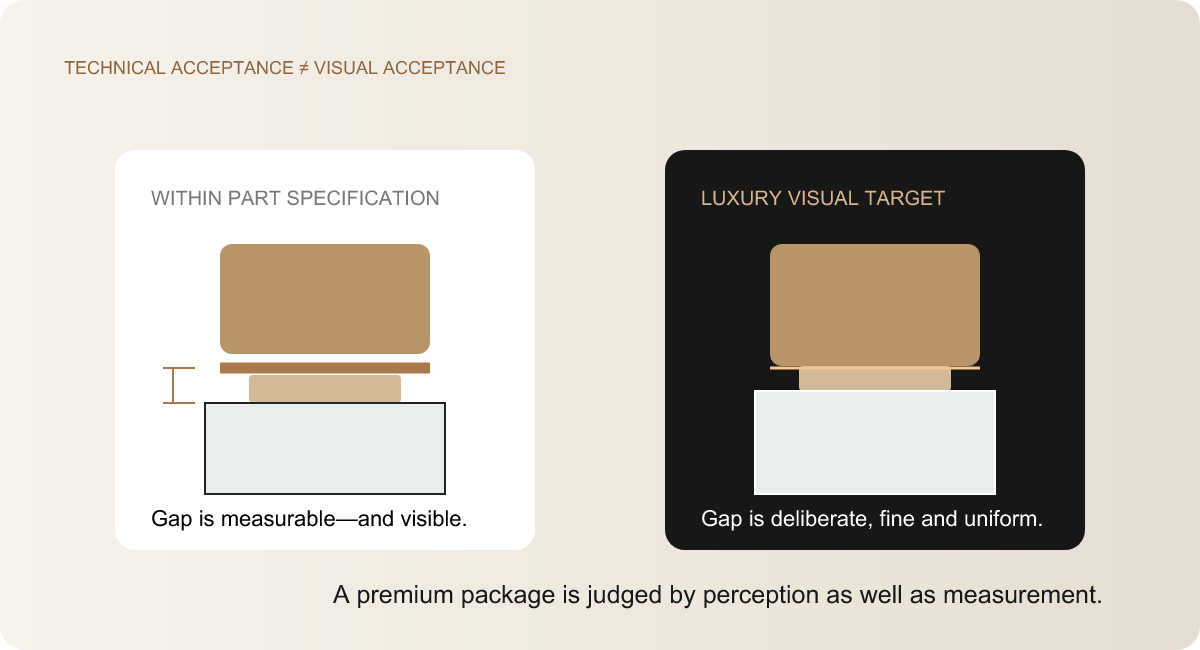
Two acceptance systems. The right target balances a premium shadow line with the variation a repeatable assembly can sustain.
05 / The hidden dimension chain
Tolerance stack-up is the combined effect of allowed variation from several dimensions on one final relationship. In a perfume closure, bottle neck height may vary around its nominal condition. The installed pump position may vary because the ferrule forms around the neck. A collar has its own depth and contact surfaces. The cap insert has a retention position. Assembly introduces alignment and seating variation. The final cap gap reflects all of them.
Imagine—not as project data, but as logic—that the neck is toward the high side of its range, the installed pump is also high and the cap insert seats the outer cap slightly shallow. No single part must be defective. Their directions simply add. A second assembly may combine a low neck, lower pump position and deeper insert, producing a visibly different gap from equally compliant components. Inspection certificates for individual parts will not reveal that system behavior unless the assembled chain was part of the specification.
The engineering objective therefore changes. “Are the parts within specification?” remains necessary, but it is insufficient. The stronger question is: “Does the assembled package remain functional and visually acceptable across credible combinations of component and process variation?” Answering it may require a stack analysis, measured samples, controlled component swaps and pilot assembly. It also requires a clear definition of which output matters—cap gap, overall height, collar visibility, actuator clearance, retention or some combination.
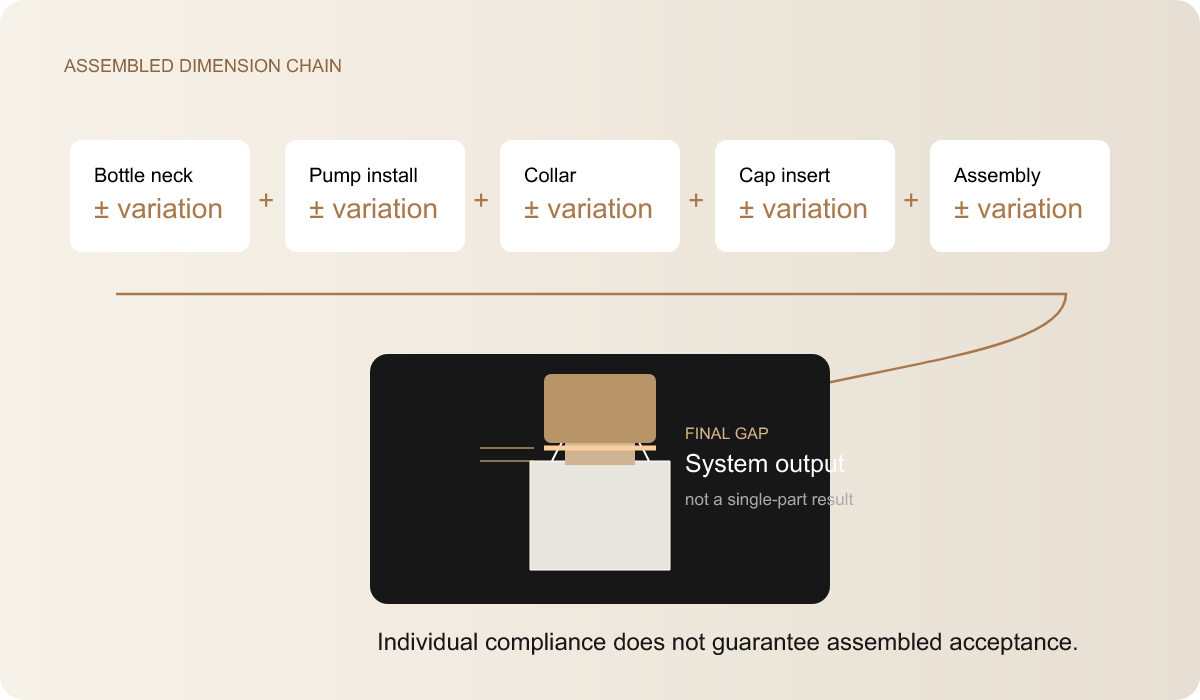
The signature risk. Individually acceptable variation can accumulate into a visible system failure.
06 / Functional architecture
A standard crimp-neck perfume bottle does not use screw threads. The bottle finish includes a threadless bead and related geometry. During pump installation, the metal ferrule is formed around the finish while a gasket supports the sealing relationship. Above that interface sit the pump body, actuator and decorative collar. The cap may retain on an insert, collar feature or another designed surface. Confusing crimp and screw architectures is not a minor drawing error; it changes how the package is assembled and controlled.
A nominal designation such as “15 mm crimp” is useful, but it should not be treated as complete proof that any pump will fit any bottle carrying the same headline size. The exact neck profile, ferrule, gasket, pump cup, installation tooling and intended assembled height matter. The pump's dosage and spray quality matter to product delivery. Dip-tube length and cut are capacity-specific. The fragrance formula and gasket compatibility may matter to sealing and material performance. The filling line needs to handle and crimp the selected assembly consistently.
A mismatch can reveal itself indirectly. A pump that installs at the wrong height can push the collar and cap upward. A ferrule that does not form consistently can create variable cap position even if the cap never touches the bottle neck directly. A collar bore can bind on a pump feature. An actuator may lose clearance under a cap. The visible symptom may therefore be “cap fit,” while the root cause sits lower in the closure stack.
DAXIN's public perfume sprayer options and custom cap and pump sourcing provide the component context. For a rescue project, availability is only the beginning. The relevant pump must be validated against the actual bottle, assembly process, collar and cap. Any project-specific pump designation, gasket, dosage, crimp setting or compatibility result in the final case requires [FACT CHECK / DAXIN TO CONFIRM].
07 / Forming reality
Premium fragrance design often asks glass to express mass and precision simultaneously: a visually heavy base, broad flat faces, crisp corners, controlled shoulders and an apparently centered internal cavity. These features are compelling because they create weight, optical depth and architectural light. They can also make stable glass distribution more demanding.
Molten glass must enter and form against the mold while maintaining enough workable temperature to distribute through the body. Abrupt transitions, narrow corners and large differences between thick and thin areas influence that movement. A very heavy-looking base is not simply an external block added in CAD; it is related to internal bottom geometry, glass weight, forming, cooling and the optical result. Large flat walls can reveal waviness or asymmetry more readily than textured surfaces. Sharp shoulders can concentrate visual and forming sensitivity at the transition into the neck.
For a B2B buyer, the point is not to become a glass-forming specialist. It is to recognize the trade-off early. A photorealistic rendering can make every wall perfectly even and every corner infinitely controlled. Production engineering has to decide which radii, transitions, internal contours and weight distribution support a repeatable physical result while keeping the recognizable design language.
In a rescue review, several symptoms might trigger glass investigation: rocking on a reference surface, variable overall height, inconsistent shoulder optics, unstable wall appearance, difficult decoration registration or an assembled closure that changes with neck variation. None proves the glass is at fault by itself. Undecorated samples, dimensional evidence, section understanding and the behavior of alternative components help establish whether mold or forming changes are justified.
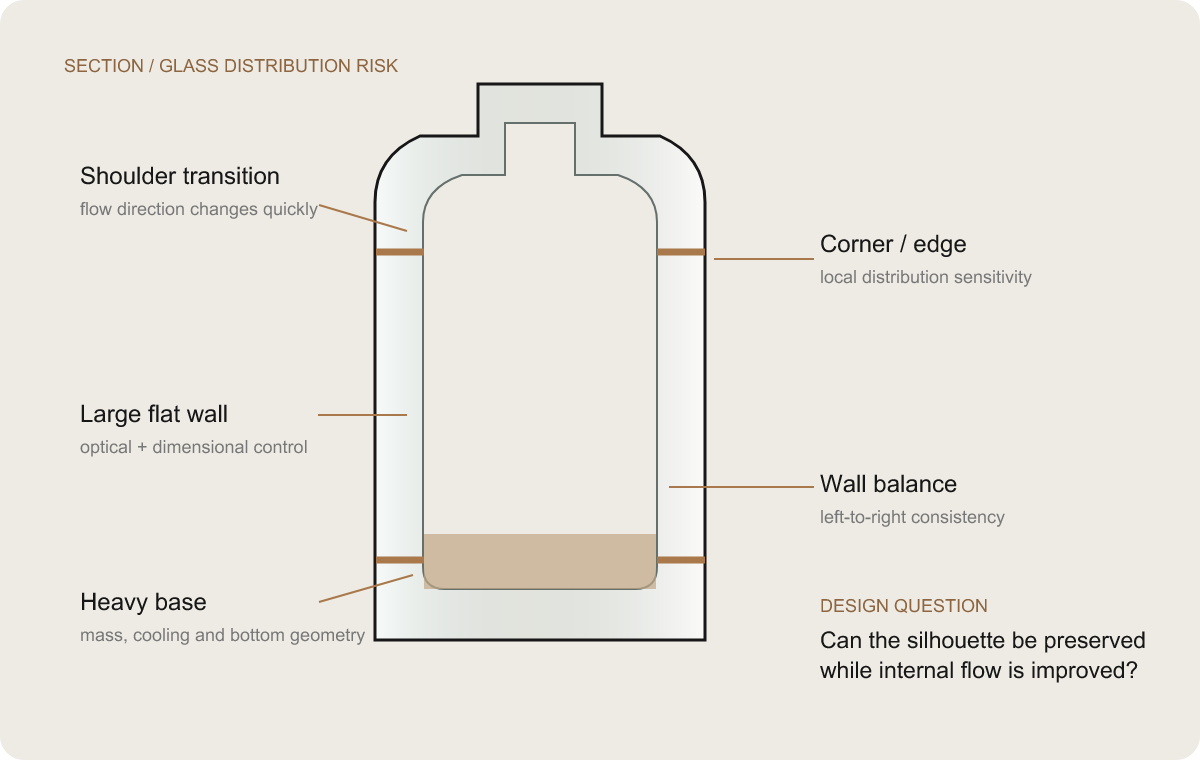
Luxury geometry meets forming reality. The heavy base, broad walls, shoulder transitions and corners influence one another.
08 / Engineering without dilution
Weak engineering simplifies a difficult design until the distinctive idea disappears. Strong engineering identifies which visible and tactile signals make the object valuable, then searches for less visible changes that improve production reliability. The consumer may care about the rectangular stance, broad front face, heavy optical base, shoulder rhythm and cap alignment. They are less likely to perceive a subtle internal radius, refined bottom contour or redistributed transition that preserves those signals.
The decision hierarchy should begin with design intent. What must remain recognizable? Which view carries the brand? Which surface must accept decoration? Which edge creates the premium highlight? Once those invariants are clear, the team can consider a radius refinement, shoulder transition, internal glass distribution, bottom structure, wall balance or neck transition. Any exact geometry change made in the real project is [FACT CHECK / DAXIN TO CONFIRM]; this diagram explains the principle rather than claiming a recorded modification.
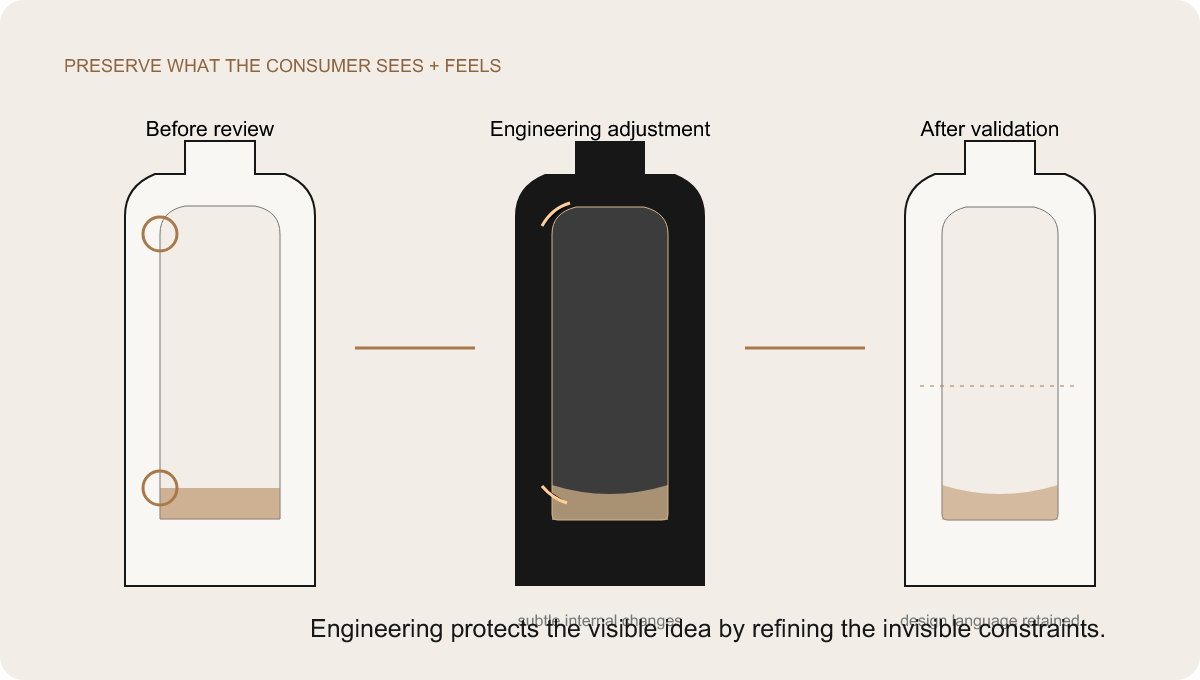
Subtle intervention. Preserve the external idea; refine the internal conditions that support repeatability.
09 / Color is a physical event
A Pantone reference, digital swatch or approved rendering is essential communication, but it is not the final physical appearance. A transparent spray on clear glass is seen through front and rear surfaces, against liquid, air and whatever sits behind the bottle. An opaque coating creates a different color body. Matte level changes reflected highlight size. Gloss can deepen apparent saturation. Coating thickness, spray consistency and curing affect opacity and surface.
Lighting and viewing geometry compound the difference. A warm studio rendering may make champagne and stone tones agree. A cool retail light can expose undertone differences. Metallic particles rotate and sparkle with angle. A color that appears balanced face-on may shift on a shoulder. Photographs introduce camera white balance, exposure, compression and display calibration. Sending phone images between suppliers is useful for discussion, but it is a weak approval standard for subtle premium color.
The practical response is to define what the color target applies to and approve it physically. Is the target the coated empty bottle, the filled bottle, or the package under a specified viewing condition? Is the matte level part of the master? Is a tolerance range described by boundary samples? Which sample becomes the retained reference for production and later reorders? These questions turn “match the Pantone” into an executable color-control plan.
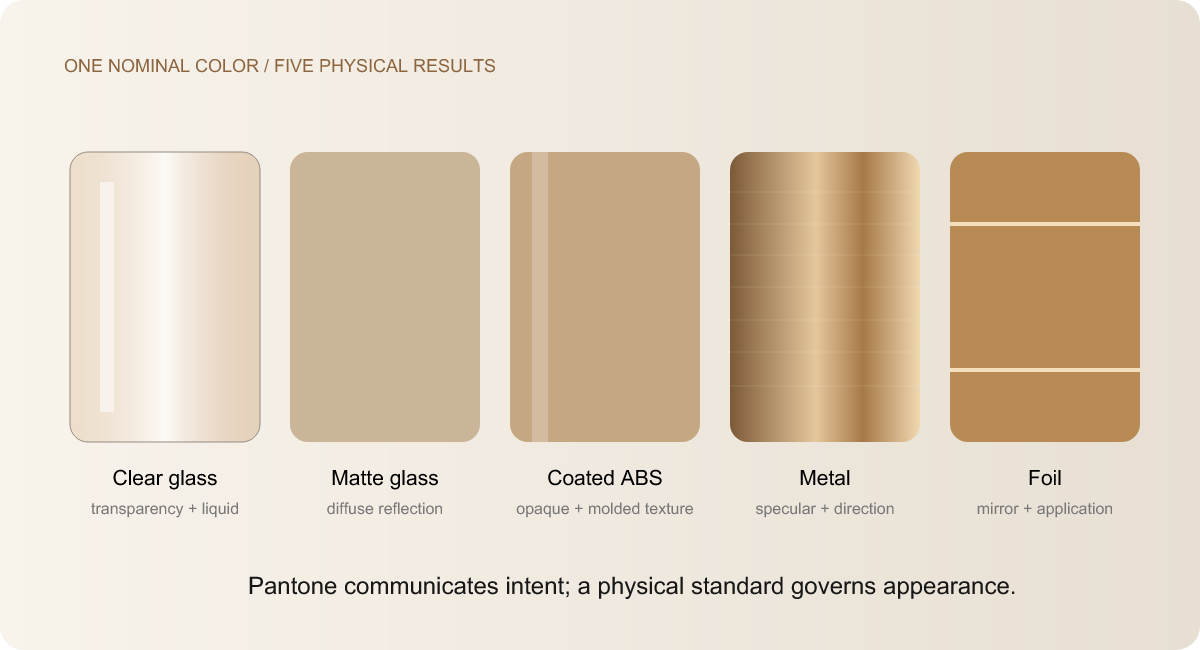
The substrate speaks. One nominal target produces different optical results on transparent, diffuse, opaque and reflective materials.
10 / Cross-material CMF
A perfume package may use the word “gold” for a metallized ABS cap, an aluminum collar, a plated zamac detail, hot-stamping foil and printed decoration. Their color names can match while their appearances do not. Each substrate and process constructs reflectivity differently. Metallization deposits a reflective layer on plastic. Aluminum may be anodized, lacquered or mechanically brushed. Zamac can receive plating over a prepared surface. Foil transfers a thin reflective layer through heat and pressure. Paint depends on pigment, binder, thickness and gloss.
Exact optical identity may be neither practical nor desirable. A brushed aluminum collar will never reflect exactly like mirror foil. The design goal may instead be a controlled family: consistent hue and temperature, with intentional differences in brightness and texture. That decision must be made with all parts together. Approving the cap alone under one lamp and the carton foil later from a photograph invites a surprise at final assembly.
A physical master standard anchors the family. The team can choose the most visually dominant gold—often the cap or another large component—as the reference, then tune adjacent materials relative to it. Viewing conditions, acceptable differences and master retention should be documented. Digital values remain useful for file transfer, but physical CMF approval governs the finished package.
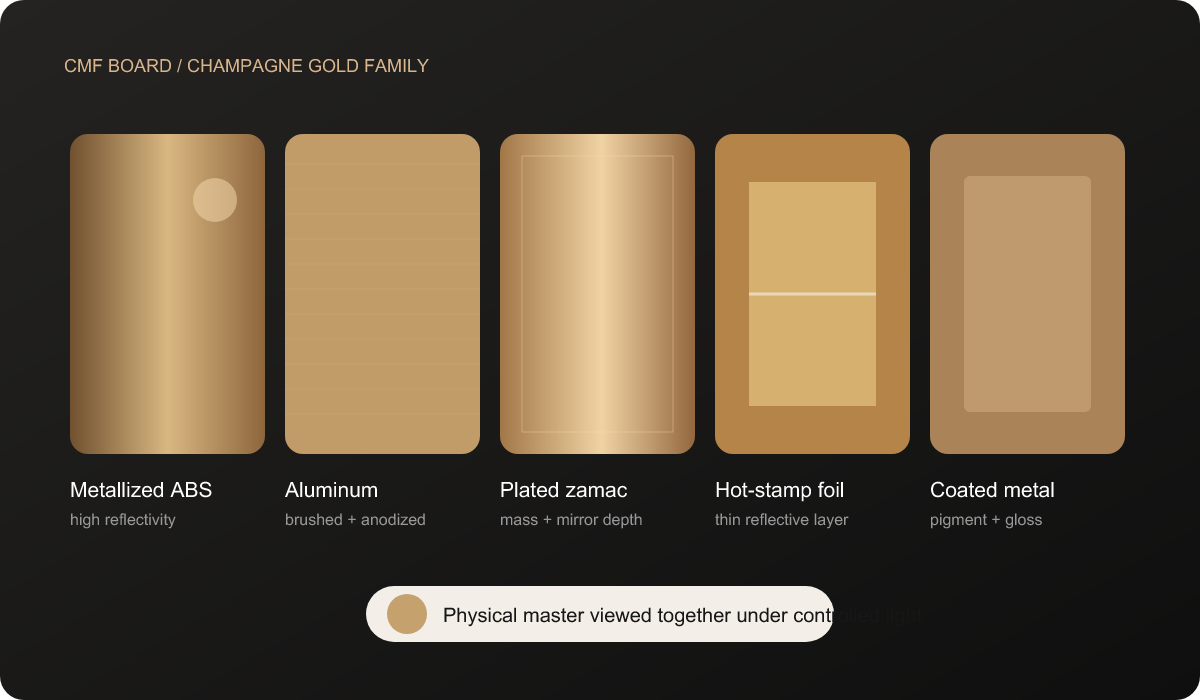
Gold is a material system. Hue, reflectivity, texture and process must be judged as one physical family.
11 / Artwork becomes process
Adobe Illustrator shows ideal vectors on an ideal plane. A perfume bottle presents a three-dimensional surface, manufacturing variation and a specific decoration process. Screen printing deposits ink through a mesh and depends on line weight, opacity, surface preparation, fixture and curing. Hot stamping transfers foil through heat, pressure and contact. Coating changes the surface underneath. Curvature changes how artwork is viewed and how a tool reaches the surface.
Fine lines that look elegant on screen may become weak, uneven or visually lost. Very small text may not maintain legibility. A large foil area can reveal transfer variation more than a compact mark. Artwork close to an edge has less registration margin. A logo that is mathematically centered on the file can appear optically low because of the shoulder, base mass or cap. Front-to-back alignment depends on a reliable bottle datum and fixture.
The decoration review should therefore move from artwork intent to process feasibility. Identify the usable decoration field, minimum feature behavior, optical center, registration datum and viewing zone. Produce a physical sample on the intended bottle finish. Compare scale, position, density, foil character and edge quality as part of the assembled package—not as a detached logo proof. DAXIN's decorating and finishing page establishes the available process context; the exact decoration route, artwork change and approval result for this case are [FACT CHECK / DAXIN TO CONFIRM].
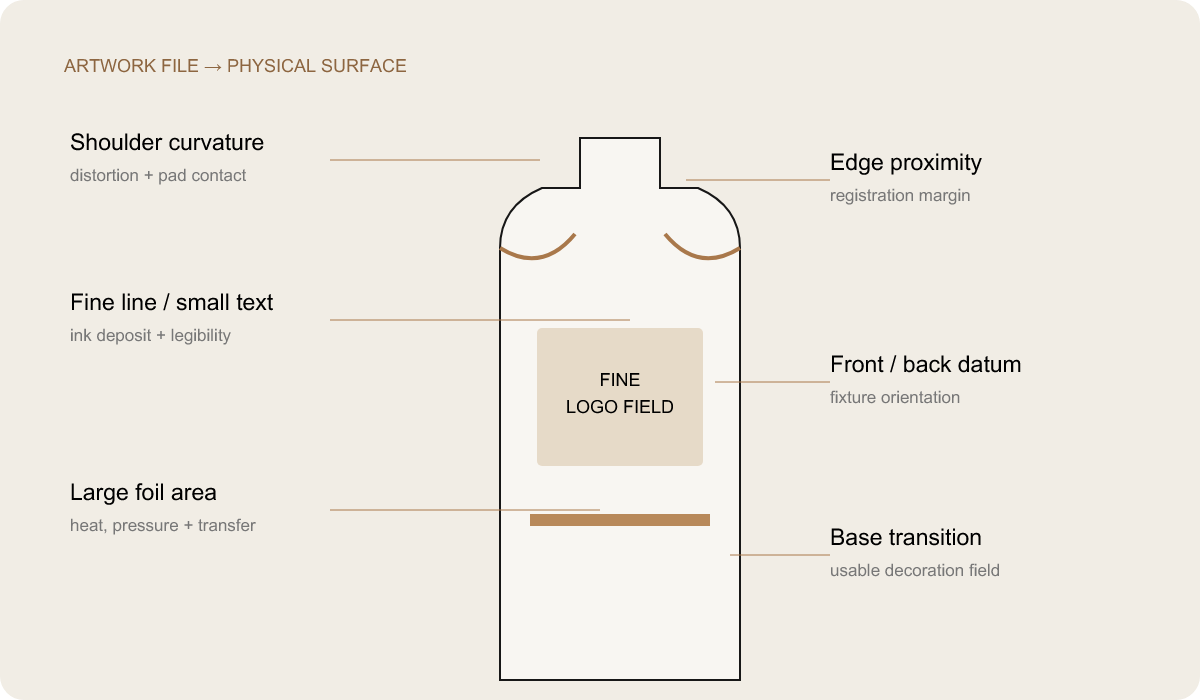
Artwork translation. The vector file defines intent; bottle geometry, coating and process define the physical result.
12 / Two acceptance languages
Functional quality answers whether the package can be assembled, actuated, handled and protected as intended. Cosmetic quality answers whether the consumer-facing object presents the approved color, gloss, geometry, alignment and decoration. Luxury perfume packaging needs both. A beautiful cap that interferes with actuation is unacceptable; so is a fully functional bottle whose tilted cap makes the brand feel inexpensive.
The categories overlap. An uneven pump installation can be a functional risk and the source of a cosmetic gap. A coating defect can be visual, but coating on a fit surface can also change assembly. A bottle that rocks is structurally stable enough to stand yet still presents poorly. Separating the categories helps the team define evidence and ownership, while evaluating the final system prevents the separation from becoming a blind spot.
| Area | Cosmetic requirement | Functional requirement | Why both matter |
| Cap and collar | Centered, consistent transition, approved finish | Retention, clearance and repeatable assembly | The closure is touched and seen before the fragrance is used |
| Bottle | Symmetry, optical quality, stable color and surface | Capacity, structural integrity, neck compatibility and stable base | The glass is both the primary structure and the visual brand object |
| Pump | Actuator and collar alignment, finish consistency | Correct mounting, actuation and product-delivery performance | A hidden installation issue can alter the visible cap position |
| Decoration | Scale, position, density, edge and gloss | Adhesion and suitability for handling and packing | A perfect first impression must survive the distribution chain |
| Transport pack | Clean presentation on arrival | Movement, compression and contact control | Protection preserves every cosmetic decision already paid for |
13 / Solve the customer's system
Perfume packaging commonly crosses several organizations: glass producer, pump supplier, cap or insert maker, decorator, metal processor, carton supplier, filler and assembler. When a problem appears, each supplier may demonstrate that its component meets its drawing. That protects a purchase order; it does not rescue the launch.
The investigation should end with a testable corrective action and a verification condition, not a meeting note that says “supplier to improve.” Improvement must have an object: change an insert stop, refine a collar height, control pump installation, adjust a decoration field, modify glass geometry or revise packing contact. The precise action depends on proof. DAXIN's project-management capability is relevant because the buyer needs one view of the assembled system, even when production crosses suppliers.
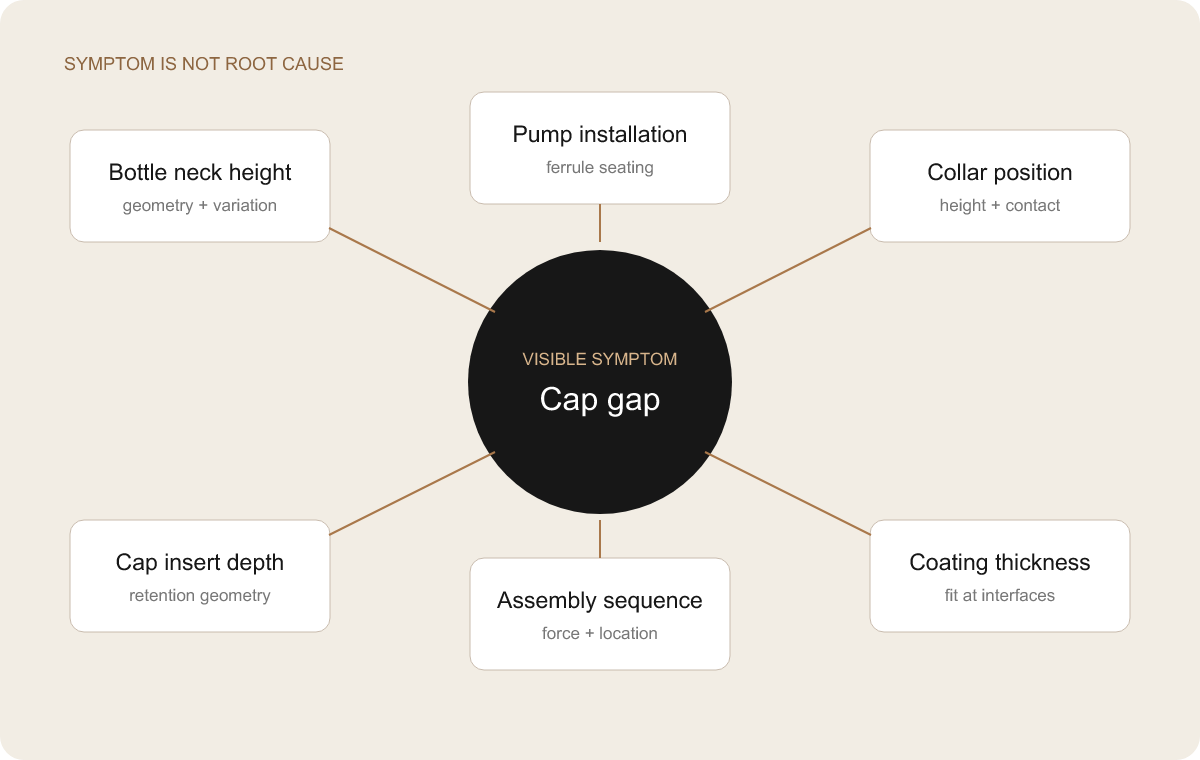
One symptom, several hypotheses. The visible component is not automatically the causal component.
14 / Correct at the best interface
The best correction is not always the change closest to the symptom. The decision should compare tooling impact, schedule impact, production risk, visual impact and reversibility. A plastic insert may be easier to adjust than a finished glass mold. A collar-height change may preserve bottle geometry. A pump change may solve an installed-height problem but create dosage, finish or filling-line work. These are examples of decision logic, not universal rules.
Glass changes deserve particular restraint because they can influence forming, capacity, decoration and every component that references the bottle. That does not make the mold untouchable; it makes evidence essential. If bottle geometry is the root cause and a subtle revision improves the system, avoiding the change only transfers risk downstream. The aim is not the cheapest isolated part. It is the lowest total-risk correction for the package.
| Problem | Glass change | Pump change | Cap / insert change | Decoration change | Decision considerations |
| Cap sits high | Only if neck geometry or height is proven causal | Consider if installed position drives the stack | Consider stop depth, retention or internal clearance | Unlikely to solve geometry | Measure the full vertical chain first |
| Uneven shadow line | Consider top-plane or neck perpendicularity evidence | Check tilt after installation | Check insert centering and cap flatness | Use only if contrast exaggerates a technically acceptable line | Rotate and swap components to see what the symptom follows |
| Logo distortion | Consider only if required field geometry is unsuitable | Not relevant | Not relevant | Usually first route: scale, line, datum, process or field | Protect brand intent while respecting the physical surface |
| Gold mismatch | Not normally geometric | Finish route may change | Finish, substrate or supplier may change | Foil or ink may be tuned | Approve all parts against one physical master |
| Shipping scuff | Surface durability may be reviewed | Protect exposed actuator if relevant | Finish durability and contact points matter | Coating and artwork location matter | Start with pack contact and movement evidence |
15 / A decision record
A matrix prevents the rescue from becoming a series of disconnected sample requests. Each row links a visible problem to possible causes, risk, controlled action and verification. The entries below are analytical examples; they do not claim project-specific test results.
| Problem | Possible cause | Component involved | Risk if unresolved | Possible corrective action | Verification method |
| Cap gap too large | Accumulated vertical position | Neck, pump, collar, insert | Premium silhouette appears disconnected | Correct the proven datum at the lowest-impact interface | Measure and visually compare repeated assembled samples |
| Gap uneven | Tilt, flatness or off-center retention | Pump, collar, cap insert, bottle | Inconsistent appearance and possible rubbing | Control perpendicularity, centering or contact surface | Rotational gap map and component-swap study |
| Pump fit uncertain | Neck/ferrule/gasket mismatch | Bottle neck and pump | Variable installation and closure height | Select compatible specification or adjust approved installation | Installed samples plus relevant functional assessment |
| Gold family disagrees | Different substrates and finish routes | Cap, collar, logo, carton foil | Fragmented CMF expression | Set anchor master; tune hue, gloss and texture by substrate | Side-by-side viewing under agreed light |
| Decoration weak or distorted | Artwork/process/surface conflict | Bottle coating and decoration | Reduced legibility or premium perception | Refine artwork field, line weight, process or fixture datum | Physical decorated samples on intended finish |
| Bottle unstable | Bottom geometry or distribution variation | Glass bottle | Rocking, assembly or presentation concern | Prove cause, then refine geometry or forming control | Several undecorated samples against agreed datum |
| Shipping abrasion | Contact, movement or divider weakness | Bottle, cap, divider and carton | Value added by decoration is lost in transit | Isolate surfaces, control movement and strengthen support | Pack-out and route-appropriate transport validation |
16 / Proving the correction
A corrected sample can be encouraging and still be misleading. It may combine unusually favorable parts, receive extra hand fitting or avoid the normal assembly sequence. Verification asks whether the correction holds across several samples, relevant dimensions and realistic variation. The number of pieces and exact tests depend on risk; a universal quantity would be false precision.
The plan should state what changed, what stayed constant and what proves success. For a cap-gap correction, check multiple assembled units, gap uniformity, overall height, retention, actuator clearance and the behavior of samples from different component positions. For color, compare against the physical master and boundary references. For decoration, check position, line quality and adhesion appropriate to the process. For packing, use final decorated surfaces and the real cap, not undecorated substitutes that hide abrasion.
Verification also protects against moving the problem. A deeper insert may reduce the gap but interfere with the actuator. A tighter cap may improve alignment but damage a collar finish. A geometry change may stabilize glass and shrink the usable decoration field. Corrective action is complete only when connected requirements have been reviewed and the approved result becomes a drawing, master sample, assembly criterion or QC checkpoint.
17 / Repeatability is the product
A prototype answers, “Can we make this?” It proves that the concept can exist. A production-ready sample asks a harder question: “Can the relevant suppliers repeatedly manufacture, decorate and assemble this package within an agreed acceptable range?” One beautiful unit may depend on selected components, manual adjustment and ideal conditions. Production introduces normal variation, more operators, more cavities, more material lots and more handling.
A production-ready approval therefore includes the surrounding control system. Drawings identify critical interfaces. Physical masters govern attributes that screens cannot. Assembly criteria explain how the components come together. Approved boundary samples clarify cosmetic judgment where useful. Quality checkpoints occur before value-adding stages make recovery more difficult. Export packing is based on the actual decorated package.
This is why “sample approved” can be an ambiguous milestone. Did the sample approve silhouette only, or final glass? Did it include the intended pump installation? Was the color a hand-matched development spray? Was the cap made by production tooling? Did the decoration use the released process? A robust approval names the status and limitations of the evidence.
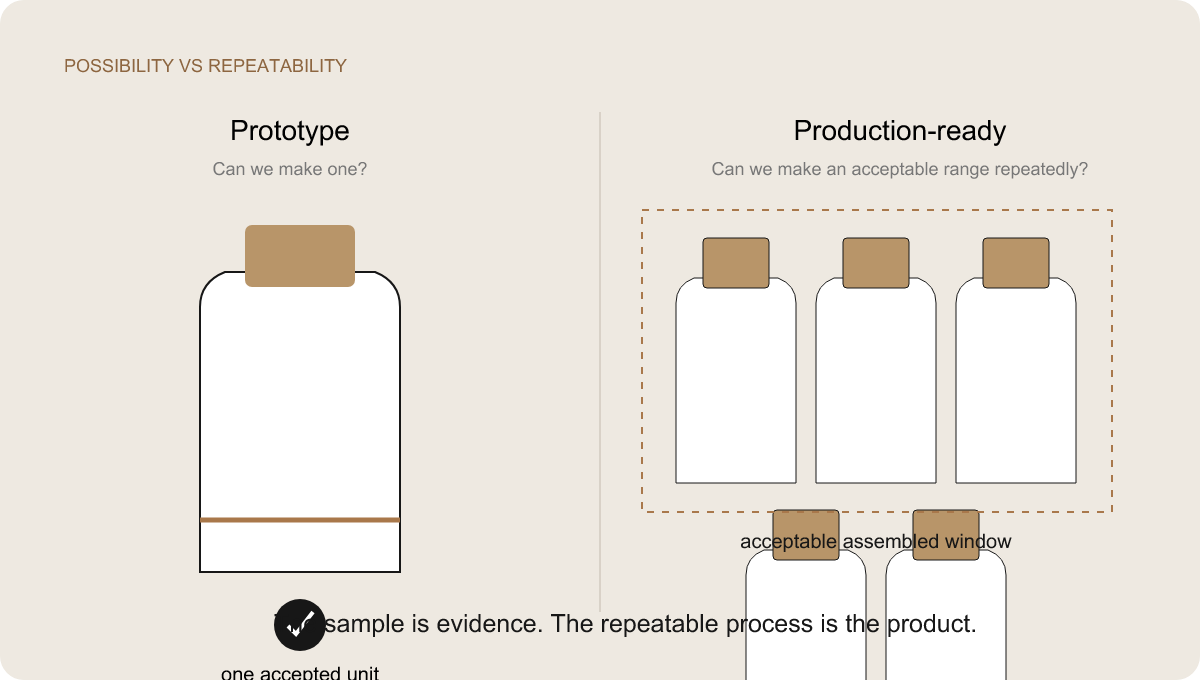
Possibility is not repeatability. The controlled acceptable window—not one selected bottle—is the manufacturing objective.
18 / The final interface
A generic carton is therefore not automatically adequate for a heavy or highly decorated perfume bottle. Product-specific packing considers where the bottle can be supported, which surfaces must not touch, how movement is limited, whether the cap has vertical clearance, how dividers behave under compression and how the pallet remains stable. The pack must also be practical to assemble consistently; an elegant protective concept that operators cannot repeat is not a control.
The validation route depends on product, destination and agreed requirements, so this case does not invent a drop, vibration or compression result. DAXIN should confirm the actual carton, divider, pallet and verification record before publication. The principle is clear: export packing belongs inside perfume packaging engineering, not after it. DAXIN's delivery and warehousing content is the relevant next resource for buyers planning this stage.
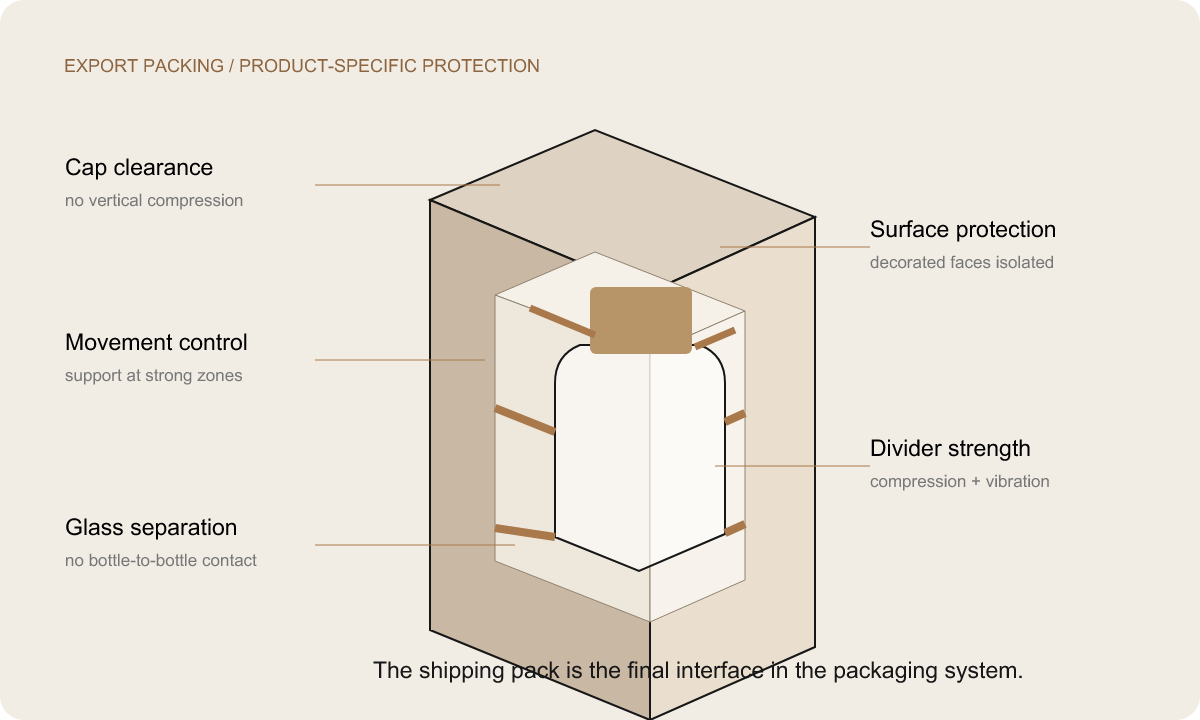
Protection by interface. Separate glass, isolate decorated faces, control movement and keep vertical load away from the cap.
19 / Timing changes the business impact
An interface problem discovered during drawing review may require a dimension change and another technical discussion. The same problem discovered after tooling may require tool work and new samples. After component production, it can involve inventory and supplier coordination. After decoration, more value has been added to every affected part. After filling, the fragrance product and filling operation are exposed. After international shipping, distance, delay and market timing enter the recovery.
No invented cost figure is needed to understand the curve. Correction becomes more complex as commitments accumulate and reversibility falls. That is why an early engineering review can create disproportionate value: it tests the high-risk interfaces while the project still has several low-impact choices.
Early review does not guarantee that no problem will ever occur. It changes where the team looks and when evidence is requested. Neck/pump compatibility, assembled cap position, difficult glass geometry, physical color and decoration feasibility can be examined before mass production turns an unclear requirement into a large physical fact.
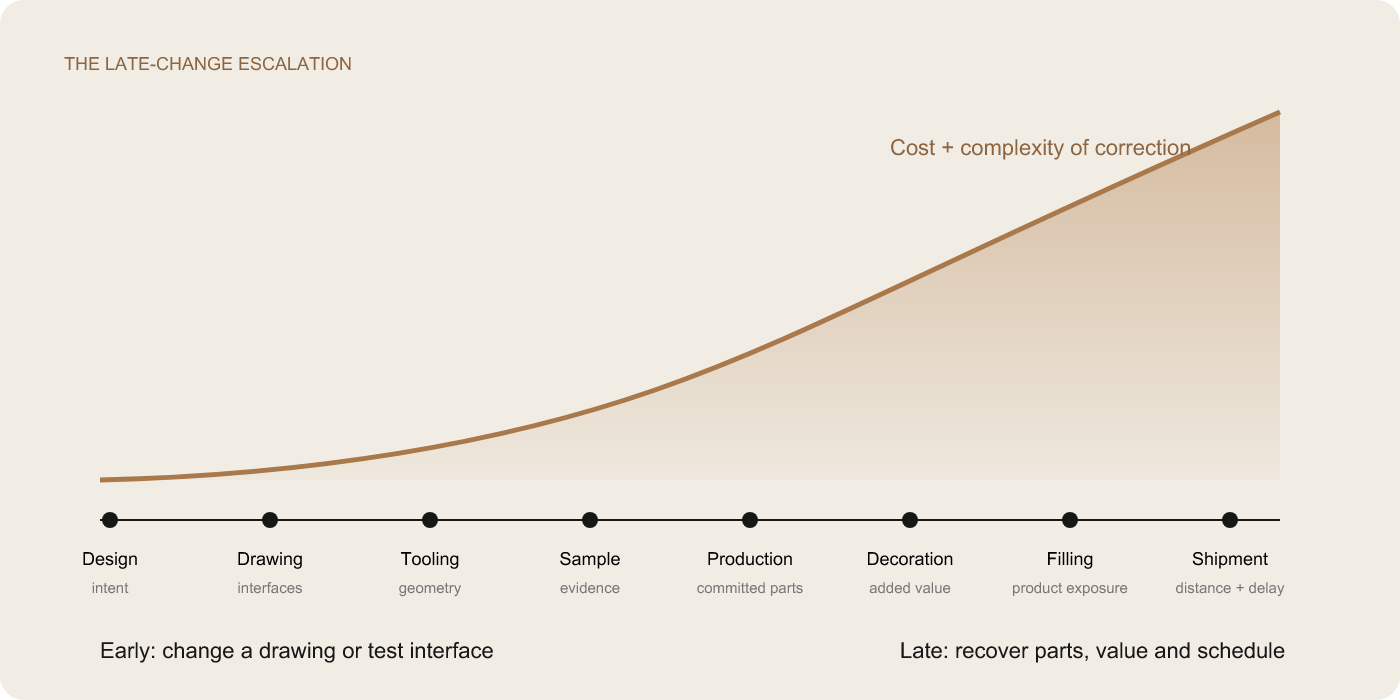
Late-change escalation. The curve is conceptual and intentionally carries no fabricated numerical values.
20 / Controlled, not “perfect”
A production-ready rescue does not end with “we fixed the cap.” It ends with a controlled system: validated bottle geometry, a defined neck and compatible pump, a managed cap-and-collar relationship, approved decoration, physical color and finish masters, an understood assembly sequence, inspection criteria and an export-pack specification built around the actual decorated product.
Those controls do not claim that every future unit will be metaphysically perfect. They define the acceptable range, the evidence used for approval and the points where risk is detected before more value is added. The exact corrected components and project outcome remain [FACT CHECK / DAXIN TO CONFIRM]. The responsible claim is risk reduction through structured diagnosis, correction and verification—not an unsupported promise that failure became impossible.

Engineering protects design quality. A conceptual beauty shot—not a photograph of the referenced customer project.
21 / Buyer takeaways
Use it to align silhouette, finish intent and brand character. Ask physical samples to prove geometry, assembly, optical behavior and process capability.
A bottle, pump and cap are not successful because they each pass alone. Their contact path and final assembled output determine success.
Define the consumer-facing shadow line, centering and proportion instead of assuming a component drawing automatically protects them.
Measure the neck, installed pump, collar and cap insert first. If glass is causal, change it deliberately—not defensively.
Transparent glass, paint, plastic, metal and foil return light differently. Screens communicate; retained physical standards govern.
Approval should represent a repeatable range and identify tooling, material, process and assembly conditions behind the evidence.
Dividers, clearances and contact zones preserve the glass, finish and cap alignment that the development process created.
Compare coordination, interfaces, samples, tooling consequences, decoration and packing—not only the isolated unit price.
A reversible insert or collar change can sometimes outperform a mold change; in other cases the bottle must be corrected. Evidence decides.
Every unresolved interface becomes more expensive to revisit after tooling, decoration, filling and shipment have added commitments.
22 / Before tooling is the ideal moment
Request a review before tooling when the bottle is highly customized, glass is unusually heavy, shoulders or corners are aggressive, or cap and bottle must align with very little visual margin. Bring engineering into the discussion when a magnetic cap or complex insert creates hidden interfaces; when the pump, bottle and cap come from different suppliers; when metallic color must agree across plastic, aluminum, zamac and foil; or when a large decoration area crosses a curved surface.
Review is equally valuable when the launch schedule is tight or the shipping destination is far from production. Those conditions reduce the room for late correction. If samples already exist, do not send only the component that looks wrong. Send the assembled package, component drawings, revision identity and photographs that show how the symptom changes. A useful investigation needs context.
DAXIN can begin from a render, technical drawing, reference bottle or physical sample. The purpose is not to force every project into a new custom mold. It is to identify the highest-risk interfaces, determine what evidence is missing and decide where to investigate first. Buyers comparing a perfume bottle range, an existing package and a fully custom fragrance packaging route can use the same review logic.
Technical FAQ
Short specifications rarely tell the full interface story. These answers show what to investigate before selecting a corrective action.
A high cap can originate at several levels: bottle neck height, the installed position of the crimp pump, collar contact, an internal cap stop or a shallow insert. Assembly force and sequence may add variation. Begin with the assembled vertical dimension chain and compare several units. Swapping known components can show what the symptom follows. Do not change the external cap or glass mold simply because the gap appears beside those parts.
Yes. Allowed variation can accumulate in the same direction across the neck, pump, collar and cap insert. No single component must be defective for the final gap to be unacceptable. Luxury visual acceptance can also be narrower than an individual technical specification. The drawing set should therefore control the assembled output, not only component dimensions.
Tolerance stack-up is the combined effect of variation from every relevant dimension and process on a final result. For a cap position, that may include the bottle neck, pump installation, collar, cap insert and assembly. A useful stack follows the actual contact path and accounts for flexible, formed or coated parts rather than treating every element as a rigid block.
Not automatically. The nominal neck size is a starting point. Exact profile, bead geometry, ferrule, gasket, installed height and crimping condition still require confirmation. Dip-tube length, dosage, fragrance compatibility and filling-line handling may also differ. Validate the pump on the actual bottle with the intended assembly process before relying on a shared nominal label.
Substrate and process change how the surface reflects light. Metallized ABS, anodized aluminum, plated zamac, paint and hot-stamping foil can share a color description while differing in brightness, hue, texture and directionality. Place the real parts together under agreed light and tune them around one physical master. The target may be a coherent family rather than impossible optical identity.
Pantone describes a target, not the complete optical system. Clear glass, liquid, spray transparency, coating thickness, opacity, gloss, matte texture, viewing angle and lighting affect the observed result. Camera and display settings add further change. Final approval should use a retained physical sample in the intended construction and under a defined viewing condition.
Modify the mold after evidence shows bottle geometry is causal and the proposed change has been compared with lower-impact alternatives. Review capacity, neck relationships, forming, decoration field and connected components before release. A mold should not be protected from a necessary change, but it should not become the default suspect when an insert, collar, pump or assembly condition may solve the problem more safely.
There is no responsible universal number. A stock bottle with a familiar decoration may need fewer iterations than a new glass mold, custom cap and cross-material CMF system. Every round should test a defined hypothesis or approval gate. Repeated samples without a controlled variable often consume time without increasing confidence; a well-planned additional round can prevent a much larger late correction.
Confirm bottle geometry, neck/pump compatibility, installed closure height, cap and collar fit, decoration, physical color masters, assembly sequence, critical dimensions, cosmetic criteria and repeatability across representative samples. Confirm which tools and processes produced the approval evidence. Finally, review export packing with the actual decorated bottle and cap so that transport does not invalidate the visual work.
Often, yes. The pack can separate glass, isolate decorated faces, provide cap clearance, control movement and support the bottle at suitable zones. Divider behavior, carton compression and pallet stability should reflect product weight and route. The specific validation method depends on the project, but transport protection should be designed before mass packing—not improvised after finished bottles arrive.
Send bottle renders, technical drawings, capacity, approximate dimensions, neck and pump specifications, cap construction, decoration artwork, color references, target quantity and destination where known. If a problem already exists, include complete assembled samples or clear photos, revision identity and a neutral description of the symptom. The team can begin without knowing the culprit; diagnosis is meant to determine where to investigate first.