
How to Choose a Perfume Bottle Manufacturer in China
How to Choose a Perfume Bottle Manufacturer in China
Choosing the right perfume bottle manufacturer in China is not simply a matter of finding an attractive bottle at the lowest quoted price. The supplier will influence the appearance of the finished fragrance, the reliability of the spray system, the fit of the cap, the consistency of the decoration, the protection provided by the box, the amount of cash tied up in inventory, and whether the launch happens on schedule.
For a fragrance brand, a packaging problem can quickly become a commercial problem. A bottle that looks good in a rendering may become unstable after filling. A cap may fit the neck visually but loosen during transportation. A low bottle MOQ may be offset by a much higher pump or cap MOQ. An inexpensive quotation may exclude decoration, inner packing, mold trials, inspection, or replacement responsibility. These risks are especially important for new brands, private-label companies, distributors, and importers sourcing internationally.
China offers a broad perfume-packaging supply base, including glass factories, stock-bottle suppliers, decoration specialists, cap and pump manufacturers, trading companies, and integrated OEM/ODM packaging suppliers. The advantage is choice. The challenge is that two companies using the same phrase—“perfume bottle manufacturer”—may provide very different services and levels of control.
This guide explains how to evaluate a Chinese perfume bottle supplier systematically. It covers supplier type, production capability, MOQ, sampling, component compatibility, quality control, mold ownership, delivery, payment, communication, factory audits, and total project cost. The goal is not to find the supplier that promises everything. It is to identify the partner whose capabilities, processes, and commercial model fit your particular fragrance project.
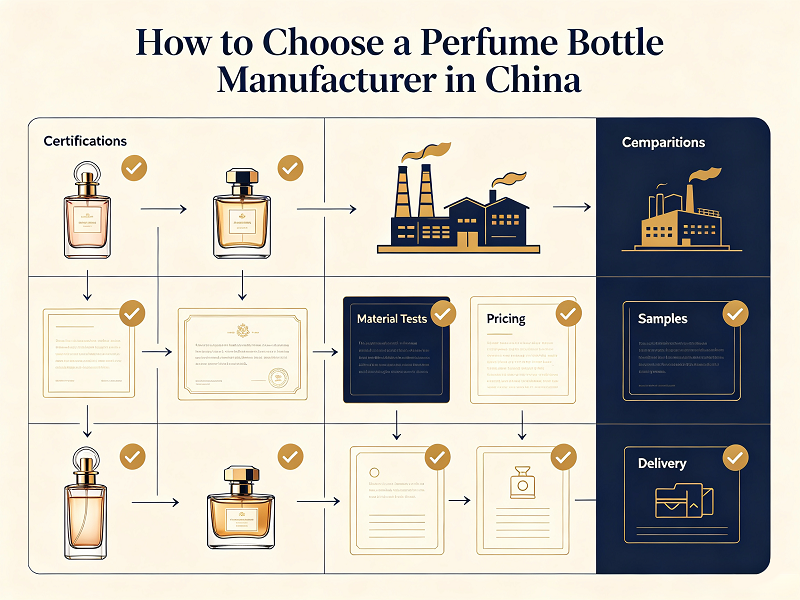
Why Choosing the Right Perfume Bottle Manufacturer in China Matters
Perfume packaging is a system rather than a single glass component. A complete retail pack may include:
Glass bottle
Spray pump
Collar or ferrule
Cap
Gasket or sealing components
Surface decoration
Label, plaque, or other decorative element
Folding carton or rigid box
Insert and protective packing
Each part has its own dimensions, tolerances, materials, minimum order quantity, production schedule, and quality risks. A supplier that coordinates only the glass bottle may offer an attractive price but leave the buyer responsible for testing pumps, sourcing caps, resolving decoration failures, and modifying the box when the final assembly changes.
The cost of choosing poorly is rarely limited to the defective component. It may also include delayed filling, idle inventory, airfreight, repacking, inspection, rework, lost retailer windows, or damage to the brand's reputation. The right supplier reduces this coordination burden by identifying dependencies early and creating a clear approval path before mass production.
For this reason, supplier selection should be treated as a risk-management and value-creation decision. Price matters, but it should be evaluated alongside technical competence, transparency, consistency, responsiveness, and long-term scalability.
First, Understand What Type of Supplier You Are Evaluating
Before comparing companies, determine what each potential supplier actually controls. Supplier type does not automatically indicate quality. It does, however, affect responsibility, communication, product range, and the way problems are resolved.
Glass Bottle Factory
A primary glass factory focuses on forming and annealing glass bottles. Some glass plants also offer mold development and basic quality inspection, while decoration, pumps, caps, and boxes may be handled by affiliated or external partners.
This route can work well for large, stable orders when the buyer has an experienced packaging team and can coordinate multiple component suppliers. It may also suit projects where proprietary glass engineering is the main priority.
However, buyers should not assume that direct access to a glass factory automatically provides a complete fragrance-packaging solution. Ask who is responsible for decoration, closure compatibility, assembly tests, packing configuration, and claims involving outsourced components.
Stock Perfume Bottle Supplier
A stock supplier offers bottles made from existing molds. It may hold physical inventory, arrange new production from existing tooling, or provide a catalog that combines bottles from several factories.
Stock suppliers are useful for new brands, shorter development schedules, and projects that do not justify a new glass mold. They can also provide variety across capacities and styles. The key is to distinguish between an existing mold and actual warehouse inventory. A bottle described as “stock” may still require a production run.
Trading Company
A trading company sources from one or more factories and manages communication, consolidation, and export. A capable trading partner can add value through supplier coordination, category breadth, language support, and lower management complexity. A weak trader may simply add margin without providing technical control or accountability.
Do not reject or select a supplier based only on the label “factory” or “trading company.” Instead, ask what work is done internally, what is outsourced, how subcontractors are qualified, and who owns responsibility when a component fails.
Integrated Perfume Packaging Manufacturer or Solution Provider
An integrated supplier coordinates the bottle, pump, collar, cap, decoration, and paper box as one project. It may manufacture some parts directly and manage approved partner factories for others.
This model is valuable when the buyer wants one commercial and technical contact for the full pack. It can reduce compatibility risk and simplify timelines, particularly for brands without an internal packaging engineer in China. The important question is whether the supplier performs real integration—sample assembly, fit testing, quality coordination, and project management—or merely combines separate quotations.
Which Supplier Type Is Best?
There is no universal winner. The right model depends on the project.
| Buyer situation | Often suitable supplier model | Main reason |
|---|---|---|
| First launch using an existing bottle | Stock supplier or integrated packaging supplier | Lower development risk and easier coordination |
| High-volume proprietary glass program | Glass factory with strong engineering, or an integrated partner with proven custom-mold control | Direct technical development and scale |
| Multi-category gift set | Integrated packaging supplier | One project owner across components |
| Experienced importer buying standard glass only | Glass factory or specialist stock supplier | Buyer can manage the remaining supply chain |
| Small team without local technical staff | Integrated supplier with documented project control | Reduced communication and compatibility burden |
Build a Clear Packaging Brief Before Contacting Suppliers
A manufacturer cannot provide a reliable recommendation or comparable quotation from a vague request such as “I need a luxury 100ml bottle.” Luxury can mean heavy clear glass, a sculptural silhouette, a metallic cap, a precise spray system, a rigid box, or a specific target cost. Each direction creates different requirements.
A useful request for quotation should include:
Bottle capacity and expected fill volume
Target order quantity and number of SKUs
Stock bottle or custom mold preference
Reference images, drawings, or desired design language
Bottle weight or dimensions if important
Neck finish and pump preference, if already decided
Cap material, closure style, and finish
Decoration processes, colors, and artwork
Box style and insert requirements
Target market and distribution channel
Required testing or documentation
Destination port or delivery term
Target production-completion or launch date
Also separate requirements from preferences. For example, a 50ml capacity, reliable crimp pump, and retail carton may be mandatory, while a magnetic cap or a particular bottle weight may be optional. This allows the supplier to propose cost-effective alternatives without changing the core concept.
A clear brief improves the quality of the quotation and also becomes an early test of the supplier. Strong manufacturers ask precise questions about missing information. Suppliers that quote immediately without confirming capacity, quantity, closure, decoration, or packing may be comparing a different product from the one you intend to buy.
Create a Shortlist Based on Project Fit, Not Catalog Size
A large catalog does not prove that a supplier is suitable for your project. Shortlist companies using criteria related to the actual purchase:
Do they regularly handle perfume bottles rather than general glassware only?
Can they support the required stock or custom development route?
Do they coordinate compatible pumps, collars, caps, and boxes?
Can their realistic MOQs fit the launch plan?
Do they have experience with the required decoration processes?
Can they explain quality standards and approval stages clearly?
Can they export to your intended market and provide the required commercial documents?
Is their communication detailed enough for an international project?
Request relevant examples rather than a general company presentation. If you need a sprayed rectangular bottle with an aluminum cap and folding carton, ask for projects involving similar geometry, coating, closure, and box construction. This provides more useful evidence than unrelated luxury renders.
At the shortlist stage, three to five serious candidates are usually more manageable than sending the same inquiry to dozens of suppliers. A focused comparison gives each supplier enough information to quote correctly and allows the buyer to evaluate the quality of the response.
This project-based approach applies whether the candidate describes itself as a Chinese glass perfume bottle manufacturer, a China-based perfume packaging manufacturer, a custom perfume bottle supplier, or an OEM perfume bottle manufacturer. The commercial label is less important than verified responsibility for the work your package actually requires.
Verify the Supplier's Business Identity and Operating Role
International buyers should verify who they are contracting with before paying for molds or production. Request the company's full legal name, registered address, business license, factory or operating address, and bank beneficiary information. The details on the quotation, pro forma invoice, contract, and payment instructions should be consistent or clearly explained.
Confirm the supplier's actual role in the project:
Which products are manufactured internally?
Which processes are outsourced?
Where will the bottle be formed, decorated, assembled, and packed?
Who inspects subcontracted components?
Who has authority to approve corrections or replacements?
Which entity owns or controls any custom tooling?
Photos and videos can support verification but should not be the only evidence for a significant program. For higher-value or custom-mold projects, consider a live video walkthrough, independent factory audit, in-person visit, or third-party inspection. The level of verification should be proportional to the order value, tooling investment, technical complexity, and consequences of failure.
The objective is not to prove that every process happens under one roof. Perfume packaging often involves specialized factories. The objective is to understand the supply chain and establish clear accountability.
Evaluate Real Perfume Bottle Manufacturing Capability
Good supplier evaluation goes beyond asking how many production lines a company has. Capacity must be relevant to your bottle, process, quantity, and schedule.
Stock-Bottle Capability
For stock bottles, ask:
Does the bottle physically exist in inventory?
If so, how many pieces are available and in which capacity?
Is the stock undecorated or already finished?
Which neck specification does it use?
Which pump and cap combinations have been tested?
Is the mold active and available for repeat production?
What is the normal reorder quantity and production schedule?
Can the same design family support 30ml, 50ml, or 100ml versions?
An available sample is useful, but it does not prove that the requested production quantity is available. Inventory should be confirmed again before order placement because stock levels can change.
Custom Glass Development Capability
For a custom bottle, evaluate the supplier's ability to translate design intent into manufacturable glass. Ask how the team reviews:
Capacity and brimful volume
Wall and base thickness
Glass distribution
Shoulder and corner geometry
Stability and center of gravity
Neck position and tolerances
Embossed or debossed details
Decoration areas
Mold separation lines
Packing orientation and shipping protection
A credible custom perfume bottle manufacturer should be willing to identify design risks before collecting a tooling payment. It should explain which details may cause uneven glass distribution, difficult mold release, unstable standing, sharp transitions, decoration inconsistency, or high rejection rates.
Request a defined development path covering technical drawings, drawing approval, mold fabrication, trial glass, dimensional and capacity checks, corrections, decoration samples, and final pre-production approval. Do not treat a 3D rendering as proof that a bottle can be manufactured consistently.
Decoration Capability
Perfume bottle decoration changes both appearance and production risk. Ask whether spraying, screen printing, hot stamping, frosting, decals, UV printing, metallization, or other finishes are completed internally or by a partner.
For every process, confirm:
Suitable glass surface and printable area
Color reference or master standard
Expected appearance variation
Artwork limits and registration tolerance
Adhesion and abrasion test method
Handling and curing requirements
Packing method for decorated surfaces
Approval sample and mass-production inspection criteria
The supplier should explain the practical effect of the chosen process, not merely say that it is available. For example, a gradient coating requires control over transition position and density, while hot stamping on a curved surface may have different artwork limitations from printing on a flat panel.
Check Bottle, Pump, Collar, and Cap Compatibility as One System
Many fragrance-packaging failures occur at interfaces between components. A glass bottle can pass visual inspection and still fail as a retail package if the pump leaks, the collar sits unevenly, or the cap is loose.
The bottle neck, pump, collar, and cap should be evaluated as one closure system. Ask the supplier to confirm:
Neck finish and critical dimensions
Crimp or screw pump specification
Gasket material and sealing contact
Dip-tube length and cut style
Pump dosage and spray pattern
Crimping or assembly method
Collar height, diameter, and finish
Cap inner structure and retention method
Cap pull force or fit standard
Clearance between cap, collar, and shoulder
Complete assembly samples are essential. Test the cap repeatedly, inspect alignment, operate the pump, and evaluate the package after filling with the intended formula or a technically appropriate test liquid. Fragrance formulas and alcohol content can affect material compatibility, so the brand or filler should define the required compatibility testing.
If the bottle, pump, cap, and box come from different suppliers, establish who owns the final assembly drawing and who will resolve dimensional conflicts. Saving a small amount on separate components can create a much larger coordination cost when nobody is accountable for system performance.
Compare MOQ at Component and Process Level
One of the most common sourcing mistakes is asking only, “What is your bottle MOQ?” The lowest minimum for the glass bottle does not necessarily represent the minimum for the complete sellable pack.
When comparing perfume bottle MOQ in China, do not rely on a single catalog number. Minimums are created by the production economics of each glass design, cap construction, pump model, color, and decoration process.
For planning purposes, DAXIN uses the following MOQ references:
| Component or process | MOQ reference |
|---|---|
| Custom glass bottle | 10,000 pcs |
| Stock glass bottle | 3,000 pcs |
| Cap | 10,000 pcs |
| Pump | 10,000 pcs |
| Paper box | 3,000 pcs |
| Spraying | 3,000 pcs per color |
| Silk printing | 1,000 pcs |
| Electroplating | 10,000 pcs |
These figures are planning references, not a universal market rule. Final quantities depend on the selected design, material, color, decoration, factory schedule, and supplier. A Chinese perfume bottle manufacturer should confirm the minimum for every component and every process in the actual specification.
Build an MOQ matrix by SKU. If a brand plans three fragrances with three bottle colors, the spraying minimum may apply separately to each color. A 3,000-piece stock bottle may still require 10,000 pumps or caps. The buyer must decide whether to choose a different component, purchase excess inventory for future orders, increase the first filling run, or redesign the package.
The best supplier is not necessarily the one with the smallest advertised MOQ. It is the one that gives a transparent component-level structure and helps the brand avoid unusable inventory without recommending an unprofitable or technically weak solution.
Use a Controlled Sampling and Approval Process
Samples should reduce uncertainty in stages. A disciplined approval path may include:
1. Reference Sample
The supplier provides an existing bottle or similar pack to confirm approximate scale, glass quality, weight, neck, and component concept. This sample does not approve a new mold or final decoration.
2. Technical or Mold-Trial Sample
For custom glass, trial bottles are checked for dimensions, capacity, stability, glass distribution, visible defects, and neck geometry. Corrections should be documented before the next stage.
3. Decorated Sample
The approved glass is produced with the intended coating, printing, stamping, frosting, or other finish. Color, gloss, artwork position, adhesion, and surface quality are reviewed against a defined reference.
4. Complete Assembly Sample
The bottle, pump, collar, cap, decoration, box, and insert are assembled together. The buyer evaluates appearance, fit, function, packing, and unboxing as one system.
5. Pre-Production or Golden Sample
The final approved sample becomes the physical and documented reference for mass production. It should correspond to the signed drawing, color standard, artwork, bill of materials, and packaging specification.
For every sample, state what is being approved and what remains open. Record changes in writing. A message such as “sample looks good” is too vague when multiple materials and processes are involved.
Also confirm whether sample parts come from mass-production tooling and processes. A hand-finished prototype can demonstrate appearance but may not represent normal production variation or assembly performance.
Examine the Manufacturer's Quality-Control System
Claims such as “strict quality control” are not enough. Ask the manufacturer to describe inspections, responsibilities, records, and acceptance criteria.
Incoming-Material and Component Checks
An integrated supplier should inspect incoming bottles, pumps, caps, decoration materials, and boxes before final packing or assembly. The checks should focus on defined risks rather than appearance alone.
Glass-Bottle Inspection
Relevant criteria may include:
Capacity and key dimensions
Neck finish and sealing surface
Stability and base flatness
Cracks, chips, sharp edges, and stones
Bubbles, cords, and surface marks
Glass distribution and visual symmetry
Mold seams and deformation
Cleanliness and contamination
Not every minor visual feature has the same commercial impact. Agree in advance which defects are critical, major, or minor and how samples will be selected. A suitable sampling plan, including an agreed AQL approach when appropriate, can be part of the purchase specification.
Closure and Functional Inspection
Checks may cover pump fit, crimp quality, leakage, spray pattern, dosage consistency, dip-tube position, collar alignment, cap retention, and repeated opening and closing.
Decoration Inspection
Define the approved color standard, acceptable color variation, artwork position, print registration, opacity, gloss, adhesion, scratch resistance, and allowed defect area. Inspection under inconsistent lighting can cause disagreements, so establish a repeatable review method where color is important.
Paper Box and Packing Inspection
Check dimensions, artwork, color, board or paper material, insert fit, adhesive performance, surface finishing, barcode legibility, and protective packing. The box should be approved only after final bottle-assembly dimensions are stable.
Ask who makes release decisions, which records are retained, and how nonconforming goods are separated. For important orders, reserve the right to conduct or appoint a pre-shipment inspection before the balance payment and dispatch.
Assess Communication and Project-Management Quality
Communication is part of manufacturing performance. Perfume packaging projects contain many linked decisions, and unclear communication can be as damaging as a technical defect.
Evaluate whether the supplier:
Confirms specifications instead of making silent assumptions
Separates confirmed facts from estimated information
Identifies risks early
Provides drawings and samples with version control
Summarizes changes and their effects on cost or timing
Answers technical questions directly
Gives realistic dates rather than automatic promises
Coordinates responsible people across glass, decoration, closures, and boxes
Escalates problems with proposed solutions
Pay attention to the questions a supplier asks. A professional team may challenge an incomplete brief, request filling information, confirm the launch quantity, or warn that a selected cap changes the MOQ. This is usually more valuable than a supplier that agrees immediately to every request.
For complex projects, request a simple milestone schedule with owners and dependencies. It should show design freeze, technical drawing, mold work, trial glass, decoration sample, component approval, box sample, mass production, inspection, and shipment readiness.
Compare Complete Project Cost, Not Just Bottle Price
Two quotations are comparable only when they cover the same specification and commercial terms. Build a normalized cost sheet that includes:
Glass bottle unit price
Mold and tooling charges
Pump, collar, and cap
Decoration and artwork setup
Paper box and insert
Samples and courier costs
Assembly and inner packing
Cartons, dividers, trays, and pallets
Inspection or testing
Replacement allowance, if agreed
Freight and insurance basis
Import duties and local charges, where applicable
Excess components caused by different MOQs
Also calculate cash exposure per sellable unit. If the first filling run is 3,000 units but pumps and caps are purchased at 10,000 pieces, the unused components still consume cash and storage space. Their value should not disappear from the comparison merely because they may be used later.
The lowest unit price can be false economy if it creates higher rejects, excess inventory, repeated sampling, airfreight, or launch delays. A sound sourcing decision balances cost, risk, flexibility, and the lifetime value of the packaging platform.
Review Lead Time and Capacity Realistically
Ask suppliers to separate development time from mass-production time. A quotation that states “30 days” may refer only to manufacturing after all samples, artwork, components, and deposits are approved.
The schedule should identify:
Technical-development period
Mold fabrication and trial time
Sample-production and courier time
Buyer review and revision cycles
Component procurement
Decoration production
Box production
Final assembly or packing
Inspection and release
Export booking and transit
At DAXIN, the normal production reference is approximately 30–35 days after the necessary details are approved, with high-season production around 40 days. Custom mold development and revision occur before this production stage and add time. Final timing must be confirmed for the actual project.
Ask how the supplier manages peak season, furnace or line scheduling, subcontractor capacity, and delayed component arrivals. A reliable manufacturer should show dependencies and update the schedule when the specification changes.
Do not set the purchase-order date equal to the required retail-launch date. Leave time for international transport, customs, filling, finished-product testing, retailer delivery, and a reasonable contingency.
Clarify Custom Mold Ownership and Intellectual Property
For a proprietary bottle, define tooling and design rights before paying for the mold. The agreement should address:
Who owns the technical drawings
Who owns the physical mold
Whether the design or mold may be used for another customer
Where the tooling will be stored
Tooling maintenance responsibility
Expected mold life or maintenance conditions, if provided
Access to future production
Conditions for mold transfer, storage, or disposal
Ownership of revisions and replacement tooling
Paying a tooling fee does not automatically clarify every right. Terms should be written and understood by both parties. If the bottle shape is strategically important, obtain appropriate professional advice on design protection and contracts in relevant jurisdictions.
The supplier should also respect third-party intellectual property. Avoid asking a factory to copy a recognizable branded bottle. Reference images should communicate design language, proportions, or functional preferences—not authorize imitation.
Evaluate Packing, Shipping, and Export Support
Perfume bottles are fragile and decorated surfaces can scratch. Ask how the packaging was designed and tested for the actual bottle, cap, finish, and transportation route.
Review:
Individual bags, sleeves, or surface protection
Dividers, trays, and carton arrangement
Carton strength and gross weight
Bottle orientation
Protection for corners, shoulders, and heavy bases
Pallet configuration, when used
Labels and handling marks
Moisture protection for paper packaging
Loading and container utilization
The heaviest bottle is not automatically the best bottle for e-commerce. Extra glass can improve shelf presence but also increase freight cost and impact energy, while a sculptural design may require more protective material. Packaging design should balance presentation, damage risk, logistics, and brand positioning.
Confirm which export documents the supplier can provide and which product or material documents are required by the buyer, filler, retailer, carrier, or destination market. Requirements vary, so the buyer should communicate them before production rather than assume that one standard document package applies everywhere.
Check Commercial Terms and Payment Controls
Commercial terms should match project risk and production milestones. A common structure for established manufacturing projects is 30% deposit and 70% before shipment, although final terms depend on the supplier, tooling, order, and relationship. Special arrangements should be documented rather than assumed.
Before payment:
Confirm the legal contracting entity
Verify bank beneficiary details through an established channel
Review the pro forma invoice and specification
Confirm which approval starts production
Define treatment of tooling, samples, and changes
State the inspection and shipment-release process
Clarify the response to verified nonconformity
Be cautious about last-minute bank-account changes, unexplained third-party beneficiaries, pressure to pay before specifications are agreed, or payment requests that do not match the contracting company. Verification does not replace a contract, and a contract does not replace technical control. Both are needed.
Long payment terms are not automatically a sign of a stronger supplier relationship, and aggressive price pressure can weaken quality or service. The objective is a commercially sustainable arrangement in which responsibilities, margins, approvals, and risk are clear.
Conduct a Factory Audit Proportionate to the Risk
Not every stock-bottle order requires a full social, quality, and technical audit. A custom mold, high-value launch, or long-term supply program may justify a deeper review.
A factory or supplier audit can examine:
Organization and Responsibility
Who manages sales, engineering, quality, production, subcontractors, complaints, and corrective actions? Is responsibility visible, or does every issue depend on one salesperson?
Production and Process Control
Are drawings, work instructions, samples, color standards, and process parameters available at the relevant workstations? How are changes controlled?
Measuring and Testing Equipment
Which tools are used to check dimensions, capacity, neck finish, coating, adhesion, leakage, spray function, and packing? Are methods appropriate and consistently applied?
Nonconforming Product Control
How are defective components identified, segregated, recorded, reviewed, and prevented from returning to production?
Traceability
Can the supplier connect finished goods to production date, process batch, component batch, or inspection records at a useful level?
Subcontractor Management
How are decoration, cap, pump, and box partners selected and monitored? Who approves their output?
Capacity and Contingency
What happens when equipment fails, a partner delays, or a quality issue affects a batch? Is there a credible recovery process?
An audit is most valuable when it is based on the specific project risks. A generic checklist can produce a high score while missing the exact problem that could delay your fragrance launch.
Use a Weighted Supplier Scorecard
A scorecard makes the decision more disciplined and prevents one attractive sample or low price from dominating the evaluation. Adjust the weights to suit the project.
| Evaluation area | Suggested weight | What to examine |
|---|---|---|
| Product and engineering fit | 20% | Bottle expertise, mold review, closure compatibility |
| Quality-control system | 20% | Standards, inspections, records, corrective action |
| Complete project cost | 15% | Comparable scope, tooling, excess inventory, packing |
| MOQ and commercial fit | 10% | Component-level minimums and scalable reorder model |
| Sampling and approval process | 10% | Clear stages, golden sample, version control |
| Communication and project management | 10% | Accuracy, speed, risk escalation, milestone control |
| Capacity and delivery reliability | 10% | Realistic schedules, peak-season planning, continuity |
| Export, packing, and documentation | 5% | Protective packing, shipment readiness, documents |
| Total | 100% |
Score each supplier from 1 to 5 for every area, multiply by the weight, and add supporting evidence. Separate “confirmed” from “promised.” A factory tour, approved sample, test report, or clear process document carries more weight than a broad claim in a sales message.
Do not automatically select the highest arithmetic score. Review any critical failure separately. A supplier with weak closure compatibility or unclear mold ownership may be unacceptable even if its total score is competitive.
Red Flags When Choosing a Chinese Perfume Bottle Supplier
One red flag does not always disqualify a supplier, but repeated signals should trigger deeper verification.
Quoting Before Understanding the Specification
A price issued without capacity, quantity, neck, decoration, cap, box, packing, and trade-term information is likely based on assumptions.
Promising Every Design at Any Quantity
Glass forming, custom caps, decoration, and pumps have technical and economic limits. Credible suppliers explain these constraints.
Treating an Existing Mold as Guaranteed Inventory
Ask for current quantity, sample availability, component status, and the date on which inventory was checked.
Avoiding Complete Assembly Samples
Separate bottle and cap samples cannot prove fit, sealing, alignment, or box compatibility.
Unclear Answers About Outsourcing
Outsourcing is normal. Refusing to explain where critical work occurs or who controls it is the concern.
Inconsistent Company or Bank Information
Unexplained changes between website name, invoice entity, contract party, and beneficiary require verification.
Vague Quality Language
“Best quality” and “zero defects” are not inspection standards. Ask for measurable criteria, sampling, records, and response procedures.
Unrealistic Lead Times
A schedule that ignores mold trials, sample approval, decoration, component procurement, and high-season capacity is not a reliable launch plan.
Pressure to Approve From Renderings Alone
Renderings are useful for design communication but do not verify glass distribution, fit, function, color, or production consistency.
Refusal to Document Changes
Verbal changes create disputes. Specifications, cost effects, and schedule effects should be recorded and approved.
Questions to Ask a Perfume Bottle Manufacturer in China
Use these questions during qualification:
Which parts of this package do you manufacture directly?
Which processes or components are outsourced, and how are partners controlled?
Is the selected stock bottle physically available or only produced from an existing mold?
What is the MOQ for the bottle, pump, cap, each decoration, box, and insert?
Which pumps and caps have already been tested with this neck?
What technical risks do you see in our design?
What is the complete sample and approval sequence?
Are samples made with production tooling and normal processes?
Which dimensions and defects will be inspected?
How are decoration color, adhesion, and artwork position controlled?
Who approves subcontracted components?
What happens if components do not fit during final assembly?
What is included and excluded in the quotation?
Which costs are one-time and which recur on future orders?
What is the development timeline, and when does mass-production lead time begin?
How do you manage production during peak season?
How will finished bottles be protected during shipment?
Can we arrange a factory audit or third-party pre-shipment inspection?
Who owns and controls the mold and technical drawings?
How are verified quality claims and corrective actions handled?
The substance of the answers matters more than the speed. Good answers identify assumptions, provide evidence, and explain tradeoffs.
A Practical Supplier-Selection Process
The following sequence helps a fragrance brand move from initial research to a controlled first order.
Stage 1: Define the Project
Create the packaging brief, target quantity, target cost range, launch schedule, approval roles, and non-negotiable requirements.
Stage 2: Prequalify Three to Five Suppliers
Check category fit, business identity, relevant examples, MOQ compatibility, export capability, and initial communication quality.
Stage 3: Issue the Same RFQ
Give each supplier the same specification and request that assumptions and exclusions be stated. Normalize quotations before comparing them.
Stage 4: Hold a Technical Review
Discuss bottle geometry, neck, pump, cap, decoration, box, tests, quality criteria, and risks. Evaluate whether the supplier can coordinate the complete system.
Stage 5: Verify the Supplier
Use documents, live video, samples, references where appropriate, a site visit, or an independent audit based on project risk.
Stage 6: Complete Sampling
Approve glass, decoration, complete assembly, and packing in controlled stages. Freeze drawings, artwork, colors, and component specifications.
Stage 7: Place a Commercially Sustainable First Order
Confirm component-level quantities, excess inventory, payment milestones, production schedule, inspection, and shipment terms. Do not force a pilot quantity below a technically or economically responsible level.
Stage 8: Inspect Before Shipment
Check production against the approved sample and written standards. Resolve material discrepancies before final release and shipping.
Stage 9: Review Performance After Delivery
Record defects, breakage, filling-line issues, customer feedback, communication performance, and actual lead time. Use the findings to improve the reorder specification and supplier score.
Should You Use One Supplier or Several?
Using one integrated supplier can simplify accountability, compatibility, consolidation, and schedule management. It is often appropriate for a new brand or a complex pack with several customized components.
Using specialist suppliers can offer deeper capability in individual components or more direct cost control. It may suit experienced buying teams with packaging engineering, local inspection, and the ability to manage interface risk.
A balanced approach is also possible. The brand can appoint one lead packaging supplier while approving the critical glass, pump, cap, decoration, and box sources. Another option is to dual-source mature standard components after the specification and demand are stable.
Avoid adding suppliers simply to create negotiating pressure. Every additional interface needs drawings, samples, logistics, quality responsibility, and schedule coordination. Supply-chain resilience comes from qualified alternatives and clear specifications, not from uncontrolled fragmentation.
Final Checklist for Choosing a Perfume Bottle Manufacturer in China
Before making the final decision, confirm that:
The supplier's legal identity and bank details have been verified
Its actual manufacturing and outsourcing roles are understood
The project specification is complete and version-controlled
Quotations cover the same scope and commercial terms
MOQs are confirmed for every component and process
Stock availability is distinguished from stock-mold availability
Custom mold feasibility has been technically reviewed
Bottle, pump, collar, and cap compatibility has been tested
Decoration standards and tolerances are documented
The complete assembly and box have been sampled
Quality criteria and inspection methods are agreed
Mold ownership and design-use rights are clear
Development and production timelines are separated
Packing and shipment protection match the product
Payment, change, inspection, and claim procedures are written
The supplier's communication is accurate and commercially realistic
If several items remain unclear, the project is not ready for a final supplier decision, even if the unit price looks attractive.
Final Thoughts
The best perfume bottle manufacturer in China is not necessarily the largest factory, the supplier with the widest catalog, or the company offering the lowest bottle price. It is the supplier whose technical capability, component network, quality process, MOQ structure, communication, and commercial model match the needs of your fragrance brand.
Start with a clear brief. Verify what the supplier actually manufactures and controls. Compare the complete packaging cost. Approve the bottle, pump, collar, cap, decoration, and box as one system. Document quality standards, timelines, tooling rights, and responsibilities before mass production.
For new brands, a proven stock bottle with carefully selected decoration and compatible components can often reduce risk. For mature brands with validated demand, custom glass can create a stronger proprietary asset. In both cases, the supplier should help the brand make a commercially sustainable decision rather than recommend complexity for its own sake.
If you are evaluating perfume bottle manufacturers in China, prepare your capacity, quantity, design references, decoration requirements, closure concept, box style, target market, and launch schedule. An experienced OEM/ODM perfume packaging supplier can then evaluate the complete project and coordinate the glass bottle, pump, collar, cap, decoration, and paper box as one compatible system.
Perfume Bottle FAQs:
1. How do I find a reliable perfume bottle manufacturer in China?
Start with a clear packaging brief and shortlist suppliers that regularly handle fragrance packaging. Verify the company's legal identity, actual operating role, relevant production capability, MOQ structure, quality process, and export experience. Request appropriate samples, conduct a technical review, and use an audit or third-party inspection when the order value or custom tooling justifies it. Reliability should be supported by evidence and process, not only by a website or low quotation.
2. What is the MOQ for perfume bottles in China?
MOQ depends on whether the bottle uses an existing mold or requires a custom mold, as well as the selected components and decoration. At DAXIN, the planning reference is 3,000 pieces for stock glass bottles and 10,000 pieces for custom glass bottles. Caps and pumps use a 10,000-piece reference, paper boxes 3,000 pieces, spraying 3,000 pieces per color, silk printing 1,000 pieces, and electroplating 10,000 pieces. Final MOQs must be confirmed for the actual specification.
3. Is it better to buy from a factory or a trading company?
Neither model is automatically better. A direct glass factory may suit large, stable bottle orders and buyers that can manage other components. A capable trading or integrated packaging supplier may add value through product range, coordination, quality control, consolidation, and export support. Evaluate what the supplier controls, how it qualifies partners, and who is accountable for the complete package.
4. How can I verify a Chinese perfume bottle manufacturer?
Check the supplier's legal company name, business license, registered and operating addresses, contracting entity, and bank beneficiary details. Confirm which processes are internal and which are outsourced. Depending on risk, use document review, live video, product samples, a factory visit, an independent audit, or third-party pre-shipment inspection. Verification should be proportional to the order value and technical complexity.
5. Can a perfume bottle manufacturer supply pumps, caps, and boxes?
Many Chinese suppliers can coordinate complete perfume packaging, but the level of integration varies. Ask whether the supplier tests bottle, pump, collar, and cap compatibility, approves outsourced components, develops the box around the final assembly, and accepts project-level responsibility. A combined quotation alone does not prove that the components have been engineered as one system.
6. How long does perfume bottle production take in China?
Production time depends on bottle availability, quantity, decoration, component supply, box production, and season. At DAXIN, the normal production reference is approximately 30–35 days after all necessary details are approved, and high-season production is around 40 days. Sampling, custom mold development, revisions, international transport, and filling occur outside or before this production period and should be planned separately.
7. What samples should I approve before mass production?
Depending on the project, approve a reference bottle, custom-mold trial glass, decorated sample, complete bottle-pump-cap assembly, and final box with insert. The last approved or golden sample should match the signed drawings, artwork, colors, bill of materials, and packing specification. State clearly what each sample approves and whether it represents normal mass-production tooling and processes.
8. What should be included in a perfume bottle quotation?
A useful quotation should identify the glass bottle, pump, collar, cap, decoration, box, insert, packing, tooling, sample charges, quantities, unit prices, lead time, payment terms, trade terms, and validity. It should also state assumptions, exclusions, component-level MOQs, and which costs are one-time or recurring. Compare quotations only after the technical scope and commercial basis are aligned.