
Stock vs Custom Perfume Bottles: Which Is Better for a New Fragrance Brand?
Stock vs Custom Perfume Bottles: Which Is Better for a New Fragrance Brand?
Choosing between stock vs custom perfume bottles is one of the earliest and most consequential packaging decisions for a new fragrance brand. The choice affects much more than appearance. It influences minimum order quantities, tooling investment, launch timing, cash tied up in inventory, component compatibility, quality-control complexity, shipping cost, and the brand's ability to change direction after market feedback.
The decision is often described too simply: stock bottles are cheaper and faster, while custom bottles are more distinctive. That summary is directionally true, but it is not enough to guide a real launch. A stock bottle can become highly recognizable through decoration, a coordinated cap, and a strong box. A custom bottle can deliver a proprietary silhouette but still fail commercially if its quantity, cost, or timeline exceeds what the brand can support.
New brands need a decision that fits both the creative concept and the business model. This guide compares stock and custom glass perfume bottles across the criteria that matter in practice. It also explains an often-overlooked third option: launching with an existing bottle mold, creating differentiation through selected custom components, and moving to a proprietary glass mold only after demand is validated.
Because perfume bottles for new brands must balance identity with capital discipline, this comparison evaluates not only the appearance of the bottle but also the complete packaging system and its effect on the launch plan.
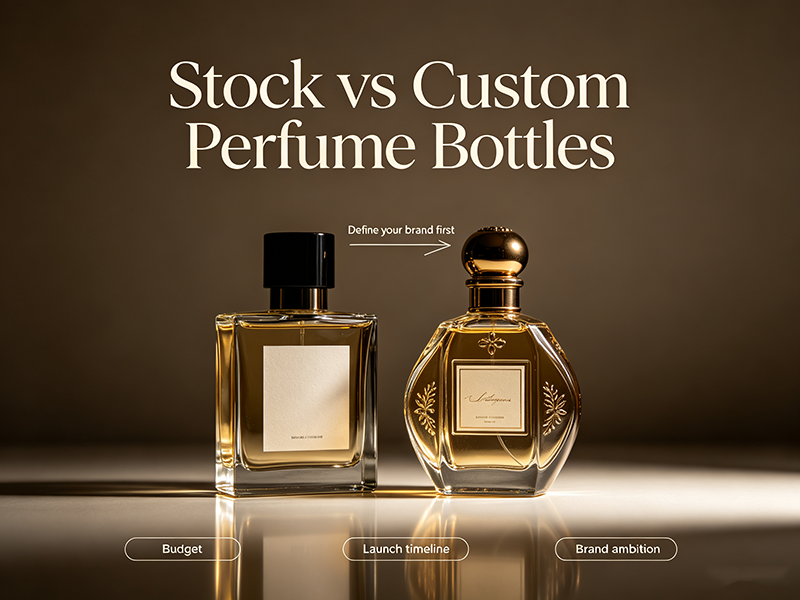
First, Define What “Stock” and “Custom” Actually Mean
Packaging discussions become confusing when the same terms are used for different levels of customization. Before comparing quotations, make sure the brand and supplier are using the same definitions.
A Stock Mold Is Not Always Ready Inventory
A stock perfume bottle usually means that the glass mold already exists. The bottle does not require the brand to pay for a new glass mold or wait for a new bottle design to be engineered from the beginning.
However, an existing mold does not necessarily mean finished bottles are physically available for immediate shipment. The supplier may have:
Finished bottles in warehouse inventory
Undecorated bottles available but no matching components
A proven mold that requires a new production run
Limited quantities in one capacity or neck specification
A bottle body that is available while the desired cap or pump is not
Brands should therefore ask two separate questions:
Does an existing mold exist?
Are the required bottles and compatible components physically available now?
This distinction affects sample availability, production planning, and the reliability of the proposed launch date.
Stock Bottles Can Still Be Customized
Using a stock glass bottle does not mean accepting a completely generic package. An existing bottle can be customized through:
Spray coating
Screen printing
Hot stamping
Frosting
UV printing
Decals
Metallization
A selected or custom-finished cap
A coordinated pump and collar
A custom folding carton or rigid box
This route is more accurately described as stock bottle customization. The glass silhouette is based on an existing mold, while the visible brand expression is created through color, decoration, accessories, and outer packaging.
Custom Decoration Is Not the Same as a Custom Glass Mold
A bottle with a custom color and printed logo may be unique to the brand visually, but the underlying glass shape can still be available to other buyers. A true custom perfume bottle generally involves a proprietary glass design and a new mold made for the project.
Custom glass development may control:
Bottle silhouette
Height, width, and depth
Shoulder profile
Base thickness
Glass weight and distribution
Footprint and stability
Capacity and fill level
Logo embossing or debossing
Special surface geometry
Neck position and compatible closure concept
This creates more differentiation, but it also introduces more technical and commercial responsibility.
The Short Answer: Most New Brands Should Start With a Strong Stock-Bottle Strategy
For many first-time fragrance launches, a well-selected stock bottle is the more commercially disciplined starting point. It reduces tooling exposure, lowers the initial glass MOQ, simplifies validation, and gives the brand more flexibility if the product, positioning, or sales forecast changes.
That does not mean every new brand should avoid a custom mold. A proprietary bottle may be justified when the silhouette is essential to the business concept, projected volume is credible, funding is sufficient, and the launch plan can absorb a longer development process.
The better question is not “Which option looks more premium?” It is:
Which packaging route creates enough differentiation to support the brand while keeping quantity, cash exposure, timing, and technical risk within a range the business can sustain?
For some brands, the answer is stock glass plus custom decoration. For others, it is a new glass mold. For many, the best answer is a staged path between the two.
Stock vs Custom Perfume Bottles at a Glance
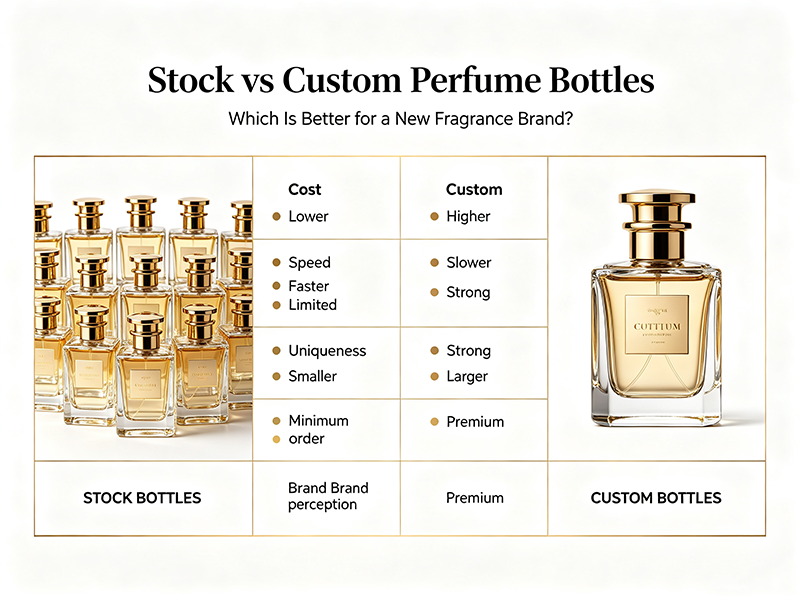
| Decision factor | Stock perfume bottle | Custom perfume bottle |
|---|---|---|
| Glass mold | Existing mold | New project-specific mold |
| Glass MOQ reference at DAXIN | 3,000 pcs | 10,000 pcs |
| Tooling investment | No new glass mold required | New mold and development investment required |
| Development path | Usually simpler | Requires drawings, engineering, mold trials, and validation |
| Brand differentiation | Created mainly through decoration, cap, and box | Includes proprietary glass silhouette and dimensions |
| Flexibility before launch | Higher | Lower after tooling and trials begin |
| Technical risk | Lower when the bottle is proven | Higher until manufacturing and assembly are validated |
| Inventory exposure | Lower glass commitment | Higher glass commitment and more project-specific inventory |
| Time to obtain a sample | Often faster if samples are available | Longer because trial samples must be produced |
| Exclusivity | Limited at the glass-shape level | Greater control, subject to tooling and commercial agreements |
| Best fit | Testing, first launch, lower-risk growth | Validated concept, higher volume, strong need for signature shape |
The table is a starting point, not a final answer. Caps, pumps, decoration, and boxes can have different MOQs from the glass bottle and may change the commercial result.
1. Compare Minimum Order Quantities Across the Complete Package
MOQ is the first practical filter because it determines how much packaging the brand must purchase before it has proven sales.
At DAXIN, the project-planning MOQ references are:
| Component or process | MOQ reference |
|---|---|
| Stock glass bottle | 3,000 pcs |
| Custom glass bottle | 10,000 pcs |
| Cap | 10,000 pcs |
| Pump | 10,000 pcs |
| Paper box | 3,000 pcs |
| Spraying | 3,000 pcs per color |
| Silk printing | 1,000 pcs |
| Electroplating | 10,000 pcs |
These are planning references. The final MOQ must be confirmed for the selected component, color, material, process, and artwork.
The Bottle MOQ Is Not the Project MOQ
A new brand may see a 3,000-piece stock-bottle MOQ and assume the complete package can be produced at 3,000 units. That assumption can be wrong if the selected pump and cap each require 10,000 pieces.
The brand may then face four choices:
Choose available components that support the lower launch quantity
Purchase excess caps and pumps for future production
Increase the first order if forecast and cash flow support it
Redesign the package around a more compatible MOQ structure
This is why every sourcing project needs an MOQ matrix. List the bottle, pump, collar, cap, each decoration process, box, and insert. Record the minimum for every line and identify which components will remain after the first filling run. When evaluating a perfume bottle MOQ, always identify which part of the project the number actually describes and what additional inventory commitments it triggers.
Multiple Fragrances Can Multiply the Real Minimum
If a brand launches three fragrances with three sprayed bottle colors, the spraying MOQ may apply to each color rather than to the combined order. Separate artwork can also create separate printing setups.
A collection that looks efficient on a total-volume spreadsheet can become inventory-heavy once quantities are divided by size, fragrance, color, and component version. New brands should calculate MOQ at the SKU and process level, not only at the collection level.
2. Compare Upfront Cash Exposure, Not Only Unit Price
Stock glass is normally associated with lower development investment because no new glass mold is required. Custom glass adds tooling, trial production, revision, and a larger minimum commitment.
But unit price alone does not describe the real financial risk.
Stock Bottle Cash Exposure
A stock route may require cash for:
Stock glass bottles
Pumps and collars
Caps
Decoration setup and units
Boxes and inserts
Samples
Packing and freight
The quantity of glass may be lower, but a custom cap or electroplated component can still require a higher purchase quantity. Brands should calculate the complete cash requirement, including excess components, rather than multiplying the bottle price by the intended filling quantity.
Custom Bottle Cash Exposure
A custom-mold route may add:
Design engineering
Glass mold cost
Trial mold or sample mold requirements
Mold modification
Trial bottle production
Larger glass MOQ
Custom packing development
Longer period before packaging can generate sales
The brand also takes on sunk-cost risk. If consumer testing, retail feedback, formula direction, or positioning changes after the mold is developed, some investment may not be recoverable.
Calculate Cash per Sellable Unit
The most useful comparison is not simply “stock costs X and custom costs Y.” Calculate:
Total cash required for packaging ÷ number of units that can actually be filled and sold in the first run
If a brand buys 10,000 caps but fills only 3,000 bottles, the unused caps remain an asset in inventory, but they still consume cash. Include storage, damage, design-change, and obsolescence risk in the decision.
3. Compare Total Development Time, Not Only Production Time
A supplier may quote a normal mass-production period of 30–35 days after order confirmation and approval of details, with high-season production around 40 days. That production period is only one part of the launch schedule.
Typical Stock-Bottle Development Stages
A stock-bottle project may still require:
Bottle and component selection
Plain sample review
Pump and cap compatibility testing
Color sampling
Artwork preparation
Decorated sample approval
Box structure development
Complete assembly approval
Mass production
Inspection and shipping
An existing bottle mold removes one major development stage, but it does not eliminate the need to approve the full package.
Additional Custom-Mold Stages
A custom bottle can add:
Concept feasibility review
Technical bottle drawings
Capacity and glass-distribution engineering
Mold design and manufacture
Trial bottle production
Dimensional inspection
Stability and neck evaluation
Mold correction where required
Decoration trials on the approved glass
Custom packing validation
Each approval can generate a new revision loop. The brand should not schedule a custom bottle as if it were simply a stock bottle with a longer factory production period.
Consider the Cost of a Late Launch
Custom glass may be worth the additional time when it creates a durable brand asset. But if a missed retailer window, seasonal launch, or funding milestone carries significant commercial cost, schedule risk may outweigh the value of the proprietary shape.
The brand should decide which date is fixed and which specification can move. If both the design and the launch date are treated as non-negotiable, risk will often reappear as air freight, rushed approvals, or compromised quality.
4. Compare Brand Differentiation Honestly
The strongest argument for a custom bottle is differentiation. A proprietary silhouette can improve recognition in product photography, on a retail shelf, and in the customer's hand. It may become a long-term brand asset that carries across multiple fragrances.
However, new brands often overestimate how much differentiation comes from glass shape alone.
A Stock Bottle Can Still Build a Recognizable Identity
Consumers experience the complete system. A stock bottle can become distinctive through:
A proprietary color palette
A disciplined print layout
A recognizable cap proportion
A consistent collar finish
A signature label or plaque
A strong box-opening sequence
Repeated visual codes across a fragrance collection
If the brand has not yet established its name, typography, color, or product architecture, a custom glass silhouette cannot solve the underlying identity problem.
A Custom Bottle Should Have a Strategic Reason
A new mold is more justified when the bottle shape performs a specific brand job, such as:
Expressing a recognizable symbol or architectural idea
Creating a distinctive grip or ritual
Supporting a refill or special closure system
Establishing a family shape for future fragrances
Delivering proportions unavailable in the stock market
Integrating logo relief into the glass
“We want something unique” is a starting desire, not a complete design brief. The brand should be able to explain what customers should recognize and why that recognition matters commercially.
5. Compare Design Flexibility and the Cost of Changing Direction
New brands learn during development. Retailers may prefer another capacity. Testing may show that the cap feels too heavy. The filling partner may require a different neck specification. The price structure may need to change.
Stock Bottles Preserve More Optionality
With an existing mold, the brand can often change color, artwork, cap selection, or box structure without abandoning the underlying bottle. This flexibility is valuable before demand and positioning are fully proven.
The bottle may also support future fragrances through new decoration. Sharing the same glass across several SKUs can simplify purchasing, filling, quality control, and inventory.
Custom Molds Increase Commitment
Once a custom mold is made and trials begin, changing height, width, base geometry, neck position, or major relief details may require mold modification or new tooling. Changes can affect the cap, box, insert, carton count, and filling setup.
This does not make custom development a bad choice. It means the brand should enter it with a more stable concept and a formal change-control process.
6. Compare Technical and Manufacturing Risk
An existing bottle that has already been produced offers useful manufacturing knowledge. The supplier may have established expectations for glass formation, decoration areas, packing, and compatible components.
A new bottle has no mass-production history until it is developed and validated.
Custom Shapes Create New Questions
Features that require careful engineering include:
Very thick or uneven bases
Sharp transitions in glass distribution
Narrow feet or small contact areas
Highly asymmetric shapes
Deep recesses
Thin projecting features
Broad flat panels sensitive to deformation
Unusual shoulder geometry
Off-center neck positions
A concept may look compelling in a rendering but create instability, decoration difficulty, glass stress, or inefficient packing.
Stock Does Not Mean Risk-Free
A stock bottle still needs inspection and assembly testing. A bottle from an existing mold may have:
A neck finish that does not match the preferred pump
Limited cap options
A decoration area smaller than expected
Variable availability
A weight that conflicts with freight targets
A shape shared too widely within the market
The difference is that stock-bottle risk is usually easier to evaluate using samples before the brand commits to glass tooling.
7. Compare Pump, Collar, and Cap Compatibility
The glass bottle cannot be evaluated independently from the closure system.
Stock Bottle Compatibility
A stock bottle with a standard, proven neck may offer a wider choice of pumps and available caps. This can shorten compatibility testing and reduce the need for custom internal structures.
However, “compatible” should still be demonstrated with an assembled sample. Check:
Pump-to-neck fit
Crimp or assembly quality
Dip-tube length
Spray pattern
Leakage resistance
Collar coverage
Cap retention
Cap alignment
Clearance around the actuator
Custom Bottle Compatibility
A custom bottle gives more control over the relationship between the glass and closure, but it also requires more coordination. If the bottle neck or shoulders are modified late, the pump, collar, cap, and box may all need to be rechecked.
The supplier should freeze key interface dimensions before related tooling is approved. The glass mold, pump specification, collar drawing, cap internal structure, and assembled height should be managed as connected documents.
Custom Caps Can Remove the MOQ Advantage of Stock Glass
A brand may choose stock glass to launch 3,000 units, then design a proprietary cap with a 10,000-piece MOQ. The cap—not the bottle—becomes the controlling commitment.
For a first launch, it may be more efficient to select an available cap structure and customize the visible finish. A fully custom cap can be introduced later when volume supports it.
8. Compare Decoration Potential
Decoration is the main tool for turning stock glass into brand-specific packaging, but bottle geometry determines what can be executed reliably.
Decoration on Stock Bottles
Before choosing a stock model, examine:
Size and flatness of the print area
Shoulder and base transitions
Ability to rotate the bottle during decoration
Areas that may collect excess coating
Visibility of seams or mold marks
How liquid color changes the visual result
Spray coating can dramatically change the character of existing glass. Screen printing and hot stamping can establish the logo hierarchy. Frosting can soften the surface, while UV printing and decals can support more complex artwork.
At DAXIN, spraying uses a 3,000-piece-per-color MOQ reference, silk printing uses a 1,000-piece reference, and electroplating uses a 10,000-piece reference.
Decoration on Custom Bottles
A custom bottle allows the decoration area to be considered during glass design. The brand can create a dedicated logo panel, relief detail, label recess, or geometry designed around a gradient.
But a custom shape can also make decoration harder. Deep curves, tight corners, and irregular surfaces may reduce color consistency or print accuracy. Decoration feasibility should be reviewed before the mold is finalized, not after the glass shape has already been approved.
9. Compare Quality-Control Complexity
Quality control should be defined before mass production regardless of the bottle route.
Stock Bottle Quality Control
For an existing bottle, the brand can often inspect representative samples and define expectations using known production characteristics. Relevant checks include:
Capacity and dimensions
Bottle stability
Neck quality
Glass distribution
Bubbles, stones, cracks, and deformation
Surface cleanliness
Decoration adhesion and position
Pump and cap fit
Custom Bottle Quality Control
A custom project needs additional validation between concept and mass-production standard. Trial samples may be used to confirm:
Whether the drawing can be manufactured consistently
Whether capacity and dimensions match the specification
Whether the bottle stands securely
Whether the glass distribution is acceptable
Whether the neck works with the intended pump
Whether decoration can be applied consistently
Whether the bottle survives the planned packing and transport method
The approved trial sample should not remain an informal visual reference. Create a controlled approval set including drawings, color standards, artwork position, closure components, box structure, and agreed inspection criteria.
10. Compare Inventory and Obsolescence Risk
Inventory risk is particularly important for new fragrance brands because demand is still uncertain.
Stock Components May Be More Reusable
Undecorated stock glass, standard pumps, and common caps may be usable across more than one fragrance if the design architecture is planned carefully. The brand can create differentiation later through decoration and boxes.
This does not guarantee that every component can be reused, but a modular package can reduce the financial impact of changing a fragrance name, color, or launch plan.
Custom Components Are More Brand-Specific
A bottle with a molded logo, unique capacity, or proprietary silhouette may have little alternative use. If the brand changes its identity or discontinues the product, remaining glass and matching components may become obsolete.
Before committing to a custom mold, calculate:
Expected first-year sell-through
Reorder probability
Storage cost
Risk of artwork or formula changes
Whether the bottle will support future fragrances
Whether the cap and pump can be shared
What happens to unused packaging if the launch underperforms
A custom bottle becomes more financially defensible when it is designed as a long-term platform, not a single short-lived novelty.
11. Compare Shipping and E-Commerce Performance
Bottle shape and weight affect logistics whether the glass is stock or custom.
Efficient Stock Shapes
Rectangular and compact stock bottles may support efficient dividers, cartons, and shelf arrangements. The brand can compare several proven shapes and choose one that balances presence with pack density.
Custom Shape Opportunities and Tradeoffs
A custom bottle can be engineered for efficient packing, but creative concepts sometimes prioritize width, projection, or weight without calculating the logistics impact.
Confirm:
Assembled bottle dimensions
Net and gross unit weight
Units per inner and master carton
Carton dimensions and gross weight
Protection between decorated surfaces
Pallet configuration where applicable
E-commerce parcel requirements
A heavy or irregular package may look impressive but increase freight and breakage exposure. The cost should be evaluated per delivered sellable unit, not only at the factory gate.
12. Compare Exclusivity and Brand Ownership
Stock glass generally offers limited exclusivity because the underlying mold may be used for other customers. Brands should not assume a catalog bottle becomes exclusive simply because they customize it.
Differentiation can still be protected through proprietary artwork, brand elements, a unique color system, custom box design, or a cap developed under a clear commercial agreement.
For a custom mold, clarify:
Who pays for the mold
Who owns or controls its use
Whether the shape is exclusive
Which regions, products, or time periods are covered
Who stores and maintains the tooling
What happens if the relationship ends
Whether replacement or repair costs are defined
How technical drawings and revisions are recorded
Intellectual-property protection depends on jurisdiction, originality, agreements, and registration strategy. A packaging supplier can clarify manufacturing and tooling arrangements, but the brand should obtain appropriate legal advice for design rights, trademarks, and contractual protection.
13. Compare Scalability Across Future Fragrances
The first bottle decision should consider what happens after a successful launch.
Stock-Bottle Family Strategy
A stock bottle can become the base of a collection. Different fragrances may share the same glass, pump, cap structure, and box dimensions while using separate colors and artwork.
Benefits can include:
Consolidated glass purchasing
Shared closure inventory
Simpler filling-line setup
Easier quality standards
More efficient box engineering
Faster introduction of new fragrances
The risk is that the collection may rely too heavily on decoration for differentiation. Strong art direction and consistent brand codes become essential.
Custom-Bottle Platform Strategy
A proprietary bottle can create a powerful family asset if the brand plans to use it across several fragrances and years. Tooling investment and development effort are spread over a larger commercial base.
Before developing it, ask:
Can the bottle support several fragrance identities?
Will one cap system work across the range?
Can future sizes use related proportions?
Is the silhouette connected to the brand rather than a short-term trend?
Can the package be produced profitably at forecast reorder volumes?
The custom route is strongest when it supports a repeatable platform rather than a one-time object.
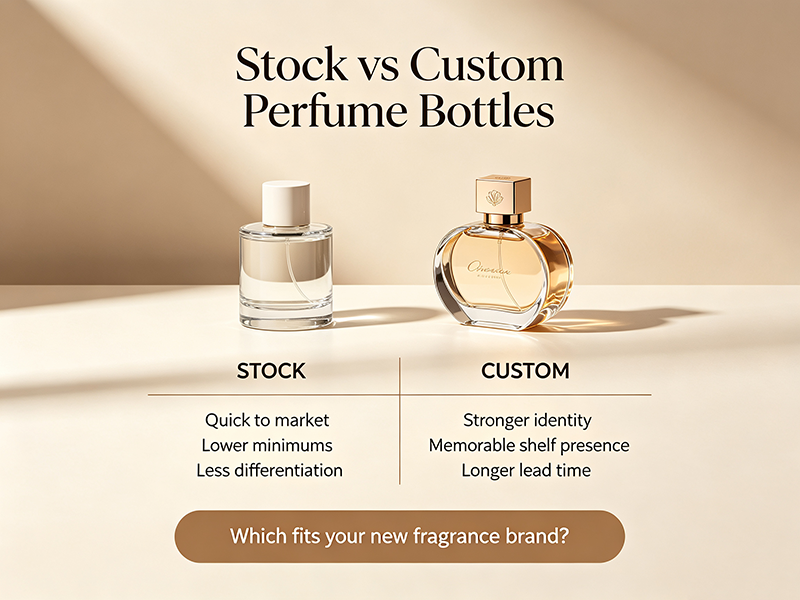
When a Stock Perfume Bottle Is the Better Choice
A stock bottle is usually the better option when several of the following conditions are true:
The brand is preparing its first launch
Demand has not yet been validated
The first order needs to remain near 3,000 glass bottles
The launch date is commercially important
Funding should be preserved for formula, marketing, filling, or distribution
The brand identity can be expressed through color, print, cap, and box
The team expects to learn from the first production run
Multiple fragrances need to share components
A suitable existing shape and neck specification are available
The business prefers lower sunk-cost exposure
The stock route is not a lack of ambition. It can be a deliberate way to protect capital and learn faster.
When a Custom Perfume Bottle Is the Better Choice
A custom glass mold becomes more suitable when:
The bottle silhouette is central to the brand proposition
No existing bottle can deliver the required proportions or function
The brand can support at least the custom-glass MOQ reference
Projected demand is supported by credible sales channels or prior performance
The business can fund tooling without weakening other launch activities
The development schedule allows trials and revisions
The design direction is stable
The bottle will support several reorders or future fragrances
The team can manage technical approvals and change control
The commercial value of exclusivity exceeds the additional risk
Custom glass should be an investment in durable brand equity, not an attempt to compensate for an unclear product strategy.
The Hybrid Route: Often the Best Answer for a New Brand
The most practical choice is not always fully stock or fully custom. A hybrid strategy uses proven elements where they reduce risk and selected custom details where they create the most brand value.
Examples include:
Stock glass with a custom sprayed color
Stock bottle and pump with a custom-finished cap
Existing cap structure with a proprietary outer shell
Stock bottle with a unique plaque or label system
Shared bottle and cap across several fragrances with distinct decoration
Stock glass for the first launch, followed by a custom mold after demand is validated
Why the Hybrid Model Works
It lets the brand concentrate investment on the touchpoints customers notice most. It also preserves proven bottle and pump geometry while creating a more ownable visual identity.
For example, if a new glass mold and fully custom cap would strain the budget, the brand might use a stock bottle and invest in a memorable cap finish, controlled gradient, and strong box. The result can appear deliberate without taking on every category of tooling and inventory risk at once.
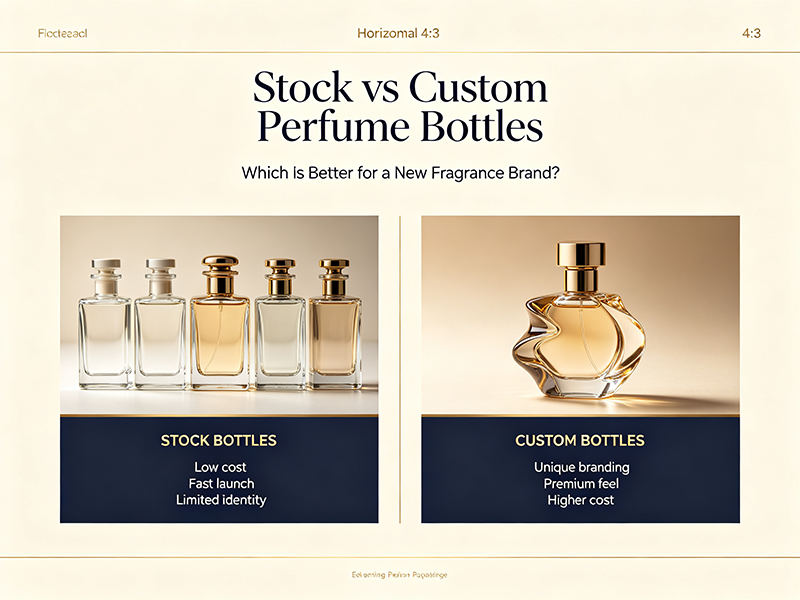
A Three-Stage Packaging Roadmap for New Fragrance Brands
Stage 1: Validate the Product
Use a proven stock bottle, compatible closure, limited decoration palette, and efficient box. Launch one hero capacity or a tightly controlled SKU range. The objective is to validate fragrance demand, positioning, and pricing.
Stage 2: Build Recognition
After repeat demand becomes visible, upgrade the element that creates the greatest brand value. This may be a proprietary cap shell, more distinctive decoration, better glass weight, or a more memorable box-opening experience.
Keep compatibility with existing pumps, filling processes, and carton structures where practical.
Stage 3: Invest in a Signature Bottle
Once the brand has a stable customer base, repeat forecast, and mature visual identity, evaluate a custom glass mold. Use sales data and customer feedback to decide which size, hand feel, silhouette, and functional details deserve long-term investment.
This roadmap turns custom packaging into a response to validated business needs rather than a speculative first expense.
A Weighted Decision Scorecard
New brands can use a simple scorecard to make the decision more objective. Assign an importance weight from 1 to 5 to each factor. Then score stock and custom from 1 to 5 based on the actual supplier proposals.
| Criterion | Suggested question |
|---|---|
| Launch speed | How costly would a delay be? |
| Available cash | Can the business support tooling and higher component commitments? |
| Demand confidence | Is the forecast supported by orders, distribution, or proven sales? |
| Need for a unique shape | Is glass geometry essential to brand recognition or function? |
| Design stability | Is the concept mature enough to freeze dimensions? |
| Quantity fit | Do planned volumes support every component MOQ? |
| Technical capacity | Can the team manage drawings, trials, tolerances, and changes? |
| Inventory tolerance | What is the financial impact of unused custom packaging? |
| Future platform value | Will the bottle support several reorders or fragrances? |
| Logistics efficiency | Does the proposed shape meet freight and breakage targets? |
Multiply importance by each option's score. The result does not replace management judgment, but it exposes where enthusiasm for a custom shape may be overriding the business constraints—or where excessive caution may be preventing a valuable long-term asset.
Example Scenarios
Scenario A: Self-Funded Niche Fragrance Startup
The brand plans one 50ml fragrance, expects modest direct-to-consumer sales, and has no prior sell-through data. Packaging must look premium, but funding is also needed for formulation, filling, photography, samples, and advertising.
Better route: Stock bottle customization.
Select a strong existing shape, use one controlled spray color, apply clean screen printing, choose an available cap structure, and invest in a well-fitted box. Preserve cash and learn from the first launch.
Scenario B: Influencer-Led Brand With Confirmed Preorders
The brand has a recognizable symbol, a large launch audience, confirmed preorder demand, and enough capital for tooling. The bottle shape is central to the story and will be used across several planned fragrances.
Potentially better route: Custom glass mold, subject to a realistic schedule and technical feasibility.
The brand should still build contingency into the timeline and validate the closure, decoration, and box using complete assembly samples.
Scenario C: Private-Label Brand Launching Five Fragrances
The company wants five scents in different colors but with a unified collection identity. The total order is meaningful, while the quantity of each fragrance is limited.
Better route: Shared stock bottle and closure platform.
Use the same glass, pump, cap, and box dimensions across the range. Differentiate through coating and artwork while checking the spraying MOQ per color.
Scenario D: Established Regional Brand Replacing a Generic Bottle
The brand already has repeat sales and distributor demand. Its current stock bottle no longer supports price positioning, and competitors use similar silhouettes.
Potentially better route: Custom bottle platform.
Use sales history to set volume, develop a recognizable shape, and plan the bottle for several fragrances and reorders rather than one limited release.
Questions to Ask a Perfume Bottle Manufacturer Before Deciding
Before approving either route, ask:
Does the proposed stock bottle physically exist, or does only the mold exist?
What quantity is currently available?
Which pumps, collars, and caps have been tested with the bottle?
What is the MOQ for every component and decoration process?
Which costs are one-time tooling costs and which are recurring?
What samples will be provided before production?
What are the main technical risks of the custom design?
Which dimensions must be frozen before cap and box development?
What decoration areas and tolerances are realistic?
How will color, print position, and cap fit be approved?
How will the bottle be packed to protect decorated surfaces?
What is the normal production period after final approval?
What inventory remains if the first filling quantity is below a component MOQ?
Who controls the custom mold, drawings, and future use?
Which change would have the greatest impact on price or timing?
Whether a brand is speaking with a custom perfume bottle manufacturer, a stock perfume bottle supplier, or an integrated perfume packaging supplier, the supplier should make the tradeoffs clearer, state assumptions, and recommend a route based on the whole project rather than pushing the most customized option.
Common Mistakes to Avoid
Assuming Stock Means Immediate Delivery
Confirm physical inventory, compatible components, and decoration capacity. An existing mold may still require production.
Choosing a Custom Bottle Before Confirming Sales Volume
Visual enthusiasm should not replace a credible quantity plan. Calculate cash exposure and expected sell-through first.
Comparing Bottle Prices Instead of Complete Packaging Costs
Include the pump, cap, decoration, box, insert, excess components, packing, freight, and inspection requirements.
Using a Custom Cap That Defeats the Stock-Bottle Strategy
A high-MOQ cap can become the largest inventory commitment. Review every component before claiming the project is a low-MOQ launch.
Finalizing the Box Before the Assembly
The approved bottle, pump, collar, and cap determine the final height, weight, and insert clearance.
Approving Only From Renderings
Renderings communicate design intent but do not prove glass quality, hand feel, stability, cap fit, spray performance, or decoration consistency.
Treating Heavier Glass as the Only Luxury Signal
Premium quality also comes from proportions, clarity, balance, fitting precision, finish consistency, and a coherent unboxing experience.
Starting Custom Tooling With an Unstable Brand Identity
If the name, logo, capacity, price point, or target customer may change, keep more options open until the strategy is mature.
Final Decision Checklist
Choose a stock perfume bottle when you need to:
Protect cash
Reduce glass MOQ
Launch with less tooling risk
Preserve design flexibility
Test market demand
Share components across fragrances
Use decoration and accessories for differentiation
Choose a custom perfume bottle when you have:
A stable and meaningful shape concept
Sufficient funding
Quantity that supports the glass MOQ
Credible demand or distribution
A realistic development schedule
Technical approval capability
A plan to use the design across multiple reorders or products
Choose a hybrid strategy when:
You need a recognizable package but cannot justify full custom glass
One touchpoint creates more value than changing every component
You want to validate demand before investing in a proprietary mold
You can share proven bottle and pump geometry while customizing visible details
Final Thoughts
For most new fragrance brands, the best first bottle is not the most technically ambitious option. It is the package that expresses the brand clearly, works reliably, meets the launch quantity, protects cash, and leaves enough flexibility to respond to real market feedback.
A stock perfume bottle can deliver a premium and recognizable result when color, decoration, cap, pump, and box are developed as one system. A custom glass mold becomes more valuable when demand is proven, the brand identity is stable, and the proprietary shape can support multiple production runs. The right perfume bottle mold decision should therefore follow the commercial case, not precede it.
The decision between stock vs custom perfume bottles should therefore be made with a complete commercial model—not only a mood board. Compare component-level MOQs, total cash exposure, development time, technical risk, inventory, logistics, and long-term brand value.
If you are evaluating stock or custom bottles for a new fragrance line, share your capacity, quantity, design references, decoration direction, cap and pump requirements, box concept, target market, and launch schedule. An experienced perfume packaging supplier can then compare practical routes and coordinate the glass bottle, pump, collar, cap, decoration, and outer packaging as one compatible custom perfume packaging system.
Perfume Bottle FAQs:
1. Are stock perfume bottles suitable for a luxury fragrance brand?
Yes. Luxury positioning depends on the complete experience, not only on whether the glass mold is proprietary. A well-proportioned stock bottle can support a luxury fragrance when it is combined with controlled decoration, a precise cap and pump system, a strong box, and consistent quality. The brand should choose a bottle that fits its price position rather than assuming every luxury launch requires custom glass.
2. What is the MOQ for stock and custom perfume bottles?
At DAXIN, the stock glass bottle MOQ reference is 3,000 pieces, while custom glass bottles use a 10,000-piece reference. Pumps and caps use a 10,000-piece reference, paper boxes 3,000 pieces, spraying 3,000 pieces per color, silk printing 1,000 pieces, and electroplating 10,000 pieces. Final MOQs depend on the selected components and processes.
3. Is a stock bottle the same as an in-stock bottle?
Not always. "Stock bottle" often means that an existing mold is available. Finished glass may or may not be physically in warehouse inventory. Brands should confirm current quantity, capacity, neck specification, compatible components, and whether a new production run is required.
4. Can a stock perfume bottle be customized?
Yes. Stock glass can be customized through spray coating, screen printing, hot stamping, frosting, UV printing, decals, metallization, selected caps, custom finishes, and branded boxes. The glass silhouette may remain available to other buyers, but the complete package can still develop a distinctive identity.
5. How much more does a custom perfume bottle cost?
There is no universal percentage. The difference depends on mold complexity, glass weight, order quantity, trial requirements, revisions, cap and pump development, decoration, packing, and freight. Brands should compare total project cash and cost per sellable unit rather than only the bottle unit price.
6. How long does it take to develop a custom perfume bottle?
Custom development is longer than a comparable stock-bottle project because it requires technical drawings, mold production, glass trials, inspection, possible correction, decoration samples, and complete assembly approval. Mass production is scheduled only after the necessary details are approved. The exact timeline depends on design complexity and revision cycles.
7. When should a new fragrance brand invest in a custom bottle mold?
A custom mold is more appropriate when the brand has a stable design direction, sufficient funding, credible demand, quantity that supports the MOQ, and a plan to use the shape across multiple reorders or fragrances. It should create commercial value that justifies the added cost and risk.
8. What is the best compromise between stock and custom packaging?
A hybrid package often provides the best balance. The brand can use proven stock glass and a compatible pump while customizing the color, print, cap finish, plaque, label, or box. This concentrates investment on visible brand touchpoints while reducing glass tooling and development risk.