
How to Source Custom Perfume Bottles and Packaging for Your Fragrance Brand
How to Source Custom Perfume Bottles and Packaging for Your Fragrance Brand
Sourcing custom perfume bottles is not simply a matter of choosing an attractive piece of glass and asking for a price. A finished fragrance package is a coordinated system: the bottle must work with the pump, the pump with the collar, the collar with the cap, and the assembled product with the insert, box, filling line, shipping carton, and intended retail position.
When these elements are sourced as separate visual decisions, problems often appear late. A cap may look correct but sit too high. A pump may fit the neck but deliver the wrong spray experience. A decorated bottle may not fit the approved insert. A heavy glass base may support luxury positioning but add unexpected freight and breakage risk. A custom component may also have a much higher minimum order quantity than the rest of the package.
The right sourcing process prevents these conflicts before mass production. It connects brand strategy, design, engineering, manufacturing, quality control, logistics, and commercial planning. Buyers evaluating a custom perfume bottle manufacturer should therefore look beyond available shapes and examine how the supplier manages the complete development process.
This guide explains how fragrance founders, brand managers, product developers, importers, and purchasing teams can source custom perfume bottles and packaging with greater control. It covers the decisions that matter from the first packaging brief to final shipment, including stock bottles versus custom molds, component compatibility, decoration, minimum order quantities, samples, cost control, supplier evaluation, and quality inspection.
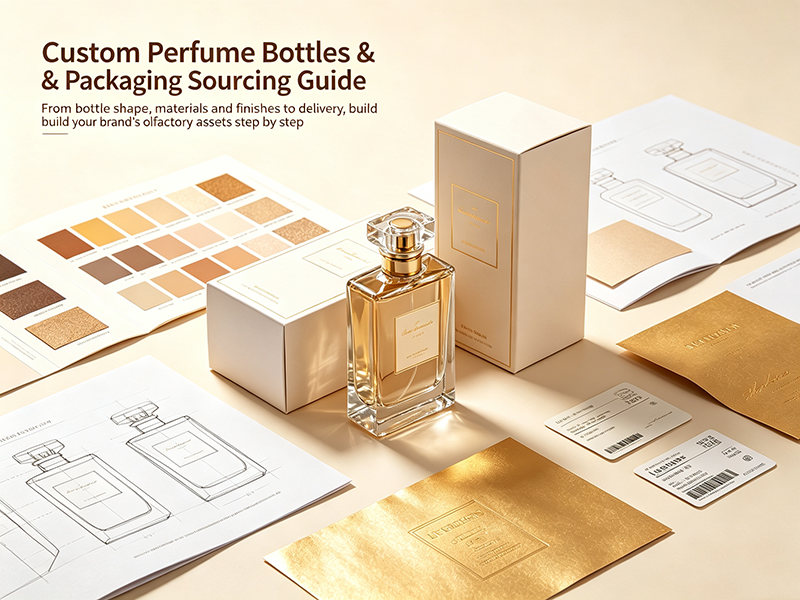
Source a Packaging System, Not a Collection of Parts
A fragrance customer experiences the package as one product. They do not separate the glass supplier from the pump supplier or the cap factory from the box converter. They see the bottle silhouette, feel the weight, remove the cap, press the atomizer, and open the box as one continuous brand experience. Effective perfume bottle packaging must preserve that continuity from the outer carton to the final spray.
Your sourcing process should reflect that reality.
At a minimum, a complete perfume packaging system may include:
Glass perfume bottle
Spray pump and dip tube
Crimp collar or decorative collar
Cap and internal cap structure
Bottle decoration
Label, plaque, charm, or other accessory
Folding carton or rigid box
Inner tray or insert
Protective packing and export carton
Every component creates technical dependencies. Changing the bottle neck may require a different pump. Changing the cap material may affect cap weight and retention. Increasing the bottle base thickness may change the box height, shipping weight, and retail cost. Adding a projecting ornament may require more space inside the insert.
This is why an experienced perfume packaging supplier should do more than send a catalog. The supplier should help identify dependencies, confirm what must be tested, and establish which specifications need approval before the next component is developed.
Step 1: Build a Commercially Clear Packaging Brief
Good sourcing begins before the first quotation. If a brand sends only a mood board and asks, “How much is this bottle?”, any immediate price is likely to be based on assumptions. Those assumptions may later change the quotation, minimum order quantity, tooling requirement, or production timeline.
A useful packaging brief gives the supplier enough information to recommend a technically and commercially realistic route.
Define the Target Customer and Brand Position
Start with the person who will buy the fragrance. Consider their market, price expectations, shopping environment, visual preferences, and reasons for choosing the product.
A niche fragrance sold through specialist retailers may need a different packaging experience from a private-label fragrance sold online. A prestige product may justify heavier glass, a custom cap, and a structured box. An accessible line may create stronger value through a good stock bottle, controlled color, clean printing, and an efficient folding carton.
“Luxury” is not a sufficient specification. Define what luxury means for the project. It could mean optical clarity, a thick base, quiet typography, a precisely fitted weighted cap, a magnetic closure, a rigid box, or a distinctive custom silhouette. The brand should identify which two or three details customers are expected to notice first.
Confirm the Fragrance Architecture
Clarify the planned bottle sizes and how they relate to one another. A collection may include 30ml, 50ml, and 100ml formats, but each additional size creates more component development, artwork, inventory, and quality-control work.
Ask whether every size is necessary for the first launch. A startup may gain more control by launching one hero size, validating demand, and adding other capacities later. If multiple sizes are essential, determine whether they should look like a proportional family or use the same cap and visual language across different bottle bodies.
Establish Quantity Before Selecting a Route
Order quantity affects almost every sourcing choice. It determines whether a stock bottle is practical, whether a custom glass mold can be justified, and whether custom pumps, caps, or decoration processes are available.
The quantity discussion should include:
First production quantity per bottle size
Quantity per fragrance or color
Expected annual volume
Reorder forecast
Number of decoration versions
Whether excess components can be used in a future production run
Do not treat “10,000 units” as one universal quantity if the collection includes five colors or several fragrances. A spraying minimum may apply per color, while a printing setup may apply per artwork. Component suppliers may also require different minimums.
Set a Real Launch Date
The date when products must arrive at the warehouse is more useful than a general statement such as “launching soon.” Work backward from that date and include time for:
Design revision
Technical drawings
Mold development, if required
Component sourcing
Plain and decorated samples
Artwork approval
Compatibility testing
Mass production
Quality inspection
Export packing
International transport
Filling and final assembly
A production estimate should not be confused with the total development timeline. At DAXIN, normal production is typically planned around 30–35 days after order confirmation and approval of the relevant details; high-season production may be around 40 days. Sampling, mold trials, revisions, shipping, and customer approval are additional stages and should be scheduled separately.
Step 2: Choose Between a Stock Bottle and a Custom Glass Mold
One of the first major decisions is whether to customize an existing perfume bottle or create a proprietary glass shape.
Neither route is automatically superior. The best option depends on expected volume, launch timing, available investment, technical risk, and how much commercial value a unique silhouette will create.
Option A: Customize a Stock Perfume Bottle
A stock bottle uses an existing glass mold. The same underlying bottle shape may be available to other buyers, but its appearance can be transformed through color, decoration, cap selection, collar finish, and outer packaging.
This route is usually appropriate when a brand:
Is launching its first product
Needs a lower starting quantity
Has a limited development budget
Wants to reduce tooling risk
Needs samples sooner
Plans to test demand before investing in a proprietary bottle
A well-selected stock bottle does not have to look generic. A distinctive sprayed color, disciplined screen print, custom cap treatment, and thoughtful box can produce a recognizable result. The key is to create a clear hierarchy. One memorable decision, executed consistently, is often stronger than adding several unrelated decorative processes.
At DAXIN, the stock-bottle MOQ reference is 3,000 pieces. Other components may carry higher minimums, so a 3,000-piece glass route does not automatically mean that every custom cap, pump, or finish is available at the same quantity.
Option B: Develop a Custom Perfume Bottle Mold
A custom mold gives the brand greater control over the glass shape, dimensions, shoulder line, footprint, base thickness, capacity, logo relief, and overall proportions. It can turn the bottle into a long-term visual asset rather than simply a container.
This route is more suitable when:
The bottle silhouette is central to brand recognition
Projected volume supports tooling and development
The brand has a stable design direction
Existing bottles cannot meet the required proportions
The filling and packing process can accommodate a new shape
The launch schedule allows for mold trials and revision
Custom glass also creates more engineering work. A drawing that looks attractive on screen may not be easy to manufacture, decorate, fill, or pack. Extremely narrow contact areas can affect stability. Abrupt changes in glass distribution can create manufacturing difficulty. Deep recesses may be difficult to spray evenly. A very wide bottle may reduce carton efficiency and increase freight.
At DAXIN, custom glass bottle projects use a 10,000-piece MOQ reference. The final feasibility, tooling requirements, and quantity must still be confirmed from the actual design.
| Decision factor | Stock bottle | Custom bottle mold |
|---|---|---|
| Initial investment | Lower | Higher because tooling and development are required |
| Development speed | Usually faster | Longer due to drawings, mold making, trials, and revisions |
| Starting risk | Lower | Higher until the bottle and assembly are validated |
| Differentiation | Mainly through decoration, cap, and box | Stronger control over the glass identity itself |
| Flexibility | Limited to existing dimensions and neck options | Greater control over proportions and features |
| Best use | Market testing, first launches, faster projects | Established direction, higher volume, long-term brand asset |
Step 3: Evaluate the Bottle Beyond Its Appearance
Bottle images and rendered concepts are useful for direction, but sourcing decisions require physical and technical information.
Capacity and Brimful Volume
The nominal capacity—such as 50ml or 100ml—is not the only relevant number. The supplier should confirm the intended fill level and brimful capacity. The shape of the shoulders and the required headspace influence where the liquid sits visually after filling.
The bottle should also be evaluated with the actual liquid color. Clear perfume liquid, amber liquid, and tinted formulations can change how the glass color and base thickness appear.
Dimensions and Stability
Confirm the bottle's height, width, depth, and contact area. A bottle that looks elegant from the front may be unstable if its base is too narrow relative to its height and cap weight. Check whether it sits flat without rocking and whether the shape is comfortable to hold during use.
For retail and e-commerce, dimensions also influence:
Shelf efficiency
Box size
Master-carton quantity
Warehouse space
Dimensional shipping cost
Photography and display presentation
Glass Weight and Distribution
Heavy glass and a thick base can create a substantial hand feel, but weight alone does not guarantee quality. Even glass distribution, stable geometry, clear surfaces, and controlled finishing matter more than simply maximizing grams. The best luxury perfume bottles use weight as one controlled design signal rather than treating it as the only measure of premium quality.
Extra weight also has commercial consequences. It increases material use, outbound freight, carton requirements, and impact energy if the product is dropped. Brands should define the desired hand feel and then find the most efficient glass construction that delivers it.
Neck Finish
The bottle neck is one of the most important technical specifications in the complete package. It determines which spray pump can be fitted and affects the collar and cap structure.
Do not approve a bottle based only on capacity and appearance. Obtain a technical drawing or confirmed neck specification and ensure the pump supplier is working from the same information.
Step 4: Engineer the Pump, Collar, and Cap as One Closure System
Many perfume packaging failures occur because components are approved individually rather than as an assembled unit.
Spray Pump Compatibility
The pump must match the bottle neck and the chosen assembly method. In addition to fitting dimensions, evaluate:
Spray pattern and mist quality
Output per actuation
Actuator comfort
Priming performance
Leakage resistance
Dip-tube length and cut
Compatibility with the fragrance formulation
Crimping or assembly requirements
Pump performance should be tested with the intended liquid whenever possible. A water test can identify basic function, but it may not represent the behavior of the final fragrance formula.
DAXIN's pump MOQ reference is 10,000 pieces. Custom colors or finishes may require additional confirmation.
Collar Design
The collar hides or integrates the pump connection and helps connect the glass visually to the cap. Its outside diameter, height, finish, and method of attachment should be coordinated with both the pump and the cap.
A collar that is slightly too wide may scratch the inside of the cap. One that is too low can expose technical parts of the pump. Metallic finishes should also be checked for shade consistency with the cap or printed decoration.
Cap Material and Construction
Cap material affects appearance, weight, cost, tooling, finish, and minimum order quantity.
Common options include:
ABS: Flexible for shapes, colors, coatings, and decorative finishes; often practical for cost-controlled custom designs.
Aluminum: Clean, precise, and contemporary; commonly used as a shell or visible metallic component.
Zamac: Provides weight and detailed forms but increases component and transport weight.
Wood: Adds warmth and natural variation; grain and shade consistency require realistic tolerance standards.
Multi-material caps: Combine an internal functional structure with an external shell to balance fit, appearance, and weight.
Magnetic caps: Offer a controlled closing action but require accurate alignment and testing of the complete internal system.
A cap should be evaluated for more than its appearance. Check whether it sits vertically, maintains an even gap around the collar, removes with appropriate force, protects the actuator, and remains secure during transport.
DAXIN's cap MOQ reference is 10,000 pieces. If a brand plans 3,000 stock bottles but wants a fully custom cap, the quantity mismatch must be resolved early. Possible solutions include selecting an available cap, using a standard structure with a custom finish, purchasing cap inventory for future orders, or increasing the launch quantity when commercially justified.
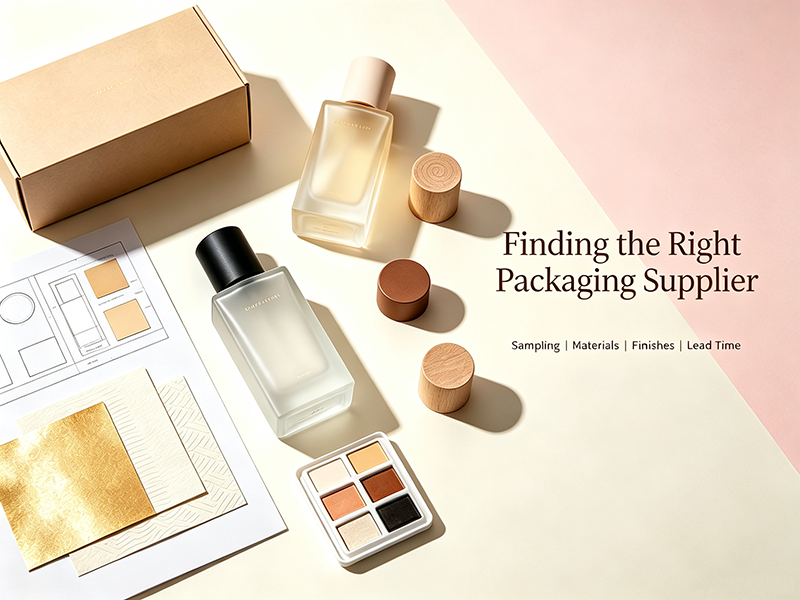
Step 5: Select Decoration for the Intended Visual Effect
Decoration should communicate brand position, not simply demonstrate how many processes can be applied to glass.
Spray Coating
Spraying can create transparent, translucent, opaque, matte, glossy, gradient, or solid-color effects. It is one of the most effective ways to transform a stock bottle.
Provide a clear color reference, ideally supported by a Pantone number and a physical target when precise matching matters. The same coating can appear different depending on glass thickness, liquid color, surface texture, lighting, and viewing angle.
DAXIN's spraying MOQ reference is 3,000 pieces per color. A collection with several colorways therefore needs an MOQ plan for each color, not only for the total order.
Screen Printing
Screen printing works well for logos, fragrance names, volume statements, and controlled graphic lines. It can provide solid, readable color directly on the bottle.
Artwork should be supplied in vector format. Very thin lines, very small text, large print areas, or artwork crossing strong curves may require adjustment. Confirm the print location using an approved drawing or physical sample rather than relying only on a front-view rendering.
DAXIN's silk-printing MOQ reference is 1,000 pieces, subject to the actual artwork and project requirements.
Hot Stamping
Hot stamping adds a reflective metallic accent. It is effective when the design needs a focused gold, silver, or other foil detail. Large or complex areas may be more sensitive to the bottle curvature and surface condition, so feasibility should be confirmed from the actual artwork.
Frosting
Frosting diffuses reflections and can give the glass a soft, quiet appearance. It may suit minimalist, skincare-inspired, classic, or tactile brand directions. The brand should check how frosting affects liquid visibility and how easily the surface shows handling marks.
Metallization and Electroplating
Metallization can create mirror-like or high-impact surfaces. Electroplating is commonly considered for caps, collars, and accessories that need a metallic appearance. Both processes require careful color and surface approval because small shade differences may become obvious when several metallic components are assembled together.
DAXIN's electroplating MOQ reference is 10,000 pieces.
UV Printing, Decals, and Relief Details
UV printing supports detailed and multicolor graphics. Decals can carry complex artwork onto areas that may not suit simple screen printing. Embossed or debossed details can be integrated into custom glass molds, caps, plaques, or paper packaging.
For every decoration process, approve measurable criteria where possible:
Color reference
Artwork size
Position tolerance
Finish level
Adhesion requirement
Abrasion resistance
Acceptable variation
Inspection lighting and viewing distance
This turns a visual preference into an inspectable specification.
Step 6: Develop the Box After the Bottle Assembly Is Confirmed
The outer box should not be finalized from a bottle rendering alone. Its internal dimensions depend on the assembled bottle, including the pump, collar, cap, decorative elements, and any protective clearance.
Folding Carton or Rigid Box
A folding carton is generally more space-efficient and may be suitable for accessible, premium, and some luxury positions depending on board, printing, finishing, and structure. A rigid box creates a more substantial opening experience but adds material, assembly, shipping volume, and cost.
Choose the structure according to the commercial role of the package—not because one box type is universally more luxurious.
Insert and Product Protection
The insert should hold the bottle securely without damaging decoration. A heavy bottle needs adequate support at the base and sides. A coated or metallized surface may need protection from rubbing. If the cap is unusually heavy, the package should prevent movement that could stress the pump or neck during transport.
Possible insert materials include paperboard, molded pulp, foam, plastic, or combined structures. Selection depends on protection, presentation, material strategy, cost, and destination-market requirements.
Artwork and Required Information
Confirm the panels available for brand copy, ingredients, warnings, volume statements, batch coding, barcodes, and other market-specific information. Packaging manufacturers can support structure and print execution, but the brand remains responsible for confirming its regulatory and legal content for each destination market.
DAXIN's paper-box MOQ reference is 3,000 pieces.
Step 7: Build an MOQ Matrix Before Approving the Design
The most common MOQ mistake is assuming that the bottle quantity controls the entire project. In practice, glass, caps, pumps, decoration, and boxes may all have different production minimums.
The current DAXIN project-planning references are:
| Component or process | MOQ reference |
|---|---|
| Stock glass bottle | 3,000 pcs |
| Custom glass bottle | 10,000 pcs |
| Cap | 10,000 pcs |
| Pump | 10,000 pcs |
| Paper box | 3,000 pcs |
| Spraying | 3,000 pcs per color |
| Silk printing | 1,000 pcs |
| Electroplating | 10,000 pcs |
These numbers should be used as early planning references, not as an automatic quotation. The final MOQ depends on the selected model, material, color, process, artwork, and component availability.
Create an MOQ matrix that lists every component and process. Then compare the production minimum with the planned filling quantity. If the brand orders more components than it will fill immediately, it should calculate the value, storage need, and risk of leftover inventory.
For example, a brand might order 3,000 stock bottles but require 10,000 pumps and caps. The extra components are not free simply because they are not immediately assembled. The brand should determine whether they can be used for reorders, shared across fragrances, or avoided through a more suitable stock component.
Step 8: Understand the Full Cost, Not Only the Bottle Price
The lowest glass-bottle price does not necessarily produce the lowest total package cost.
A meaningful quotation should separate or clearly define:
Glass bottle cost
Mold and tooling cost
Pump, collar, and cap cost
Decoration setup and unit cost
Box and insert cost
Sample charges
Packing method
Inspection requirements
Export carton configuration
Freight basis and destination
Identify the Cost Drivers
Typical cost drivers include:
Glass weight and shape complexity
Custom mold development
Number of colors and decoration passes
Cap material and construction
Metallic finishes
Custom pump or collar colors
Box material and assembly method
Insert complexity
Order quantity per version
Quality tolerance and inspection level
Shipping weight and carton efficiency
Cost control should begin during design, not after every component has been approved. Decide where customization creates the most value. A brand may achieve a stronger result by investing in a distinctive cap and disciplined decoration while using a proven stock bottle, rather than stretching the budget across a custom glass mold, several special finishes, and an expensive box simultaneously.
Consider Inventory and Cash Exposure
Packaging cost is not limited to unit price. Excess inventory ties up cash and creates storage, damage, and obsolescence risk. Highly customized components may not be reusable if the formula, name, artwork, or brand direction changes.
The purchasing team should therefore evaluate:
Total cash required for all MOQs
Quantity available for the first filling run
Expected sell-through
Reorder timing
Storage responsibility
Risk of artwork or regulation changes
Whether common components can be shared across SKUs
This commercial view is particularly important for new fragrance brands. A visually ambitious package is valuable only when the order structure supports a profitable launch.
Step 9: Use a Controlled Sampling and Approval Process
A supplier sample is not merely a sales presentation. It is a decision gate.
The sample process may include several stages:
1. Reference or Existing Sample
This confirms the basic bottle shape, size, glass weight, and available components. It may not carry the final color or artwork.
2. Technical or Mold Trial Sample
For custom bottles, a mold trial is used to evaluate glass formation, dimensions, stability, capacity, neck quality, and manufacturability. Revision may be required before decoration begins.
3. Decorated Sample
This confirms color, print, hot stamping, frosting, metallization, or other finishes on the actual bottle. Review it under realistic lighting and with the intended liquid if possible.
4. Complete Assembly Sample
Assemble the bottle, pump, collar, cap, and box. Check cap fit, total height, appearance, spray function, insert retention, and unboxing sequence.
5. Pre-Production Approval
The final approved sample, artwork, drawings, color standards, and signed specifications should form the production reference. Avoid approving important details only through informal chat messages or compressed photographs.
Record every approval with a version number or date. If one component changes after approval, identify which other specifications must be rechecked. A new cap, for example, may require the box height and insert to be validated again.
Step 10: Define Quality Standards Before Mass Production
“High quality” cannot be inspected unless it is translated into criteria.
Glass Inspection
Depending on the design and agreed standard, glass inspection may include:
Cracks and critical damage
Stones or hard inclusions
Excessive bubbles
Deformation
Uneven or unstable base
Neck defects
Capacity and key dimensions
Glass distribution
Surface marks
Cleanliness
Not every visual variation carries the same severity. Separate critical, functional, and cosmetic issues, and agree on acceptable limits before production.
Closure and Functional Inspection
Check:
Pump-to-neck fit
Crimp or assembly condition
Leakage
Spray pattern and actuation
Dip-tube length
Cap retention
Cap alignment
Clearance between cap and collar
Repeated opening and closing
Decoration Inspection
Review:
Color match
Coverage consistency
Print position
Logo clarity
Adhesion
Abrasion resistance
Dust or contamination
Scratches and handling marks
Consistency across the production lot
Box and Packing Inspection
Confirm:
Box dimensions and squareness
Print color and registration
Foil, embossing, or lamination quality
Insert fit
Barcode readability
Bottle retention
Protection between units
Export carton strength and labeling
Inspection criteria should match the product's retail position and real use. Unrealistically strict cosmetic standards can increase cost and rejection without improving the customer experience, while vague standards leave the brand exposed to avoidable inconsistency.
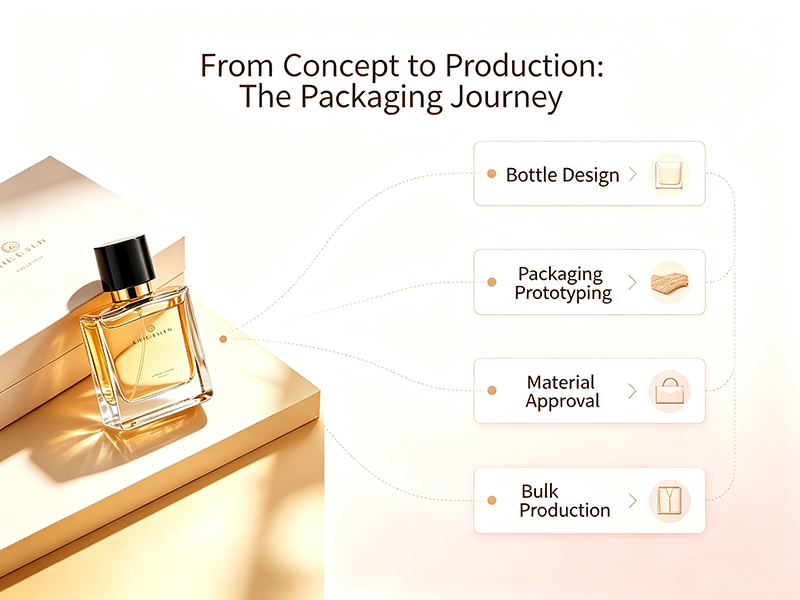
Step 11: Plan Packing, Freight, and Breakage Risk
Packaging design affects logistics from the beginning.
A heavy, wide, or irregular bottle may reduce the number of units per carton. A projecting cap can create empty space. A rigid box can significantly increase shipment volume compared with a folding carton. Metallic or coated surfaces may need individual protection to avoid rubbing.
Before confirming mass production, request or calculate:
Unit net and gross weight
Assembled product dimensions
Inner and master-carton quantity
Carton dimensions and gross weight
Pallet plan when required
Protection method
Expected shipping route
Transport testing should reflect the actual pack configuration. A sample sent individually by courier does not prove that thousands of units will withstand container transport, warehouse handling, and final-mile delivery.
If the brand sells primarily through e-commerce, the retail package may need to survive parcel distribution rather than only palletized delivery to stores. That difference should influence the insert and secondary shipping carton.
Step 12: Evaluate Sustainability as a Design and Supply Decision
Sustainability claims should be specific and supportable. Avoid assuming that one material or design is automatically better in every circumstance.
Practical questions include:
Can unnecessary glass weight be reduced without losing the intended hand feel?
Can the number of materials in the cap or insert be simplified?
Can components be separated for recovery where relevant?
Can the box size be reduced?
Can the same pump and cap be shared across several SKUs?
Can a refill concept be engineered safely and conveniently?
Will a special coating affect local recovery options?
Can improved carton efficiency reduce shipping volume?
A lighter, efficient package may reduce material and freight, but it must still protect the product. A damaged bottle and wasted fragrance do not represent a successful material reduction. The right solution balances product protection, customer expectations, infrastructure, cost, and brand strategy.
Step 13: Evaluate a Perfume Bottle Manufacturer or Packaging Supplier
A strong supplier should make the project clearer as discussions progress. The buyer should receive better-defined specifications, risks, choices, and next steps—not only more catalog images.
Ask Technical Questions
Useful supplier-evaluation questions include:
Is the proposed bottle a stock model or a custom mold?
What is the MOQ for each component and decoration process?
Which neck finish and pump are being proposed?
Will pump, collar, and cap compatibility be tested as an assembly?
What drawings and samples will be provided for approval?
Which decoration tolerances should the brand expect?
How will color be approved and controlled?
What are the main risks in the proposed design?
How will decorated surfaces be protected during packing?
What quality checks occur before shipment?
What is included—and excluded—from the quotation?
Which details must be confirmed before production timing begins?
Evaluate Communication Quality
Fast replies are useful, but accurate questions are more valuable than immediate answers based on assumptions. A reliable supplier should identify missing information and explain how it affects price, feasibility, MOQ, or timeline.
Look for communication that is:
Specific rather than generic
Consistent across sales and technical teams
Clear about assumptions
Honest about limitations
Organized around approvals
Supported by drawings, specifications, and samples
Manufacturer, Trading Company, or Integrated Supplier?
The label alone does not determine whether a supplier is suitable. A glass perfume bottle manufacturer may control glass production while having limited capability in pumps, caps, or boxes. A perfume bottle supplier may offer a broad catalog but depend on other factories for technical execution. A capable integrated perfume packaging manufacturer may coordinate specialized production resources across glass, closures, decoration, and paper packaging.
The important question is who owns technical coordination, quality responsibility, communication, and problem resolution across the complete project. When assessing a fragrance packaging supplier, the buyer should understand which processes are performed directly, which are coordinated, and how consistency is controlled.
Common Sourcing Mistakes Fragrance Brands Should Avoid
Choosing the Bottle Before Confirming Quantity
A design may require a custom mold or component quantity beyond the brand's launch plan. Confirm the commercial range first.
Comparing Quotations That Cover Different Specifications
One quotation may include a heavy cap and decorated box, while another covers plain glass only. Compare equivalent components, materials, finishes, packing, and trade terms.
Approving Components Separately
A correct bottle and a correct cap do not guarantee a correct assembly. Test the complete system.
Designing the Box Too Early
Final box dimensions should follow approval of the assembled bottle. Otherwise, cap height, insert clearance, or decoration protection may be wrong.
Ignoring Component-Level MOQs
A low stock-bottle MOQ can be misleading when pumps, caps, or finishes require higher quantities.
Treating a Rendering as a Production Specification
A rendering communicates visual intent but does not define capacity, neck finish, glass weight, tolerances, decoration limits, or fit.
Selecting the Lowest Unit Price Without Calculating Total Risk
Rework, delays, unusable components, excess inventory, breakage, and air freight can cost more than a modest difference in the original quotation.
Changing Details Without Revalidating Dependencies
A late change to the cap, pump, coating, or bottle height can affect other approved parts. Use change control even for changes that appear small.
A Practical RFQ Checklist for Custom Perfume Packaging
To receive a more accurate recommendation and quotation, send the supplier a structured request containing:
Brand and Market Information
Target country or region
Target customer
Expected retail positioning
Sales channel
Planned launch date
Bottle Requirements
Capacity or capacities
Stock bottle or custom mold preference
Target order quantity per size
Reference images, sketch, or drawing
Preferred glass color
Desired glass weight or hand feel
Required bottle dimensions, if constrained
Closure Requirements
Pump type and color
Collar color and finish
Cap material
Cap finish
Standard, weighted, or magnetic closing preference
Decoration Requirements
Spray color and transparency
Logo and text artwork
Screen printing colors
Hot stamping
Frosting
Metallization or electroplating
Other special effects
Box Requirements
Folding carton or rigid box
Insert preference
Printing and finishing
Artwork status
Retail and transport requirements
Commercial and Logistics Information
First-order quantity
Annual forecast
Reorder plan
Required delivery location
Target completion date
Sample requirements
Inspection requirements
If some details are not yet decided, label them as open rather than allowing the supplier to assume. A good supplier can then present two or three realistic routes with clear differences in MOQ, cost, customization, and timeline.
Match the Sourcing Route to the Brand's Stage
Early-Stage or Market-Test Brand
Prioritize a proven stock bottle, available cap, reliable pump, focused decoration, and an efficient box. Limit the number of SKUs and colors. The goal is to create a coherent product while protecting cash and launch flexibility.
Growing Brand With Validated Demand
Consider upgrading one high-value element: a custom cap, proprietary decoration system, improved glass weight, or more distinctive box. Use annual forecasts to negotiate a component strategy and reduce future inconsistency.
Established Brand Building a Signature Asset
A custom glass mold may be justified when the brand has repeat demand, a stable identity, and a clear plan to use the bottle across several years or product extensions. Invest in engineering, intellectual-property review where relevant, tooling records, and controlled master samples.
The objective at every stage is the same: create enough differentiation to support the brand without taking on more cost, inventory, or technical risk than the business can sustain.
Final Thoughts
The most successful custom perfume packaging projects are not the ones with the greatest number of special effects. They are the ones in which every decision supports the same commercial and brand objective.
Start with a clear target customer, retail position, quantity, budget, and launch date. Then choose whether a stock bottle or custom mold provides the right balance. Confirm the bottle neck before approving the pump, collar, and cap. Develop the box around the final assembly. Build an MOQ matrix, calculate the total cost, approve physical samples, and define quality standards before mass production.
For fragrance brands, sourcing custom perfume bottles and packaging should be managed as one connected development process. Working with an experienced perfume bottle manufacturer or integrated perfume packaging supplier can help coordinate the glass bottle, pump, collar, cap, decoration, insert, and outer box as one compatible system.
If you are preparing a new fragrance project, send your preferred capacity, quantity, bottle references, decoration direction, cap and pump requirements, box concept, target market, and launch schedule. A complete brief makes it possible to recommend a practical route and prepare an accurate quotation without relying on costly assumptions.
Perfume Bottle FAQs:
1. What is the MOQ for custom perfume bottles?
The MOQ depends on whether the bottle is a stock model or requires a new glass mold. At DAXIN, the stock-bottle MOQ reference is 3,000 pieces, while custom glass bottles use a 10,000-piece reference. Caps, pumps, boxes, and decoration processes have their own minimums, so buyers should review the complete MOQ matrix rather than the bottle quantity alone.
2. Is it better to use a stock perfume bottle or create a custom mold?
A stock bottle is generally better for faster launches, lower development cost, and market testing. A custom mold provides stronger differentiation and control over the glass design but requires more investment, volume, time, and technical validation. The right choice depends on the brand's stage and the commercial value of a proprietary shape.
3. What information is needed to quote custom perfume packaging?
Provide the bottle capacity, order quantity, stock or custom preference, design references, decoration, cap, pump, collar, box requirements, destination, and required timeline. Also identify which details remain open so the supplier can state assumptions or recommend alternatives.
4. Can the bottle, pump, cap, and box be sourced separately?
They can be purchased from different sources, but technical coordination is essential. The bottle neck must match the pump, the cap must fit the collar and actuator, and the final assembly must fit the insert and box. When multiple suppliers are involved, the brand needs clear ownership of drawings, samples, compatibility testing, and change control.
5. How long does custom perfume packaging production take?
Production time begins after specifications, samples, artwork, and commercial terms are approved. At DAXIN, normal production is typically planned around 30–35 days, with high-season production around 40 days. Custom mold development, trials, sampling, revisions, transport, and customer approvals must be added to the overall project schedule.
6. Which decoration method is best for a perfume bottle?
There is no single best process. Spraying controls the overall color; screen printing supports clear logos and text; hot stamping adds a metallic accent; frosting softens reflections; UV printing supports detailed multicolor artwork; and metallization creates a high-impact surface. Select the process that supports the brand idea, bottle geometry, quantity, budget, and required durability.
7. How should a fragrance brand evaluate a perfume packaging supplier?
Evaluate whether the supplier asks the right technical questions, explains component-level MOQs, provides drawings and samples, tests compatibility, defines decoration limits, manages approvals, and has a clear quality-control process. The supplier should make risks and next steps more visible as the project develops.
8. What should be checked before mass production?
Confirm the approved bottle dimensions and capacity, neck and pump fit, spray performance, collar and cap alignment, decoration color and position, complete assembled height, insert retention, box dimensions, artwork, packing method, quality criteria, order quantities, and final delivery schedule.